估计硬决策和软决策 Viterbi 解码的 BER
R2026b估计 AWGN 中硬决策和软决策 Viterbi 解码器的误码率 (BER) 性能。将该性能与未编码的 64-QAM 链路进行比较。
设置仿真参数。
rng default
M = 64;                % Modulation order
k = log2(M);           % Bits per symbol
EbNoVec = (4:10)';     % Eb/No values (dB)
numSymPerFrame = 1000; % Number of QAM symbols per frame
初始化 BER 结果向量。
berEstSoft = zeros(size(EbNoVec));
berEstHard = zeros(size(EbNoVec));
为码率为 1/2、约束长度为 7 的卷积码设置网格结构和回溯深度。
trellis = poly2trellis(7,[171 133]);
tbl = 32;
rate = 1/2;
主处理循环执行以下步骤:
生成二进制数据
对数据进行卷积编码
对数据符号应用 QAM 调制。指定发射信号的单位平均功率
使调制信号通过 AWGN 信道
使用硬决策和近似 LLR 方法解调接收信号。指定接收信号的单位平均功率
使用硬决策和非量化方法对信号进行 Viterbi 解码
计算误码数
while 循环继续处理数据,直到遇到 100 个误码或发射 个比特。
for n = 1:length(EbNoVec)
    % Convert Eb/No to SNR
    snrdB = EbNoVec(n) + 10*log10(k*rate);
    % Noise variance calculation for unity average signal power
    noiseVar = 10.^(-snrdB/10);
    % Reset the error and bit counters
    [numErrsSoft,numErrsHard,numBits] = deal(0);

    while numErrsSoft < 100 && numBits < 1e7
        % Generate binary data and convert to symbols
        dataIn = randi([0 1],numSymPerFrame*k,1);

        % Convolutionally encode the data
        dataEnc = convenc(dataIn,trellis);

        % QAM modulate
        txSig = qammod(dataEnc,M, ...
            InputType='bit', ...
            UnitAveragePower=true);

        % Pass through AWGN channel
        rxSig = awgn(txSig,snrdB,'measured');

        % Demodulate the noisy signal using hard decision (bit) and
        % soft decision (approximate LLR) approaches.
        rxDataHard = qamdemod(rxSig,M, ...
            OutputType='bit', ...
            UnitAveragePower=true);
        rxDataSoft = qamdemod(rxSig,M, ...
            OutputType='approxllr', ...
            UnitAveragePower=true, ...
            NoiseVariance=noiseVar);

        % Viterbi decode the demodulated data
        dataHard = vitdec(rxDataHard,trellis,tbl,'cont','hard');
        dataSoft = vitdec(rxDataSoft,trellis,tbl,'cont','unquant');

        % Calculate the number of bit errors in the frame.
        % Adjust for the decoding delay, which is equal to
        % the traceback depth.
        numErrsInFrameHard = ...
            biterr(dataIn(1:end-tbl),dataHard(tbl+1:end));
        numErrsInFrameSoft = ...
            biterr(dataIn(1:end-tbl),dataSoft(tbl+1:end));

        % Increment the error and bit counters
        numErrsHard = numErrsHard + numErrsInFrameHard;
        numErrsSoft = numErrsSoft + numErrsInFrameSoft;
        numBits = numBits + numSymPerFrame*k;

    end

    % Estimate the BER for both methods
    berEstSoft(n) = numErrsSoft/numBits;
    berEstHard(n) = numErrsHard/numBits;
end
绘制估计的硬决策和软决策 BER 数据。绘制未编码 64-QAM 信道的理论性能。
semilogy(EbNoVec,[berEstSoft berEstHard],'-*')
hold on
semilogy(EbNoVec,berawgn(EbNoVec,'qam',M))
legend('Soft','Hard','Uncoded','location','best')
grid
xlabel('Eb/No (dB)')
ylabel('Bit Error Rate')
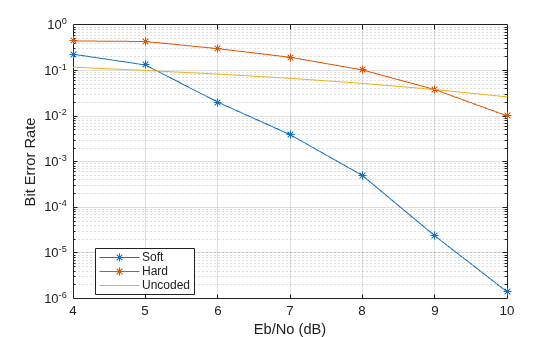
与预期相符,软决策解码产生最佳结果。

