CAN Receive
R2026bCAN Receive block
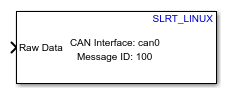
To add a block to a model, double-click the canvas and start typing the block name. Then, select the block from the list.
Libraries:
Embedded Coder Support Package for Real-Time Linux /
SocketCAN
Description
Add-On Required: This feature requires the Embedded Coder Support Package For Real-Time Linux add-on.
The CAN Receive block receives messages from the CAN network. This block uses SocketCAN which is a device-independent driver for implementing the CAN interface supporting all CAN shields.
The CAN Receive block supports Raw data and
CAN Msg as output types. To use the bus mode, create a
CAN_MESSAGE_BUS type in the base workspace. See canMessageBusType (Vehicle Network Toolbox) function. To use a CANdb (CAN database) file or to
specify signals manually, use CAN Msg output type and the
CAN Unpack (Simulink Real-Time) block.
You can use CAN Receive block to interact with a real or virtual CAN interface. For more information on how to set up a virtual CAN interface, see Transmit and Receive CAN Raw Data and Messages on Virtual Linux Target Device.
Note
To generate code C/C++ code for this block, you must have an Embedded Coder® license.
Examples
Create and Run Real-Time Application from Simulink Model on Linux Target Device
Create and run real-time application on Linux target device.
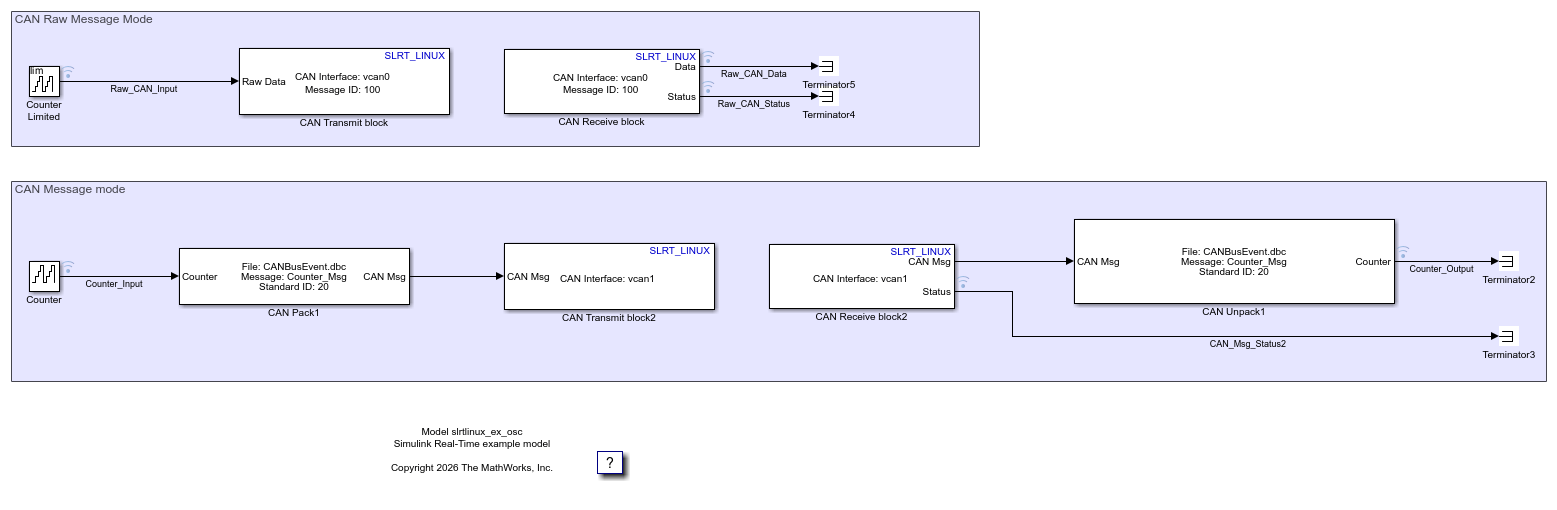
Transmit and Receive CAN Raw Data and Messages on Virtual Linux Target Device
Transmit and receive CAN raw data or messages on virtual Linux target device.
Ports
Output
Parameters
Enter the name of the real or virtual CAN interface. To find the name of
the CAN interface, in the target Linux device terminal, execute the
ifconfig command. To configure the CAN interface, see
the target Linux device documentation.
Programmatic Use
Block Parameter:
DeviceID
|
Select a type to receive message.
Raw data– To receive message as a 1-by-Nuint8array, select Data output type asRaw data.CAN Msg– To receive message in CAN message format, select Data output type asCAN Msgand then perform these steps:Add a CAN Unpack (Simulink Real-Time) block to your Simulink® model.
Connect the output of the CAN Receive block to the input of the CAN Unpack (Simulink Real-Time) block.
Using the options in the Data output type list of the CAN Unpack (Simulink Real-Time) block, specify if you want to create your messages or you want to upload a CAN database file. If you choose to upload a CAN database file, the CAN Unpack (Simulink Real-Time) inherits the message properties from the uploaded file.
Programmatic Use
Block Parameter:
OutputDataType
|
The type of message identifier.
Dependencies
This parameter appears only when you select Data output
type as Raw data.
Programmatic Use
Block Parameter:
IdentifierType
|
Message identifier, which is 11 bits long for the standard frame size or
29 bits long for the extended frame size, specified in decimal, binary, or
hex. For binary and hex formats, use bin2dec(' ') and
hex2dec(' '), respectively, to convert the entry. The
message identifier is coded into a message that is sent to the CAN
bus.
Dependencies
This parameter appears only when you select Data output
type as Raw data. To output
the identifier of the CAN Msg, select
Output identifier of the CAN Unpack (Simulink Real-Time)
block.
Programmatic Use
Block Parameter:
MessageId
|
The length of the message, in bytes.
Dependencies
This parameter appears only when you select Data output
type as Raw data. To output
the length of the CAN Msg, select
Output length of the CAN Unpack (Simulink Real-Time)
block.
Programmatic Use
Block Parameter:
MsgLength
|
Specify how often the block receives message, in seconds. When you specify
this parameter as -1, Simulink determines the best sample time for the block based on the
block context within the model.
Programmatic Use
Block Parameter:
SampleTime
|
When you select the Enable error output signal
parameter, the block configures an output port, Error.
The port outputs the error code as a uint8 integer. Each
bit in code corresponds to the type of error in the received message. An
output of 0 indicates that the message is error-free. Any
value other than 0 indicates that the message is an error
frame.

Dependencies
This parameter appears only when you select Data output
type as Raw data. To output
the error in the CAN Msg, select
Output error of the CAN Unpack (Simulink Real-Time)
block.
Programmatic Use
Block Parameter:
OutputError
|
Select this parameter to enable the Remote output port. This port outputs the message remote frame status.
Dependencies
To enable this parameter, set Data output
type to Raw data.
Programmatic Use
Block Parameter:
OutputRemote
|
Extended Capabilities
Version History
Introduced in R2026b
See Also
CAN Transmit | CAN Pack (Simulink Real-Time) | CAN Unpack (Simulink Real-Time)

