使用 FFT 进行多项式插值
R2026b使用快速傅里叶变换 (FFT) 来估算用于对一组数据进行插值的三角函数多项式的系数。
数学中的 FFT
FFT 算法通常与信号处理应用相关,但也可以在数学领域更广泛地用作快速计算工具。例如,通常通过解算简单的线性系统来计算用于对一组数据进行插值的 n 次多项式 的系数 ci。在 19 世纪初研究小行星轨道时,卡尔·弗里德里希·高斯发现了一种数学捷径,即通过将问题分解为多个较小的子问题,然后将结果合并来计算多项式插值的系数。他的方法等同于估算其数据的离散傅里叶变换。
小行星数据插值
在高斯的论文中,他描述了一种估算小行星智神星轨道的方法。他从以下 12 个二维数据点 x 和 y 开始。
x = 0:30:330;
y = [408 89 -66 10 338 807 1238 1511 1583 1462 1183 804];
plot(x,y,'ro')
xlim([0 360])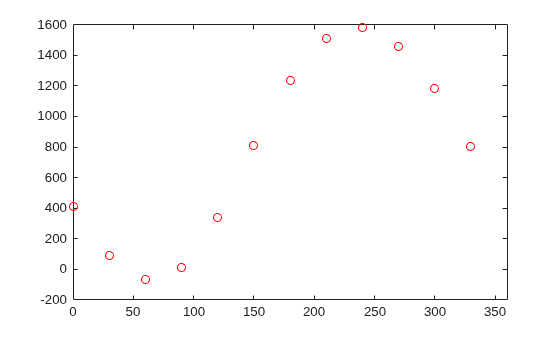
高斯使用以下形式的三角函数多项式为小行星的轨道建模。
使用 fft 计算多项式的系数。
m = length(y);
n = floor((m+1)/2);
z = fft(y)/m;

a0 = z(1);
an = 2*real(z(2:n));
a6 = z(n+1);
bn = -2*imag(z(2:n));
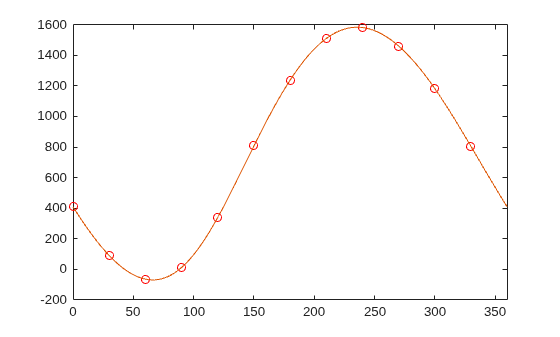
在原始数据点上绘制插值多项式。
hold on
px = 0:0.01:360;
k = 1:length(an);
py = a0 + an*cos(2*pi*k'*px/360) ...
        + bn*sin(2*pi*k'*px/360) ...
        + a6*cos(2*pi*6*px/360);

plot(px,py)
参考
[1] Briggs, W. and V.E. Henson. The DFT: An Owner's Manual for the Discrete Fourier Transform. Philadelphia: SIAM, 1995.
[2] Gauss, C. F. “Theoria interpolationis methodo nova tractata.” Carl Friedrich Gauss Werke. Band 3. Göttingen: Königlichen Gesellschaft der Wissenschaften, 1866.
[3] Heideman M., D. Johnson, and C. Burrus. “Gauss and the History of the Fast Fourier Transform.” Arch. Hist. Exact Sciences. Vol. 34. 1985, pp. 265–277.
[4] Goldstine, H. H. A History of Numerical Analysis from the 16th through the 19th Century. Berlin: Springer-Verlag, 1977.

