Writing Tests Using Polyspace Test xUnit API for C/C++ Code
R2026bThe Polyspace®
Test™ xUnit API for C/C++ code uses macros to define tests and suites of tests. For example, the macro PST_SIMPLE_TEST used as:
PST_SIMPLE_TEST(test)  {
    /*test case body*/
}PST_ (or pst_) and are defined in the header file pstunit.h, located in <polyspaceroot>\polyspace\pstest\pstunit\include. Here, <polyspaceroot> is the Polyspace installation folder, for example, C:\Program Files\Polyspace\R2026b. To use the macros, include this header file in your tests:#include <pstunit.h>PST_ to see autocomplete suggestions for macros from the C/C++ xUnit API. You can hover on a suggestion to see a description of the macro, and select a suggestion to enter the macro with placeholders to be filled in.The sections below show the various strategies for authoring tests for C/C++ code. You can mix the strategies described below. For instance, you can author a suite of tests with a one-time setup and teardown before the suite and also add test-specific setup and teardown for a particular test in the suite.
Prerequisites
This topic describes test authoring using the Polyspace Test xUnit API. To compile these tests, you are required to know some file paths in advance. For your convenience, you can define environment variables to stand for the file paths, or otherwise include the file paths in your build. For more information, see Set Up C/C++ Testing and Code Profiling Using Self-Managed Builds.
Overview
The Polyspace Test xUnit API for C/C++ code provides macros for defining tests at different levels of complexity — from standalone test cases to suites of tests with shared setup and teardown routines. The sections below summarize the key concepts.
Simple Test Versus Suite of Tests
A simple test is a standalone test case that runs independently without belonging to any group. In Polyspace
Test, you write a simple test using the macro PST_SIMPLE_TEST and register the test using PST_ADD_SIMPLE_TEST.
A suite is a collection of related tests grouped together. The suite can define shared behavior — like common setup and teardown — that applies to all tests in the group. In Polyspace
Test, you write a test that belongs to a suite using the macro PST_TEST and register it using PST_ADD_TEST.
Tests With Setup and Teardown
A test without setup and teardown is defined as a single block containing only the test body. For instance, you can write an entire test block in a PST_TEST macro (or PST_SIMPLE_TEST for standalone tests).
When a test needs setup and teardown — code that runs before and after the test — the definition splits into two parts: a configuration that declares the setup and teardown routines, and a body that contains the test logic. In Polyspace
Test, you write the configuration using PST_TEST_CONFIG (or PST_SIMPLE_TEST_CONFIG for standalone tests) with PST_SETUP and PST_TEARDOWN inside it, and the test logic using PST_TEST_BODY (or PST_SIMPLE_TEST_BODY).
Setup and teardown can exist at three levels:
Suite-level, one-time — This setup runs once before the first test in the suite and the teardown runs once after the last. The setup and teardown are defined using
PST_SUITE_SETUPandPST_SUITE_TEARDOWNinsidePST_SUITE_CONFIG.Suite-level, per-test — This setup runs before each test in the suite and the teardown runs after each test, using the same routine. The setup and teardown are defined using
PST_SUITE_TEST_SETUPandPST_SUITE_TEST_TEARDOWNinsidePST_SUITE_CONFIG.Test-specific — This setup and teardown runs before and after a particular test, in addition to any suite-level setup and teardown. The setup and teardown are defined using
PST_SETUPandPST_TEARDOWNinsidePST_TEST_CONFIG.
Write Simple Test
Write a simple test that is not part of a suite:
/* Write test */
PST_SIMPLE_TEST(test)  {
    /* Test case body */
}

/* Register test - not needed in C++*/
PST_REGFCN(register_function) {
    PST_ADD_SIMPLE_TEST(test);
}

/* Call registered tests - not needed in C++*/
int main(int argc, char* argv[]) {
    PST_REGFCN_CALL(register_function);
    return PST_MAIN(argc, argv);
}Write Simple Test With Setup and Teardown
Write a simple test with test setup and teardown:
/* Define setup and teardown functions */
void setup_function(void) {
   /* Setup function body */
}

void teardown_function(void) {
   /* Teardown function body */
}

/* Write test configuration with setup and teardown */
PST_SIMPLE_TEST_CONFIG(test)  {
    PST_SETUP(setup_function);
    PST_TEARDOWN(teardown_function);
}

/* Write test body */
PST_SIMPLE_TEST_BODY(test)  {
    /*test case body*/
}

/* Register test - not needed in C++*/
PST_REGFCN(register_function) {
    PST_ADD_SIMPLE_TEST(test);
}

/* Call registered tests - not needed in C++*/
int main(int argc, char* argv[]) {
    PST_REGFCN_CALL(register_function);
    return PST_MAIN(argc, argv);
}
Write Suite of Tests With One-Time Setup and Teardown
Write a suite of tests with:
A setup function that runs once before all tests.
A teardown function that runs after all tests.
Use the setup and teardown function to ensure that relevant global data are in a known state when the suite begins and ends execution.
/* Define setup and teardown functions */
void suite_setup_function(void) {
   /* Setup function body */
}

void suite_teardown_function(void) {
   /* Teardown function body */
}

/* Write suite configuration */
PST_SUITE_CONFIG(suite) {
    PST_SUITE_SETUP(suite_setup_function);
    PST_SUITE_TEARDOWN(suite_teardown_function);
}

/* Write test 1*/
PST_TEST(suite, test_1) {
    /* Test 1 body */
}

/* Write test 2*/
PST_TEST(suite, test_2) {
    /* Test 2 body */
}

/* Register tests - not needed in C++ */
PST_REGFCN(register_function) {
    PST_ADD_TEST(suite, test_1);
    PST_ADD_TEST(suite, test_2);
}

/* Call registered tests - not needed in C++*/
int main(int argc, char* argv[]) {
    PST_REGFCN_CALL(register_function);
    return PST_MAIN(argc, argv);
}
The bodies of the setup/teardown functions and the tests execute in this order:

For more information, see Group C/C++ Tests into Suites with Common Setup and Teardown Code.
In C++, you can alternatively define the suite fixture data and methods as a class. A suite fixture class inherits from the class pst_suite_fixture and defines the methods suite_setup() and suite_teardown() in the suite fixture class for setup and teardown. These methods are automatically invoked prior to running the suite. If you define a data member in the suite fixture class, you can access the member using the macro
PST_SUITE_FIXTURE_PTR.
/* Define suite setup and teardown */
class suite_fixture : public pst_suite_fixture {
  public:
    static void suite_setup()
       {/* suite setup body */}
    static void suite_teardown()
       {/* suite teardown body */}
    int a_suite_fixture_data_member;
}

PST_SUITE_WITH_FIXTURE(suite, suite_fixture);
/* suite pst_default_suite is reserved */

/* Write test 1*/
PST_TEST(suite, test_1) {
    int suite_fixture_data = PST_SUITE_FIXTURE_PTR() -> a_suite_fixture_data_member;
    /* Test 1 body */
}

/* Write test 2*/
PST_TEST(suite, test_2) {
    int suite_fixture_data = PST_SUITE_FIXTURE_PTR() -> a_suite_fixture_data_member;
    /* Test 2 body */
}

/* You do not need explicit test registration in C++*/Write Suite of Tests With Same Setup and Teardown Before Each Test
Write a suite of tests with:
A setup function that runs once before each test.
A teardown function that runs after each test.
Use the setup and teardown function to ensure that relevant global data are in a known state when each test in the suite begins and ends execution.
/* Define setup and teardown functions */
void suite_test_setup_function(void) {
   /* Setup function body */
}

void suite_test_teardown_function(void) {
   /* Teardown function body */
}

/* Write suite configuration */
PST_SUITE_CONFIG(suite) {
    PST_SUITE_TEST_SETUP(suite_test_setup_function);
    PST_SUITE_TEST_TEARDOWN(suite_test_teardown_function);
}


/* Write test 1 */
PST_TEST(suite, test_1) {
    /* Test 1 body */
}

/* Write test 2 */
PST_TEST(suite, test_2) {
    /* Test 2 body */
}

/* Register tests - not needed in C++ */
PST_REGFCN(register_function) {
    PST_ADD_TEST(suite, test_1);
    PST_ADD_TEST(suite, test_2);
}

/* Call registered tests - not needed in C++*/
int main(int argc, char* argv[]) {
    PST_REGFCN_CALL(register_function);
    return PST_MAIN(argc, argv);
}
The bodies of the setup/teardown functions and the tests execute in this order:
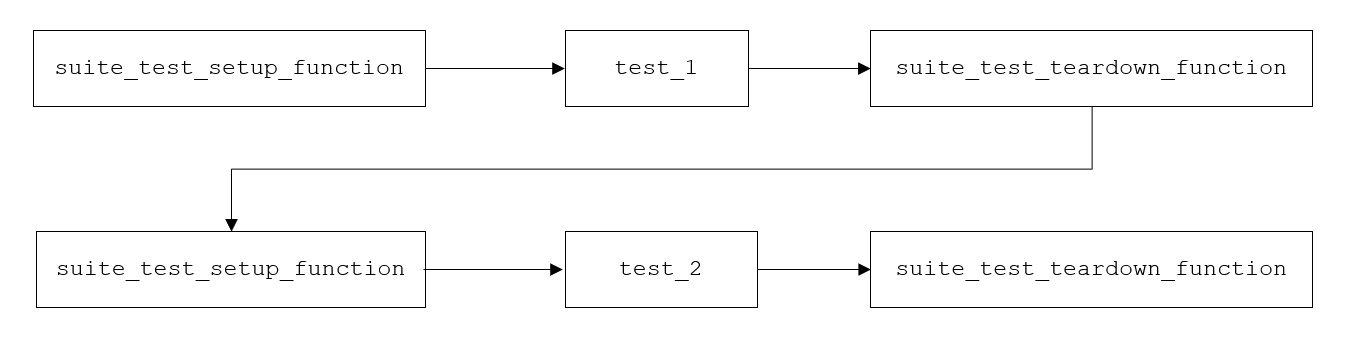
For more information, see Group C/C++ Tests into Suites with Common Setup and Teardown Code.
In C++, define the suite fixture data and methods as a class. A suite fixture class inherits from the class pst_suite_fixture and defines the methods test_setup() and test_teardown() in the suite fixture class for per-test setup and teardown. These methods are automatically invoked prior to running each test in the suite. If you define a data member in the suite fixture class, you can access the member using the macro
PST_SUITE_TEST_FIXTURE_PTR.
/* Define suite setup and teardown */
class suite_fixture : public pst_suite_fixture {
  public:
    void test_setup()
        {/* setup body */}
    void test_teardown()
        {/* teardown body */}
    int a_test_fixture_data_member;
}

PST_SUITE_WITH_FIXTURE(suite, suite_fixture);
/* suite pst_default_suite is reserved */


/* Write test 1*/
PST_TEST(suite, test_1) {
    int test_fixture_data = PST_SUITE_TEST_FIXTURE_PTR() -> a_test_fixture_data_member;
    /* Test 1 body */
}

/* Write test 2*/
PST_TEST(suite, test_2) {
    int test_fixture_data = PST_SUITE_TEST_FIXTURE_PTR() -> a_test_fixture_data_member;
    /* Test 2 body */
}

/* You do not need explicit test registration in C++*/Write Suite of Tests With Different Setup and Teardown Before Each Test
Write a suite of tests that requires a different setup and teardown before each test. Use a common setup and teardown function for any steps that are common to all tests, and a test-specific setup and teardown function for steps that are specific to a particular test.
/* Define setup and teardown function common to all tests in suite */
void suite_test_setup_function(void) {
   /* Setup function body */
}

void suite_test_teardown_function(void) {
   /* Teardown function body */
}

/* Write suite configuration */
PST_SUITE_CONFIG(suite) {
    PST_SUITE_TEST_SETUP(suite_test_setup_function);
    PST_SUITE_TEST_TEARDOWN(suite_test_teardown_function);
}

/* Define test 1 setup and teardown functions */
void setup_function_1(void) {
   /* Setup function body */
}

void teardown_function_1(void) {
   /* Teardown function body */
}

/* Write test 1 cconfiguration*/
PST_TEST_CONFIG(suite, test_1) {
    PST_SETUP(setup_function_1);
    PST_TEARDOWN(teardown_function_1);
}

/* Write test 1 body */
PST_TEST_BODY(suite, test_1) {
    /* Test 1 body */
}

/* Define test 2 setup and teardown functions */
void setup_function_2(void) {
   /* Setup function body */
}

void teardown_function_2(void) {
   /* Teardown function body */
}

/* Write test 2 cconfiguration*/
PST_TEST_CONFIG(suite, test_2) {
    PST_SETUP(setup_function_2);
    PST_TEARDOWN(teardown_function_2);
}

/* Write test 2 body */
PST_TEST_BODY(suite, test_2) {
    /* Test 2 body */
}

/* Register tests - not needed in C++ */
PST_REGFCN(register_function) {
    PST_ADD_TEST(suite, test_1);
    PST_ADD_TEST(suite, test_2);
}

/* Call registered tests - not needed in C++*/
int main(int argc, char* argv[]) {
    PST_REGFCN_CALL(register_function);
    return PST_MAIN(argc, argv);
}
The bodies of the setup/teardown functions and the tests execute in this order:

For more information, see Group C/C++ Tests into Suites with Common Setup and Teardown Code.
In C++, you can alternatively define the test-specific fixture data as a class. A test fixture class inherits from the class pst_test_fixture and defines the methods setup() and teardown() in the test fixture class for setup and teardown. These methods are automatically invoked prior to running each test in the suite. If you define a data member in the test fixture class, you can access the member using the macro
PST_TEST_FIXTURE_PTR.
/* Define suite setup and teardown common to all tests in suite*/
class suite_fixture : public pst_suite_fixture {
  public:
    void test_setup()
        {/* setup body */}
    void test_teardown()
        {/* teardown body */}
    int a_test_fixture_data_member;
}

PST_SUITE_WITH_FIXTURE(suite, suite_fixture);
/* suite pst_default_suite is reserved */

/* Define test 1 setup and teardown */
class test_1_fixture : public pst_test_fixture {
  public:
    void setup() {/* setup body */}
    void teardown() {/* teardown body */}
    int a_test_1_fixture_data_member;
};

/* Define test 2 setup and teardown */
class test_2_fixture : public pst_test_fixture {
  public:
    void setup() {/* setup body */}
    void teardown() {/* teardown body */}
    int a_test_2_fixture_data_member;
};

/* Write test 1*/
PST_TEST_WITH_FIXTURE(suite, test_1, test_1_fixture) {
    int test_common_fixture_data = PST_SUITE_TEST_FIXTURE_PTR() -> a_test_fixture_data_member;
    int test_1_fixture_data = PST_TEST_FIXTURE_PTR() -> a_test_1_fixture_data_member;
    /* test body */
}

/* Write test 2*/
PST_TEST_WITH_FIXTURE(suite, test_2, test_2_fixture) {
    int test_common_fixture_data = PST_SUITE_TEST_FIXTURE_PTR() -> a_test_fixture_data_member;
    int test_2_fixture_data = PST_TEST_FIXTURE_PTR() -> a_test_2_fixture_data_member;
    /* test body */
}

/* You do not need explicit test registration in C++*/Write Tests with Known Failures
You can create tests for work in progress by using macros that encapsulate undefined functions or functions that are not fully implemented and therefore known to fail test requirements. You can enable these tests by defining the macro PST_ENABLE_EXPECTED_FAILURES at build time.
To define a test that is known to fail, use the macro
PST_EXPECT_FAIL()in the test body, for example:This macro causes the test to pass as long as there is a failing assessment in the test.PST_TEST(suite, test) { PST_EXPECT_FAIL(); /* test body */ }To define a test for an undefined function, you can encapsulate the test body inside a
PST_TEST_NOT_IMPLEMENTED()macro, for example:When you execute the test, you see passing test results despite the presence of failed assertions, and additional messages stating that the test is not implemented. Once the function is defined, you can simply remove the encapsulation and thereby reenable the test.PST_TEST(suite, test) PST_TEST_NOT_IMPLEMENTED(({ /* test body that does not compile */ }))
For more information, see Write C/C++ Tests with Known Errors or Failures to Support Test-Driven Development.

