AMI
R2026bAMI block
To add a block to a model, double-click the canvas and start typing the block name. Then, select the block from the list.
Libraries:
SerDes Toolbox /
Utilities
Description
The AMI block allows you to co-design SerDes projects with other vendor IPs. It also allows you to correlate the code-generated/compiled IBIS-AMI models with the Simulink® models they were generated from.
The block can replace a transmitter or receiver component or run alongside them. To restore the transmitter or receiver component to their default settings, replace the AMI block with a Tx or Rx block.
You can only use the block in a Simulink model exported from the SerDes Designer app. The SerDes Designer sets up the required AMI tree for the block to work correctly. The block must be used on the top-level of a SerDes Simulink model.
In order to get exact correlation between Rx and AMI, you must add a delay block of length 1024 after the Rx. This delay accounts for the buffer/unbuffer inside the AMI block which handles the Block Size.
Note
You need license to both SerDes Toolbox™ and Signal Integrity Toolbox™ to use this block.
Examples
Using the correlation workflow, you can compare the results of the IBIS-AMI models generated using SerDes Toolbox with the original Simulink models.
Open the SerDes Designer app. Add a FFE to the transmitter side and a CTLE and DFECDR to the receiver side.
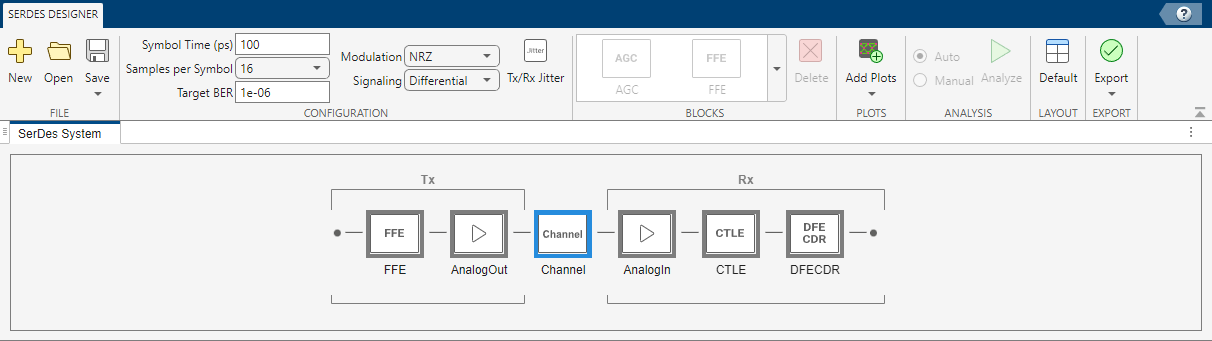
Generate the dll/so and ami models by clicking the Export > Make IBIS-AMI model for SerDes System in the app toolstrip. Export the SerDes system to Simulink.
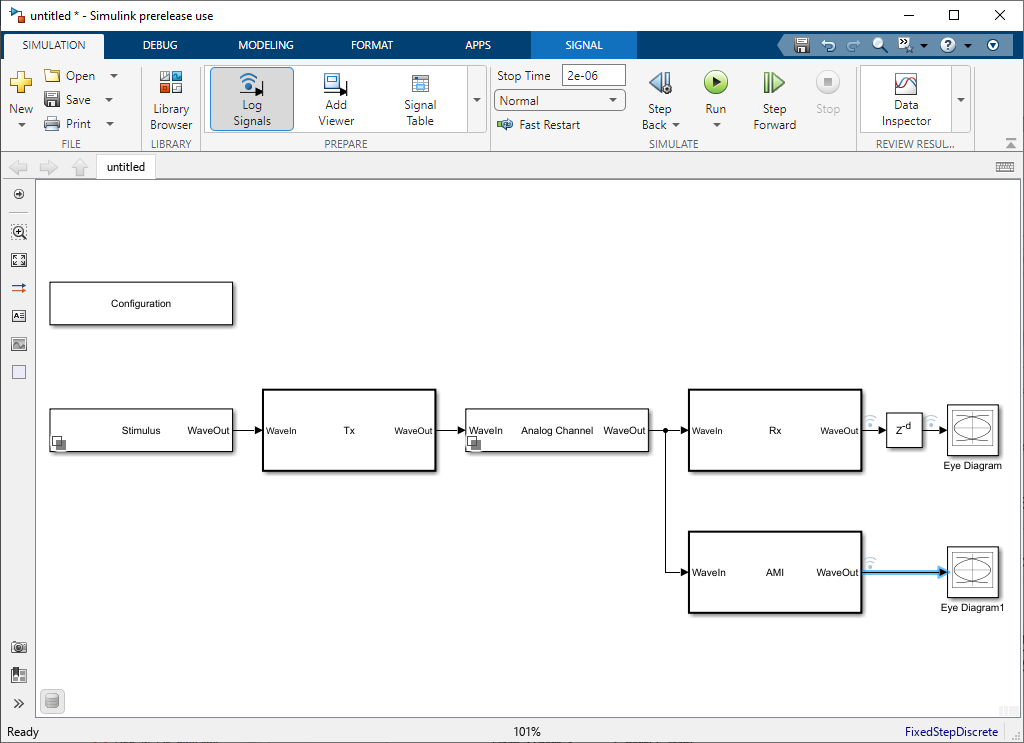
In the Simulink model, add a Delay between the Rx subsystem and the Eye Diagram block. Insert an AMI block and another Eye Diagram and connect them in parallel with the branch containing the Rx subsystem, Delay, and Eye Diagram blocks.
Double click the AMI block to open the Block Parameters dialog box. Refer to the dll and ami files for the receiver you created before. The block automatically creates the Input String parameter and populates the AMI tree.
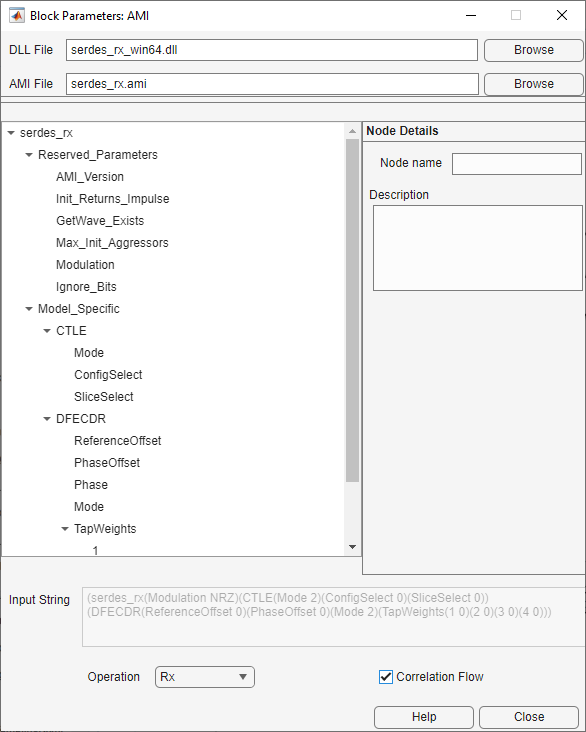
Change the Operation parameter to Rx
and select the Correlation Flow option.
Since you are correlating Rx subsystem to the previously generated IBIS-AMI model using the AMI block, double check that the settings for the two systems match.
The AMI block introduces a 1024 sample delay for compatibility with the block size requirement of the IBIS-AMI standard. If you are not doing sample by sample correlation, you can ignore this delay.
Since this example uses sample by sample correlation, you need to mitigate the delay
introduced by the AMI block. To do so, set the Delay
length of the Delay block to 1024.
Enable data logging for the outputs of the AMI and Delay blocks by selecting the signals and clicking the Log Signals button in the Simulation tab.
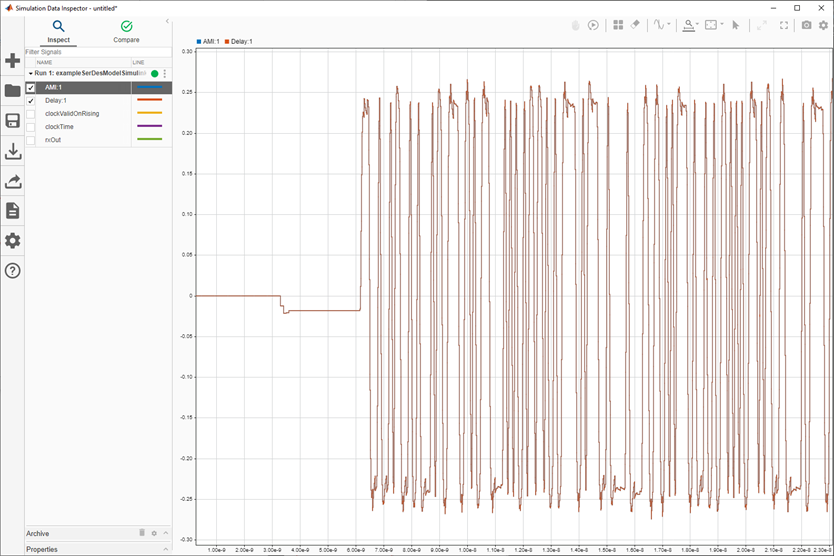
Run the simulation. Open the Simulation Data Inspector and select the AMI and Delay signals. The two signals overlay perfectly.
To compare the two signals, click the Compare button. Select
both signals and set Global Tolerance parameter to
1e-12 to use a small voltage tolerance of 1 pV.
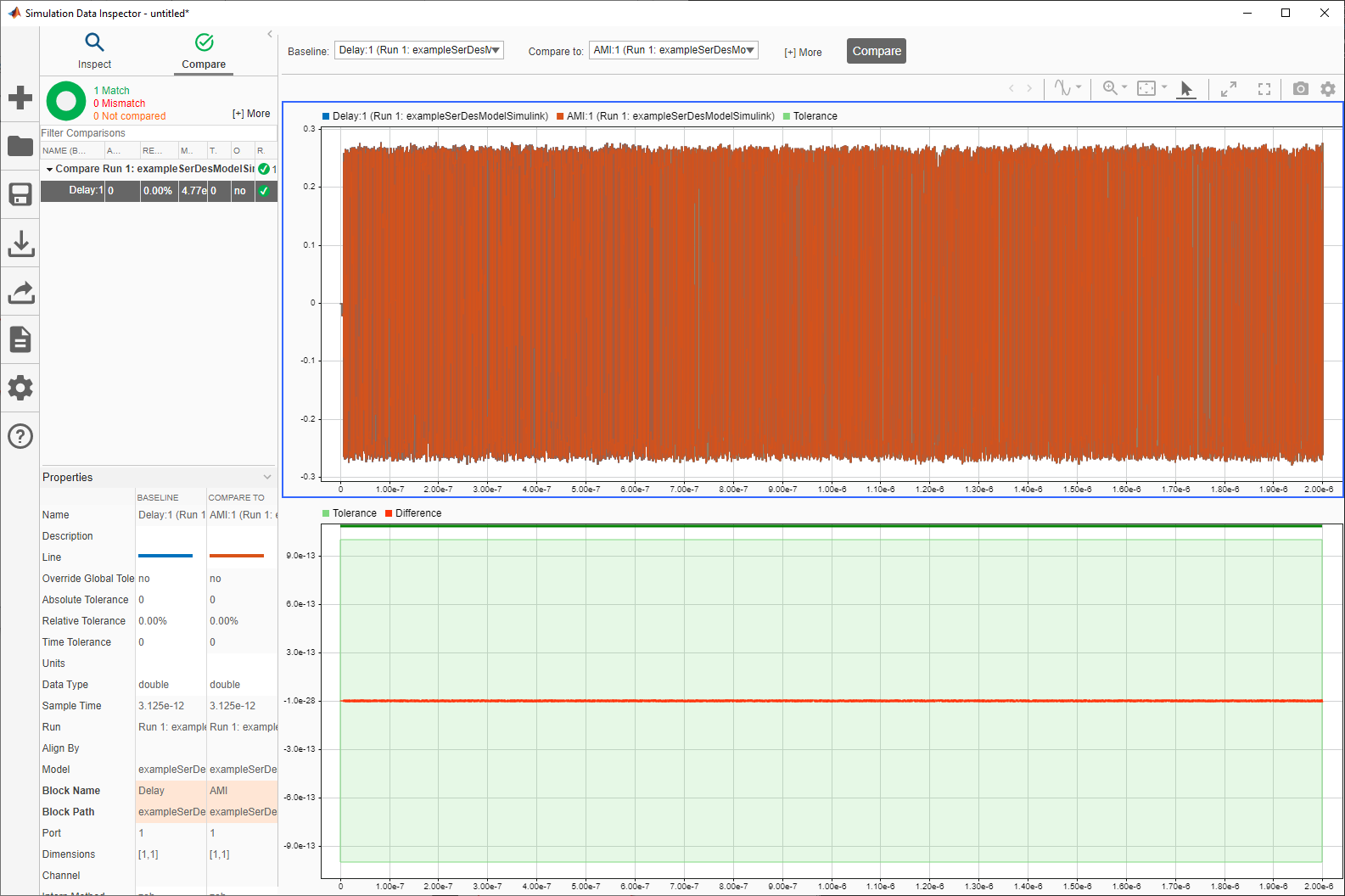
Observe in the bottom panel that the difference is well within the tolerance set. Both the Rx subsystem and AMI block outputs correlate extremely well.
Using the co-design workflow, you can integrate IBIS-AMI models from third-party vendors or other team members with an active SerDes System design.
Open the SerDes Designer app. Add a FFE to the transmitter side and a CTLE and DFECDR to the receiver side.
Generate the dll/so and ami models by clicking the Export > Make IBIS-AMI model for SerDes System in the app toolstrip. Export the SerDes system to Simulink.
In the Simulink model, delete the Tx subsystem. Add an AMI between the Stimulus and the Analog Channel blocks in place of the Tx subsystem.
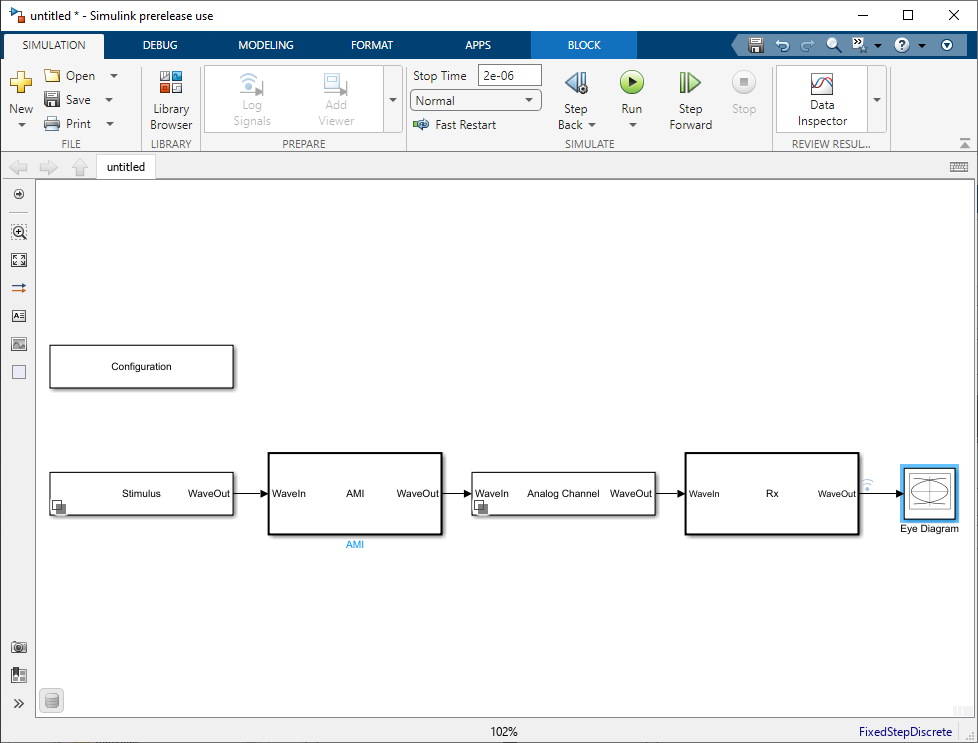
Double click the AMI block to open the Block Parameters dialog box. Refer to the dll and ami files for the transmitter you created before. The block automatically creates the Input String parameter and populates the AMI tree.
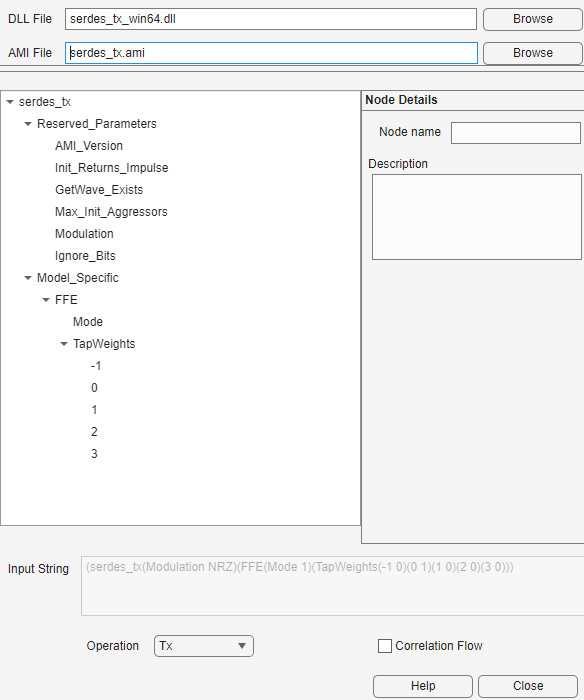
Check that the Operation parameter is set to
Tx and the Correlation Flow option is
deselected.
You can now interactively modify the design of the receiver to work with the transmitter. This example uses the IBIS-AMI models created from the SerDes Designer app, but you can use any IBIS-AMI models, either from your team members or from a third-party vendor.

