EN14511 Heat Pump (2P)
R2026bEN14511 Heat Pump (2P) block

To add a block to a model, double-click the canvas and start typing the block name. Then, select the block from the list.
Libraries:
Simscape /
Fluids /
Two-Phase Fluid /
Thermodynamic Cycles
Description
The EN14511 Heat Pump (2P) block models a heat pump based on EN14511 performance data. EN14511 is a testing standard for the rating and performance of heat pumps. The block can operate in heating or cooling mode.
The block defines the outdoor and indoor fluid temperatures according to the EN14511
standards. For all settings of the Outdoor heat exchanger fluid
parameter, the outdoor fluid temperature denotes the inlet temperature of the outdoor
heat exchanger. When Outdoor heat exchanger fluid is
Gas or Moist air, the indoor
fluid temperature denotes the inlet temperature of the indoor heat exchanger. When
Outdoor heat exchanger fluid is Thermal
liquid, the indoor fluid temperature denotes the outlet temperature of
the indoor heat exchanger. Ports Ai and Ao are
always inlets and ports Bi and Bo are always
outlets.
Heating and Cooling Parameterizations
Use the Mode parameter to specify whether the block functions
in heating, cooling, or heating and cooling mode. If you set
Mode to Heating and cooling, the
signal at port M controls the block mode. When the signal is
non-negative, the block operates in heating mode. When the signal is negative, the
block operates in cooling mode.
When Outdoor heat exchanger fluid or Indoor heat
exchanger fluid is Physical signal, you
specify the outdoor or indoor fluid temperature by using the input ports
Ti or To. The temperature can be the
inlet or outlet heat exchanger temperature, depending on the EN14511 standards for
the heat pump that you are modeling. Otherwise, the block calculations for capacity
and efficiency depend on the Heating mode parameterization or
Cooling mode parameterization parameters.
When Heating mode parameterization or Cooling
mode parameterization is Nominal, the
block calculates the second-law efficiency from the nominal conditions and uses
it to determine the heat pump capacity.
When the block is in heating mode, the heating capacity, QH, is
where:
CS is the compressor capacity, which is the value of the signal at port S.
WnomH is the value of the Nominal heating power input parameter.
The coefficient of performance is
where:
Toutdoor is the outdoor temperature.
Tindoor is the indoor temperature.
The block caps the COP at the value of the Maximum COP parameter.
The second-law efficiency is
where:
QnomH is the value of the Nominal heating capacity parameter.
Tindoor,nom is the value of the Nominal indoor fluid temperature parameter.
Toutdoor,nom is the value of the Nominal outdoor fluid temperature parameter.
When the block is in cooling mode, the cooling capacity, QC, is
where WnomC is the value of the Nominal cooling power input parameter.
The energy efficiency ratio is
The block caps the EER at the value of the Maximum EER parameter.
The second-law efficiency for cooling is
where QnomC is the value of the Nominal cooling capacity parameter.
When Heating mode parameterization or Cooling
mode parameterization is Linear fitting - capacity
and efficiency, the block uses linear fits on the indoor and
outdoor fluid temperatures and the compressor capacity to determine the capacity
and efficiency.
When the block is in heating mode, the heating capacity and power are
where ai and bi are coefficients. The block solves for the coefficients by performing a least squares fit, which is equivalent to solving the system
where:
is the Outdoor fluid temperature vector parameter.
is the Indoor fluid temperature vector parameter.
is the Compressor capacity vector parameter.
is the Heating capacity vector parameter.
is the Heating power input vector parameter.
The symbol ⚬ denotes element-wise multiplication.
When the block is in cooling mode, the cooling capacity and power are
The block solves for the ai and bi coefficients in the same way as in heating mode, but uses the Cooling capacity vector and Cooling power input vector parameters.
When Heating mode parameterization or Cooling
mode parameterization is Tabulated data - capacity
and efficiency, the block uses lookup tables to calculate the
capacity and efficiency.
When the block is in heating mode and you clear Scale heating capacity linearly with compressor capacity, the heating capacity and the heating power at the outdoor temperature, Toutdoor, and the indoor temperature, Tindoor, are
where:
Toutdoor,TLU is the Outdoor fluid temperature vector, Tod parameter.
Tindoor,TLU is the Indoor fluid temperature vector, Tid parameter.
CTLU is the Compressor capacity vector, s parameter.
QH,TLU,3D is the Heating capacity 3D table, q(Tod, Tid, s) parameter.
WH,TLU,3D is the Heating power input 3D table, w(Tod, Tid, s) parameter.
When the block is in heating mode and you select Scale heating capacity linearly with compressor capacity, the block linearly scales the heating capacity and the power input with respect to the compressor capacity. The heating capacity and the heating power are
where:
QH,TLU,2D is the Heating capacity 2D table, q(Tod, Tid) parameter.
WH,TLU,2D is the Heating power input 2D table, w(Tod, Tid) parameter.
When the block is in cooling mode and you clear Scale heating capacity linearly with compressor capacity, the cooling capacity and the cooling power are
where:
QC,TLU,3D is the Cooling capacity 3D table, q(Tod, Tid, s) parameter.
WC,TLU,3D is the Cooling power input 3D table, w(Tod, Tid, s) parameter.
When the block is in cooling mode and you select Scale heating capacity linearly with compressor capacity, the cooling capacity and the cooling power are
where:
QC,TLU,2D is the Cooling capacity 2D table, q(Tod, Tid) parameter.
WC,TLU,2D is the Cooling power input 2D table, w(Tod, Tid) parameter.
Pressure Loss
The pressure loss inside the outdoor and indoor heat exchanger depends on the values of the Outdoor heat exchanger fluid and Indoor heat exchanger fluid parameters.
When Outdoor heat exchanger fluid or Indoor
heat exchanger fluid is Thermal Liquid
and you clear Enable dynamic compressibility, the pressure
loss across the heat exchanger is
where:
A is the mass flow rate at port Ao or Ai, depending on the heat exchanger.
lam is the value of the Fraction of nominal mass flow rate for laminar flow transition parameter.
is a proportionality constant, where Δpnom is the value of the Nominal pressure drop parameter and Δnom is the value of the Nominal mass flow rate parameter.
When you select Enable dynamic compressibility, the block calculates the pressure loss over each half of the heat exchanger by using the pressure at the fluid ports and the internal node, pI,
When Outdoor heat exchanger fluid or Indoor
heat exchanger fluid is Gas and you
clear Enable dynamic compressibility, the pressure loss
across the heat exchanger is
where:
ρnom is the nominal density of the fluid, which the block calculates by using atmospheric pressure and the Nominal temperature parameter.
ρ is the fluid density at the inlet.
When you select Enable dynamic compressibility, the pressure loss over each half of the heat exchanger is
When Outdoor heat exchanger fluid or Indoor
heat exchanger fluid is Moist air, the
pressure loss across the heat exchanger is
The block calculates the nominal density from the Nominal wet-bulb temperature and Nominal dry-bulb temperature parameters.
Examples
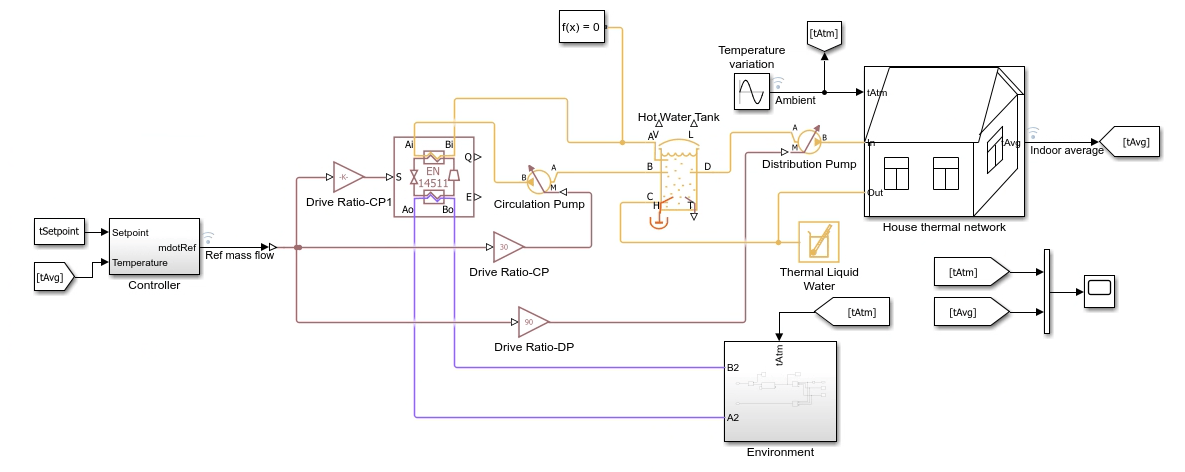
Convert a Heat Pump Model to Use the EN14511 Heat Pump (2P) Block
Parameterize the EN14511 Heat Pump (2P) block to meet specific performance conditions. In this example, you parameterize the EN14511 Heat Pump (2P) block to meet the same performance conditions as the ResidentialAirSourceHeatPump model. For more information on the ResidentialAirSourceHeatPump model, see Residential Air Source Heat Pump.
- Since R2026b
- Open Live Script
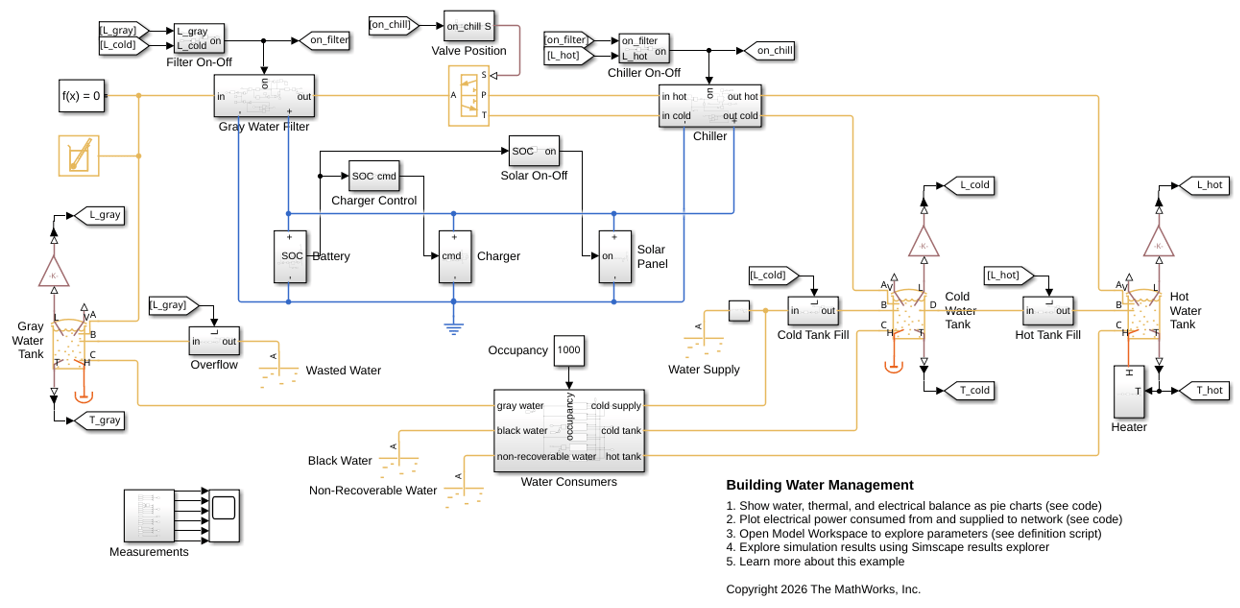
Building Water Management
Simulates a water and energy saving system in a commercial building, such as a hotel. The wastewater is recycled with a filtering system, and the heat contained in the wastewater is recovered with a refrigeration system. A solar panel and battery storage system mitigate the energy cost of running the filtering and refrigeration system.
- Since R2026b
- Open Model
Ports
Input
Physical signal input port that specifies the compressor capacity. When the signal is
0, the compressor is off. When the signal is
1, the compressor operates at the nominal
capacity.
Programmatic Use
Port:
S
Physical signal input port that specifies the heat pump mode. When the signal at port M is non-negative, the block operates in heating mode. When the signal at port M is negative, the block operates in cooling mode.
Dependencies
To enable this port, set Mode to Heating and
Cooling.
Programmatic Use
Port:
M
Physical signal input port that specifies the indoor fluid temperature.
Dependencies
To enable this port, set Indoor heat exchanger fluid to
Physical signal.
Programmatic Use
Port:
Ti
Physical signal input port that specifies the outdoor fluid temperature.
Dependencies
To enable this port, set Outdoor heat exchanger fluid to
Physical signal.
Programmatic Use
Port:
To
Conserving
Gas, moist air, or thermal liquid conserving port associated with the outdoor heat exchanger inlet. The Outdoor heat exchanger fluid parameter determines the domain of the port.
Programmatic Use
Port:
Ao_TL
Gas, moist air, or thermal liquid conserving port associated with the outdoor heat exchanger outlet. The Outdoor heat exchanger fluid parameter determines the domain of the port.
Programmatic Use
Port:
Bo_TL
Gas, moist air, or thermal liquid conserving port associated with the indoor heat exchanger inlet. The Indoor heat exchanger fluid parameter determines the domain of the port.
Programmatic Use
Port:
Ai_TL
Gas, moist air, or thermal liquid conserving port associated with the indoor heat exchanger outlet. The Indoor heat exchanger fluid parameter determines the domain of the port.
Programmatic Use
Port:
Bi_TL
Output
Physical signal output port that measures either the heating or cooling capacity, in kW. When the heat pump is in heating mode, port Q outputs the heating capacity. When the heat pump is in cooling mode, port Q outputs the cooling capacity.
Programmatic Use
Port:
Q
Physical signal output port that measures either the coefficient of performance or the energy efficiency ratio. When the heat pump is in heating mode, port E outputs the COP. When the heat pump is in cooling mode, port E outputs the EER.
Programmatic Use
Port:
E
Parameters
Parameters
Heat pump operating mode.
Programmatic Use
| Parameter: | mode |
| Values: | "fluids.two_phase_fluid.thermodynamic_cycles.enum.EN14511HeatPumpMode.Heating" | "fluids.two_phase_fluid.thermodynamic_cycles.enum.EN14511HeatPumpMode.Cooling" | "fluids.two_phase_fluid.thermodynamic_cycles.enum.EN14511HeatPumpMode.HeatingAndCooling" |
Heating Mode
Parameterization option when the block is in heating mode:
Nominal— The block calculates the heat pump capacity and efficiency from nominal operating conditions.Linear fitting - capacity and efficiency— The block uses linear fits on the indoor and outdoor fluid temperatures and the compressor capacity to determine the capacity and efficiency.Tabulated data - capacity and efficiency— The block uses lookup tables to calculate the capacity and efficiency from indoor and outdoor fluid temperatures and, optionally, the compressor capacity data.
Dependencies
To enable this parameter, set Mode to
Heating or Heating and
Cooling.
Programmatic Use
| Parameter: | param_heating |
| Values: | "fluids.two_phase_fluid.thermodynamic_cycles.enum.EN14511HeatPumpParameterization.Nominal" | "fluids.two_phase_fluid.thermodynamic_cycles.enum.EN14511HeatPumpParameterization.Fitting" | "fluids.two_phase_fluid.thermodynamic_cycles.enum.EN14511HeatPumpParameterization.Table" |
Heating capacity at nominal operating conditions.
Dependencies
To enable this parameter, set Mode to
Heating or Heating and
Cooling and Heating mode
parameterization to
Nominal.
Programmatic Use
Parameter:
Q_nominal_heating
Heating power input at nominal operating conditions.
Dependencies
To enable this parameter, set Mode to
Heating or Heating and
Cooling and Heating mode
parameterization to
Nominal.
Programmatic Use
Parameter:
power_nominal_heating
Outdoor fluid temperature at nominal operating conditions when the block is in heating mode. The block uses this value to calculate the second-law efficiency.
Dependencies
To enable this parameter, set Mode to
Heating or Heating and
Cooling and Cooling mode
parameterization to
Nominal.
Programmatic Use
Parameter:
T_od_nominal_heating
Indoor fluid temperature at nominal operating conditions when the block is in heating mode. The block uses this value to calculate the second-law efficiency.
Dependencies
To enable this parameter, set Mode to
Heating or Heating and
Cooling and Cooling mode
parameterization to
Nominal.
Programmatic Use
Parameter:
T_id_nominal_heating
Maximum value of the calculated coefficient of performance (COP) when the block is in heating mode. The block caps the dynamically calculated COP at this value.
Dependencies
To enable this parameter, set Mode to
Heating or Heating and
Cooling and Heating mode
parameterization to
Nominal.
Programmatic Use
Parameter:
COP_max
Outdoor fluid temperature data that the block uses as an independent variable to fit the heating capacity data. The elements in this vector correspond one-to-one with the elements in the Indoor fluid temperature vector, Compressor capacity vector, Heating capacity vector, and Heating power input vector parameters.
Dependencies
To enable this parameter, set Mode to
Heating or Heating and
Cooling and Heating mode
parameterization to Linear fitting -
capacity and efficiency.
Programmatic Use
Parameter:
T_od_fit_heating
Indoor fluid temperature data that the block uses as an independent variable to fit the heating capacity data. The elements in this vector correspond one-to-one with the elements in the Outdoor fluid temperature vector, Compressor capacity vector, Heating capacity vector, and Heating power input vector parameters.
Dependencies
To enable this parameter, set Mode to
Heating or Heating and
Cooling and Heating mode
parameterization to Linear fitting -
capacity and efficiency.
Programmatic Use
Parameter:
T_id_fit_heating
Compressor capacity data that the block uses to scale the linearly fit
heating capacity and power input. A value of 1 means
the compressor is operating at the nominal capacity and a value of
0 means the compressor is off. The elements in
this vector correspond one-to-one with the elements in the
Indoor fluid temperature vector,
Outdoor fluid temperature vector,
Heating capacity vector, and Heating
power input vector parameters.
Dependencies
To enable this parameter, set Mode to
Heating or Heating and
Cooling and Heating mode
parameterization to Linear fitting -
capacity and efficiency.
Programmatic Use
Parameter:
comp_fit_heating
Heating capacity data that the block uses as a dependent variable in the linear fit for heating capacity. The elements in this vector correspond one-to-one with the elements in the Indoor fluid temperature vector, Outdoor fluid temperature vector, Compressor capacity vector, and Heating power input vector parameters.
Dependencies
To enable this parameter, set Mode to
Heating or Heating and
Cooling and Heating mode
parameterization to Linear fitting -
capacity and efficiency.
Programmatic Use
Parameter:
Q_fit_heating
Heating power input data that the block uses as a dependent variable in the linear fit for heating power input. The elements in this vector correspond one-to-one with the elements in the Indoor fluid temperature vector, Outdoor fluid temperature vector, Compressor capacity vector, and Heating capacity vector parameters.
Dependencies
To enable this parameter, set Mode to
Heating or Heating and
Cooling and Heating mode
parameterization to Linear fitting -
capacity and efficiency.
Programmatic Use
Parameter:
power_fit_heating
Outdoor fluid temperature data that the block uses as an independent variable for the table lookup function. The elements in this vector correspond one-to-one with the elements in the Indoor fluid temperature vector, Tid and Compressor capacity vector, s parameters.
Dependencies
To enable this parameter, set Mode to
Heating or Heating and
Cooling and Heating mode
parameterization to Tabulated data -
capacity and efficiency.
Programmatic Use
Parameter:
T_od_TLU_heating
Indoor fluid temperature data that the block uses as an independent variable for the table lookup function. The elements in this vector correspond one-to-one with the elements in the Outdoor fluid temperature vector, Tod and Compressor capacity vector, s parameters.
Dependencies
To enable this parameter, set Mode to
Heating or Heating and
Cooling and Heating mode
parameterization to Tabulated data -
capacity and efficiency.
Programmatic Use
Parameter:
T_id_TLU_heating
Option to specify the capacity with the Compressor capacity vector, s parameter. If you select the parameter, the block linearly scales the heating capacity and the power input with respect to the compressor capacity. Select this parameter if you do not have performance data across different compressor capacities.
Dependencies
To enable this parameter, set Mode to
Heating or Heating and
Cooling and Heating mode
parameterization to Tabulated data -
capacity and efficiency.
Programmatic Use
| Parameter: | enable_compressor_capacity_scaling_heating |
| Values: | "true" | "false" |
Compressor capacity data that the block uses as an independent
variable for the table lookup function. A value of 1
means the compressor is operating at the nominal capacity and a value of
0 means the compressor is off. The elements in
this vector correspond one-to-one with the elements in the
Outdoor fluid temperature vector, Tod and
Indoor fluid temperature vector, Tid
parameters.
Dependencies
To enable this parameter, set Mode to
Heating or Heating and
Cooling, Heating mode
parameterization to Tabulated data -
capacity and efficiency, and clear Scale
heating capacity linearly with compressor
capacity.
Programmatic Use
Parameter:
comp_TLU_heating
Heating capacity data that the block uses as a dependent variable in the table lookup for heating capacity. The Outdoor fluid temperature vector, Tod and Indoor fluid temperature vector, Tid parameters specify the locations of these data points.
Dependencies
To enable this parameter, set Mode to
Cooling or Heating and
Cooling, Cooling mode
parameterization to Tabulated data -
capacity and efficiency, and select
Scale cooling capacity linearly with compressor
capacity.
Programmatic Use
| Parameter: | Q_2D_TLU_heating |
| Values: |
Heating power data that the block uses as a dependent variable in the table lookup for heating power. The Outdoor fluid temperature vector, Tod and Indoor fluid temperature vector, Tid parameters specify the locations of these data points.
Dependencies
To enable this parameter, set Mode to
Cooling or Heating and
Cooling, Cooling mode
parameterization to Tabulated data -
capacity and efficiency, and select
Scale cooling capacity linearly with compressor
capacity.
Programmatic Use
| Parameter: | power_2D_TLU_heating |
| Values: |
Heating capacity data that the block uses as a dependent variable in the table lookup for heating capacity. The Outdoor fluid temperature vector, Tod, Indoor fluid temperature vector, Tid, and Compressor capacity vector, s parameters specify the locations of these data points.
Dependencies
To enable this parameter, set Mode to
Cooling or Heating and
Cooling, Cooling mode
parameterization to Tabulated data -
capacity and efficiency, and clear Scale
cooling capacity linearly with compressor
capacity.
Programmatic Use
| Parameter: | Q_3D_TLU_heating |
| Values: |
Heating power data that the block uses as a dependent variable in the table lookup for heating power. The Outdoor fluid temperature vector, Tod, Indoor fluid temperature vector, Tid, and Compressor capacity vector, s parameters specify the locations of these data points.
Dependencies
To enable this parameter, set Mode to
Cooling or Heating and
Cooling, Cooling mode
parameterization to Tabulated data -
capacity and efficiency, and clear Scale
cooling capacity linearly with compressor
capacity.
Programmatic Use
| Parameter: | power_3D_TLU_heating |
| Values: |
Cooling Mode
Parameterization option when the block is in cooling mode:
Nominal— The block calculates the heat pump capacity and efficiency from nominal operating conditions.Linear fitting - capacity and efficiency— The block uses linear fits on the indoor and outdoor fluid temperatures and the compressor capacity to determine the capacity and efficiency.Tabulated data - capacity and efficiency— The block uses lookup tables to calculate the capacity and efficiency from indoor and outdoor fluid temperatures and, optionally, the compressor capacity data.
Dependencies
To enable this parameter, set Mode to
Cooling or Heating and
Cooling.
Programmatic Use
| Parameter: | param_cooling |
| Values: | "fluids.two_phase_fluid.thermodynamic_cycles.enum.EN14511HeatPumpParameterization.Nominal" | "fluids.two_phase_fluid.thermodynamic_cycles.enum.EN14511HeatPumpParameterization.Fitting" | "fluids.two_phase_fluid.thermodynamic_cycles.enum.EN14511HeatPumpParameterization.Table" |
Cooling capacity at nominal operating conditions.
Dependencies
To enable this parameter, set Mode to
Cooling or Heating and
Cooling and Cooling mode
parameterization to
Nominal.
Programmatic Use
Parameter:
Q_nominal_cooling
Cooling power input at nominal operating conditions.
Dependencies
To enable this parameter, set Mode to
Cooling or Heating and
Cooling and Cooling mode
parameterization to
Nominal.
Programmatic Use
Parameter:
power_nominal_cooling
Outdoor fluid temperature at nominal operating conditions when the block is in cooling mode. The block uses this value to calculate the second-law efficiency.
Dependencies
To enable this parameter, set Mode to
Cooling or Heating and
Cooling and Cooling mode
parameterization to
Nominal.
Programmatic Use
Parameter:
T_od_nominal_cooling
Indoor fluid temperature at nominal operating conditions when the block is in cooling mode. The block uses this value to calculate the second-law efficiency.
Dependencies
To enable this parameter, set Mode to
Cooling or Heating and
Cooling and Cooling mode
parameterization to
Nominal.
Programmatic Use
Parameter:
T_id_nominal_cooling
Maximum value of the calculated energy efficiency ratio (EER) when the block is in cooling mode. The block caps the dynamically calculated EER at this value.
Dependencies
To enable this parameter, set Mode to
Cooling or Heating and
Cooling and Cooling mode
parameterization to
Nominal.
Programmatic Use
Parameter:
EER_max
Outdoor fluid temperature data that the block uses as an independent variable to fit the cooling capacity data. The elements in this vector correspond one-to-one with the elements in the Indoor fluid temperature vector, Compressor capacity vector, Cooling capacity vector, and Cooling power input vector parameters.
Dependencies
To enable this parameter, set Mode to
Cooling or Heating and
Cooling and Cooling mode
parameterization to Linear fitting -
capacity and efficiency.
Programmatic Use
Parameter:
T_od_fit_cooling
Indoor fluid temperature data that the block uses as an independent variable to fit the cooling capacity data. The elements in this vector correspond one-to-one with the elements in the Outdoor fluid temperature vector, Compressor capacity vector, Cooling capacity vector, and Cooling power input vector parameters.
Dependencies
To enable this parameter, set Mode to
Cooling or Heating and
Cooling and Cooling mode
parameterization to Linear fitting -
capacity and efficiency.
Programmatic Use
Parameter:
T_id_fit_cooling
Compressor capacity data that the block uses to scale the linearly fit cooling capacity and power input. The elements in this vector correspond one-to-one with the elements in the Indoor fluid temperature vector, Outdoor fluid temperature vector, Cooling capacity vector, and Cooling power input vector parameters.
Dependencies
To enable this parameter, set Mode to
Cooling or Heating and
Cooling and Cooling mode
parameterization to Linear fitting -
capacity and efficiency.
Programmatic Use
Parameter:
comp_fit_cooling
Cooling capacity data that the block uses as a dependent variable in the linear fit for cooling capacity. The elements in this vector correspond one-to-one with the elements in the Indoor fluid temperature vector, Outdoor fluid temperature vector, Compressor capacity vector, and Cooling power input vector parameters.
Dependencies
To enable this parameter, set Mode to
Cooling or Heating and
Cooling and Cooling mode
parameterization to Linear fitting -
capacity and efficiency.
Programmatic Use
| Parameter: | Q_fit_cooling |
| Values: |
Cooling power input data that the block uses as a dependent variable in the linear fit for cooling power input. The elements in this vector correspond one-to-one with the elements in the Indoor fluid temperature vector, Outdoor fluid temperature vector, Compressor capacity vector, and Cooling capacity vector parameters.
Dependencies
To enable this parameter, set Mode to
Cooling or Heating and
Cooling and Cooling mode
parameterization to Linear fitting -
capacity and efficiency.
Programmatic Use
| Parameter: | power_fit_cooling |
| Values: |
Outdoor fluid temperature data that the block uses as an independent variable for the table lookup function. The elements in this vector correspond one-to-one with the elements in the Indoor fluid temperature vector, Tid and Compressor capacity vector, s parameters.
Dependencies
To enable this parameter, set Mode to
Cooling or Heating and
Cooling and Cooling mode
parameterization to Tabulated data -
capacity and efficiency.
Programmatic Use
Parameter:
T_od_TLU_cooling
Indoor fluid temperature data that the block uses as an independent variable for the table lookup function. The elements in this vector correspond one-to-one with the elements in the Outdoor fluid temperature vector, Tod and Compressor capacity vector, s parameters.
Dependencies
To enable this parameter, set Mode to
Cooling or Heating and
Cooling and Cooling mode
parameterization to Tabulated data -
capacity and efficiency.
Programmatic Use
Parameter:
T_id_TLU_cooling
Option to specify the capacity with the Compressor capacity vector, s parameter. If you select the parameter, the block linearly scales the cooling capacity and the power input with respect to the compressor capacity. Select this parameter if you do not have performance data across different compressor capacities.
Dependencies
To enable this parameter, set Mode to
Cooling or Heating and
Cooling and Cooling mode
parameterization to Tabulated data -
capacity and efficiency.
Programmatic Use
| Parameter: | enable_compressor_capacity_scaling_cooling |
| Values: | "true" | "false" |
Compressor capacity data that the block uses as an independent variable for the table lookup function. The elements in this vector correspond one-to-one with the elements in the Outdoor fluid temperature vector, Tod and Indoor fluid temperature vector, Tid parameters.
Dependencies
To enable this parameter, set Mode to
Cooling or Heating and
Cooling, Cooling mode
parameterization to Tabulated data -
capacity and efficiency, and clear Scale
cooling capacity linearly with compressor
capacity.
Programmatic Use
Parameter:
comp_TLU_cooling
Cooling capacity data that the block uses as a dependent variable in the table lookup for cooling capacity. The Outdoor fluid temperature vector, Tod and Indoor fluid temperature vector, Tid parameters specify the locations of these data points.
Dependencies
To enable this parameter, set Mode to
Cooling or Heating and
Cooling, Cooling mode
parameterization to Tabulated data -
capacity and efficiency, and select
Scale cooling capacity linearly with compressor
capacity.
Programmatic Use
Parameter:
Q_2D_TLU_cooling
Cooling power data that the block uses as a dependent variable in the table lookup for cooling power. The Outdoor fluid temperature vector, Tod and Indoor fluid temperature vector, Tid parameters specify the locations of these data points.
Dependencies
To enable this parameter, set Mode to
Cooling or Heating and
Cooling, Cooling mode
parameterization to Tabulated data -
capacity and efficiency, and select
Scale cooling capacity linearly with compressor
capacity.
Programmatic Use
Parameter:
power_2D_TLU_cooling
Cooling capacity data that the block uses as a dependent variable in the table lookup for cooling capacity. The Outdoor fluid temperature vector, Tod, Indoor fluid temperature vector, Tid, and Compressor capacity vector, s parameters specify the locations of these data points.
Dependencies
To enable this parameter, set Mode to
Cooling or Heating and
Cooling, Cooling mode
parameterization to Tabulated data -
capacity and efficiency, and clear Scale
cooling capacity linearly with compressor
capacity.
Programmatic Use
| Parameter: | Q_3D_TLU_cooling |
| Values: |
Cooling power data that the block uses as a dependent variable in the table lookup for cooling power. The Outdoor fluid temperature vector, Tod, Indoor fluid temperature vector, Tid, and Compressor capacity vector, s parameters specify the locations of these data points.
Dependencies
To enable this parameter, set Mode to
Cooling or Heating and
Cooling, Cooling mode
parameterization to Tabulated data -
capacity and efficiency, and clear Scale
cooling capacity linearly with compressor
capacity.
Programmatic Use
| Parameter: | power_3D_TLU_cooling |
| Values: |
Outdoor Heat Exchanger
Fluid to model in the outdoor side of the heat exchanger.
Programmatic Use
| Parameter: | fluid_od |
| Values: | "fluids.two_phase_fluid.thermodynamic_cycles.enum.EN14511HeatPumpFluidDomain.MA" | "fluids.two_phase_fluid.thermodynamic_cycles.enum.EN14511HeatPumpFluidDomain.G" | "fluids.two_phase_fluid.thermodynamic_cycles.enum.EN14511HeatPumpFluidDomain.TL" | "fluids.two_phase_fluid.thermodynamic_cycles.enum.EN14511HeatPumpFluidDomain.PS" |
Pressure drop from port Ao to port Bo during nominal operating conditions.
Dependencies
To enable this parameter, set Outdoor heat exchanger
fluid to Gas,
Thermal
				liquid
, or Moist
air.
Programmatic Use
Parameter:
delta_p_nominal_od
Mass flow rate from port Ao to port Bo during nominal operating conditions.
Dependencies
To enable this parameter, set Outdoor heat exchanger
fluid to Gas,
Thermal liquid, or Moist
air.
Programmatic Use
Parameter:
mdot_nominal_od
Temperature in the heat exchanger fluid volume at nominal operating conditions.
Dependencies
To enable this parameter, set Outdoor heat exchanger
fluid to Gas.
Programmatic Use
Parameter:
T_nominal_od
Wet-bulb temperature in the heat exchanger fluid volume at nominal operating conditions.
Dependencies
To enable this parameter, set Outdoor heat exchanger
fluid
Moist
									air
.
Programmatic Use
Parameter:
Tw_nominal_od
Dry-bulb temperature in the heat exchanger fluid volume at nominal operating conditions.
Dependencies
To enable this parameter, set Outdoor heat exchanger
fluid
Moist
									air
.
Programmatic Use
Parameter:
Td_nominal_od
Ratio of the threshold mass flow rate to the nominal mass flow rate of the fluid.
Dependencies
To enable this parameter, set Outdoor heat exchanger
fluid to Gas,
Thermal liquid, or Moist
air.
Programmatic Use
Parameter:
laminar_fraction_od
Flow area at the heat exchanger fluid ports Ao and Bo.
Dependencies
To enable this parameter, set Outdoor heat exchanger
fluid to Gas,
Thermal liquid, or Moist
air.
Programmatic Use
Parameter:
area_od
Total volume of fluid in the heat exchanger.
Dependencies
To enable this parameter, set Outdoor heat exchanger
fluid to Gas,
Thermal liquid, or Moist
air.
Programmatic Use
Parameter:
volume_od
Relative humidity point of condensation. Condensation occurs above this value. In most cases, this value is 1. A value greater than 1 indicates a supersaturated vapor.
Dependencies
To enable this parameter, set Outdoor heat exchanger
fluid to Moist air.
Programmatic Use
Parameter:
RH_ws_od
Characteristic time scale at which an oversaturated moist air volume returns to saturation by condensing out excess humidity.
Dependencies
To enable this parameter, set Outdoor heat exchanger
fluid to Moist air.
Programmatic Use
Parameter:
time_constant_cond_od
Characteristic time scale at which water droplets evaporate to vapor.
Dependencies
To enable this parameter, set Outdoor heat exchanger
fluid to Moist air.
Programmatic Use
Parameter:
time_constant_evap_od
Fraction of the condensate in the moist air that is entrained as water droplets.
Dependencies
To enable this parameter, set Outdoor heat exchanger
fluid to Moist air.
Programmatic Use
Parameter:
fraction_entrained_od
Whether to model the dynamic compressibility of the liquid. Dynamic compressibility affects the transient response of the system at small timescales. If you select this parameter, the pressure responds dynamically based on the accumulation of fluid mass in the volume. If you clear this parameter, the volume does not accumulate mass and the pressure response is instantaneous. Clearing this setting can improve simulation performance, but may have a negative effect on the simulation robustness. Only clear this setting for small fluid volumes or models with long simulation times.
Dependencies
To enable this parameter, set Outdoor heat exchanger
fluid to Gas or
Thermal liquid.
Programmatic Use
| Parameter: | dynamic_compressibility_od |
| Values: | "true" | "false" |
Heat exchanger fluid pressure at the start of the simulation.
Dependencies
To enable this parameter, set either:
Outdoor heat exchanger fluid to
Moist air.Outdoor heat exchanger fluid to
GasorThermal liquidand select Enable dynamic compressibility.
Programmatic Use
Parameter:
p_init_od
Priority that the solver assigns to the Initial pressure parameter when initializing the block.
Set this parameter to High to define your
initial conditions. You may need to set this parameter to
Low or None if
this initial condition conflicts with the initial conditions of another
block.
Dependencies
To enable this parameter, set either:
Outdoor heat exchanger fluid to
Moist air.Outdoor heat exchanger fluid to
GasorThermal liquidand select Enable dynamic compressibility.
Programmatic Use
| Parameter: | p_init_priority_od |
| Values: | "foundation.enum.Priority.High" | "foundation.enum.Priority.Low" | "foundation.enum.Priority.None" |
Temperature in the heat exchanger at the start of simulation.
Dependencies
To enable this parameter, set Outdoor heat exchanger
fluid to Gas,
Thermal liquid, or Moist
air.
Programmatic Use
Parameter:
T_init_od
Priority that the solver assigns to the Initial temperature parameter when initializing the block.
Set this parameter to High to define your initial conditions.
Set this parameter to Low or
None if this initial condition conflicts
with the initial conditions of another block.
Dependencies
To enable this parameter, set Outdoor heat exchanger
fluid to Gas,
Thermal liquid, or Moist
air.
Programmatic Use
| Parameter: | T_init_priority_od |
| Values: | "foundation.enum.Priority.High" | "foundation.enum.Priority.Low" | "foundation.enum.Priority.None" |
Method to use to describe the initial humidity level in the heat exchanger fluid.
Dependencies
To enable this parameter, set Outdoor heat exchanger
fluid to Moist air.
Programmatic Use
| Parameter: | humidity_spec_od |
| Values: | "foundation.enum.HumiditySpec.RelativeHumidity" | "foundation.enum.HumiditySpec.SpecificHumidity" | "foundation.enum.HumiditySpec.MoleFraction" | "foundation.enum.HumiditySpec.HumidityRatio" | "foundation.enum.HumiditySpec.WetBulbTemperature" |
Heat exchanger fluid relative humidity at the start of simulation.
Dependencies
To enable this parameter, set Outdoor heat exchanger
fluid to Moist air and
Initial humidity specification to
Relative humidity.
Programmatic Use
Parameter:
RH_init_od
Priority that the solver assigns to the Initial relative humidity parameter when initializing the block.
Set this parameter to High to define your initial conditions.
Set this parameter to Low or
None if this initial condition conflicts
with the initial conditions of another block.
Dependencies
To enable this parameter, set Outdoor heat exchanger
fluid to Moist air and
Initial humidity specification to
Relative humidity.
Programmatic Use
| Parameter: | RH_init_priority_od |
| Values: | "foundation.enum.Priority.High" | "foundation.enum.Priority.Low" | "foundation.enum.Priority.None" |
Heat exchanger fluid specific humidity, defined as the mass fraction of water vapor in a moist air mixture, at the start of simulation.
Dependencies
To enable this parameter, set Outdoor heat exchanger
fluid to Moist air and
Initial humidity specification to
Specific humidity.
Programmatic Use
Parameter:
x_w_init_od
Priority that the solver assigns to the Initial specific humidity parameter when initializing the block.
Set this parameter to High to define your initial conditions.
Set this parameter to Low or
None if this initial condition conflicts
with the initial conditions of another block.
Dependencies
To enable this parameter, set Outdoor heat exchanger
fluid to Moist air and
Initial humidity specification to
Specific humidity.
Programmatic Use
| Parameter: | x_w_init_priority_od |
| Values: | "foundation.enum.Priority.High" | "foundation.enum.Priority.Low" | "foundation.enum.Priority.None" |
Mole fraction of the water vapor in the heat exchanger fluid at the start of simulation.
Dependencies
To enable this parameter, set Outdoor heat exchanger
fluid to Moist air and
Initial humidity specification to
Mole fraction.
Programmatic Use
Parameter:
y_w_init_od
Priority that the solver assigns to the Initial water vapor mole fraction parameter when initializing the block.
Set this parameter to High to define your initial conditions.
Set this parameter to Low or
None if this initial condition conflicts
with the initial conditions of another block.
Dependencies
To enable this parameter, set Outdoor heat exchanger
fluid to Moist air and
Initial humidity specification to
Mole fraction.
Programmatic Use
| Parameter: | y_w_init_priority_od |
| Values: | "foundation.enum.Priority.High" | "foundation.enum.Priority.Low" | "foundation.enum.Priority.None" |
Heat exchanger fluid humidity ratio, defined as the mass ratio of water vapor to dry air and trace gas, at the start of simulation.
Dependencies
To enable this parameter, set Outdoor heat exchanger
fluid to Moist air and
Initial humidity specification to
Humidity ratio.
Programmatic Use
Parameter:
HR_init_od
Priority that the solver assigns to the Initial humidity ratio humidity parameter when initializing the block.
Set this parameter to High to define your initial conditions.
Set this parameter to Low or
None if this initial condition conflicts
with the initial conditions of another block.
Dependencies
To enable this parameter, set Outdoor heat exchanger
fluid to Moist air and
Initial humidity specification to
Humidity ratio.
Programmatic Use
| Parameter: | HR_init_priority_od |
| Values: | "foundation.enum.Priority.High" | "foundation.enum.Priority.Low" | "foundation.enum.Priority.None" |
Heat exchanger wet-bulb temperature at the start of the simulation.
Dependencies
To enable this parameter, set Outdoor heat exchanger
fluid to Moist air and
Initial humidity specification to
Wet-bulb temperature.
Programmatic Use
Parameter:
Tw_init_od
Priority that the solver assigns to the Initial wet-bulb temperature parameter when initializing the block.
Set this parameter to High to define your initial conditions.
Set this parameter to Low or
None if this initial condition conflicts
with the initial conditions of another block.
Dependencies
To enable this parameter, set Outdoor heat exchanger
fluid to Moist air and
Initial humidity specification to
Wet-bulb temperature.
Programmatic Use
| Parameter: | Tw_init_priority_od |
| Values: | "foundation.enum.Priority.High" | "foundation.enum.Priority.Low" | "foundation.enum.Priority.None" |
Method to use to describe the trace gas level at the start of simulation.
Dependencies
To enable this parameter, set Outdoor heat exchanger
fluid to Moist air.
Programmatic Use
| Parameter: | trace_gas_spec_od |
| Values: | "foundation.enum.trace_gas_spec.mass_fraction" | "foundation.enum.trace_gas_spec.mole_fraction" |
Mass fraction of trace gas in a moist air mixture at the start of simulation.
The block ignores this parameter if the Trace gas
model parameter in the Moist Air
Properties (MA) block is
None.
Dependencies
To enable this parameter, set Outdoor heat exchanger
fluid to Moist air and
Initial trace gas specification to
Mass fraction.
Programmatic Use
Parameter:
x_g_init_od
Priority that the solver assigns to the Initial trace gas mass fraction priority parameter when initializing the block.
Set this parameter to High to define your initial conditions.
Set this parameter to Low or
None if this initial condition conflicts
with the initial conditions of another block.
Dependencies
To enable this parameter, set Outdoor heat exchanger
fluid to Moist air and
Initial trace gas specification to
Mass fraction.
Programmatic Use
| Parameter: | x_g_init_priority_od |
| Values: | "foundation.enum.Priority.High" | "foundation.enum.Priority.Low" | "foundation.enum.Priority.None" |
Mole fraction of the trace gas in a moist air mixture at the start of simulation.
The block ignores this parameter if the Trace gas
model parameter in the Moist Air
Properties (MA) block is
None.
Dependencies
To enable this parameter, set Outdoor heat exchanger
fluid to Moist air and
Initial trace gas specification to
Mole fraction.
Programmatic Use
Parameter:
y_g_init_od
Priority that the solver assigns to the Initial trace gas mole fraction priority parameter when initializing the block.
Set this parameter to High to define your initial conditions.
Set this parameter to Low or
None if this initial condition conflicts
with the initial conditions of another block.
Dependencies
To enable this parameter, set Outdoor heat exchanger
fluid to Moist air and
Initial trace gas specification to
Mole fraction.
Programmatic Use
| Parameter: | y_g_init_priority_od |
| Values: | "foundation.enum.Priority.High" | "foundation.enum.Priority.Low" | "foundation.enum.Priority.None" |
Initial mass ratio of water droplets to moist air.
Dependencies
To enable this parameter, set Outdoor heat exchanger
fluid to Moist air.
Programmatic Use
Parameter:
r_d_init_od
Priority that the solver assigns to the Initial mass ratio of water droplets to moist air priority parameter when initializing the block.
Set this parameter to High to define your initial conditions.
Set this parameter to Low or
None if this initial condition conflicts
with the initial conditions of another block.
Dependencies
To enable this parameter, set Outdoor heat exchanger
fluid to Moist air.
Programmatic Use
| Parameter: | r_d_init_priority_od |
| Values: | "foundation.enum.Priority.High" | "foundation.enum.Priority.Low" | "foundation.enum.Priority.None" |
Indoor Heat Exchanger
Fluid to model in the indoor side of the heat exchanger.
Programmatic Use
| Parameter: | fluid_id |
| Values: | "fluids.two_phase_fluid.thermodynamic_cycles.enum.EN14511HeatPumpFluidDomain.TL" | "fluids.two_phase_fluid.thermodynamic_cycles.enum.EN14511HeatPumpFluidDomain.G" | "fluids.two_phase_fluid.thermodynamic_cycles.enum.EN14511HeatPumpFluidDomain.MA" | "fluids.two_phase_fluid.thermodynamic_cycles.enum.EN14511HeatPumpFluidDomain.PS" |
Pressure drop from port Ai to port Bi during nominal operating conditions.
Dependencies
To enable this parameter, set Outdoor heat exchanger
fluid to Gas,
Thermal liquid, or Moist
air.
Programmatic Use
Parameter:
delta_p_nominal_id
Mass flow rate from port Ai to port Bi during nominal operating conditions.
Dependencies
To enable this parameter, set Indoor heat exchanger
fluid to Gas,
Thermal liquid, or Moist
air.
Programmatic Use
Parameter:
mdot_nominal_id
Temperature in the heat exchanger fluid volume at nominal operating conditions.
Dependencies
To enable this parameter, set Indoor heat exchanger
fluid to Gas.
Programmatic Use
Parameter:
T_nominal_id
Wet-bulb temperature in the heat exchanger fluid volume at nominal operating conditions.
Dependencies
To enable this parameter, set Indoor heat exchanger
fluid
Moist
									air
.
Programmatic Use
Parameter:
Tw_nominal_id
Dry-bulb temperature in the heat exchanger fluid volume at nominal operating conditions.
Dependencies
To enable this parameter, set Indoor heat exchanger
fluid
Moist
									air
.
Programmatic Use
Parameter:
Td_nominal_id
Ratio of the threshold mass flow rate to the nominal mass flow rate of the fluid.
Dependencies
To enable this parameter, set Indoor heat exchanger
fluid to Gas,
Thermal liquid, or Moist
air.
Programmatic Use
Parameter:
laminar_fraction_id
Flow area at the heat exchanger fluid ports Ai and Bi.
Dependencies
To enable this parameter, set Indoor heat exchanger
fluid to Gas,
Thermal liquid, or Moist
air.
Programmatic Use
Parameter:
area_id
Total volume of fluid in the heat exchanger.
Dependencies
To enable this parameter, set Indoor heat exchanger
fluid to Gas,
Thermal liquid, or Moist
air.
Programmatic Use
Parameter:
volume_id
Relative humidity point of condensation. Condensation occurs above this value. In most cases, this value is 1. A value greater than 1 indicates a supersaturated vapor.
Dependencies
To enable this parameter, set Indoor heat exchanger
fluid to Moist air.
Programmatic Use
Parameter:
RH_ws_id
Characteristic time scale at which an oversaturated moist air volume returns to saturation by condensing out excess humidity.
Dependencies
To enable this parameter, set Indoor heat exchanger
fluid to Moist air.
Programmatic Use
Parameter:
time_constant_cond_id
Characteristic time scale at which water droplets evaporate to vapor.
Dependencies
To enable this parameter, set Indoor heat exchanger
fluid to Moist air.
Programmatic Use
Parameter:
time_constant_evap_id
Fraction of the condensate in the moist air that is entrained as water droplets.
Dependencies
To enable this parameter, set Indoor heat exchanger
fluid to Moist air.
Programmatic Use
Parameter:
fraction_entrained_id
Whether to model the dynamic compressibility of the liquid. Dynamic compressibility affects the transient response of the system at small timescales. If you select this parameter, the pressure responds dynamically based on the accumulation of fluid mass in the volume. If you clear this parameter, the volume does not accumulate mass and the pressure response is instantaneous. Clearing this setting can improve simulation performance, but may have a negative effect on the simulation robustness. Only clear this setting for small fluid volumes or models with long simulation times.
Dependencies
To enable this parameter, set Indoor heat exchanger
fluid to Gas or
Thermal liquid.
Programmatic Use
| Parameter: | dynamic_compressibility_id |
| Values: | "true" | "false" |
Heat exchanger fluid pressure at the start of the simulation.
Dependencies
To enable this parameter, set either:
Indoor heat exchanger fluid to
Moist air.Indoor heat exchanger fluid to
GasorThermal liquidand select Enable dynamic compressibility.
Programmatic Use
Parameter:
p_init_id
Priority that the solver assigns to the Initial pressure parameter when initializing the block.
Set this parameter to High to define your initial conditions.
Set this parameter to Low or
None if this initial condition conflicts
with the initial conditions of another block.
Dependencies
To enable this parameter, set either:
Indoor heat exchanger fluid to
Moist air.Indoor heat exchanger fluid to
GasorThermal liquidand select Enable dynamic compressibility.
Programmatic Use
| Parameter: | p_init_priority_id |
| Values: | "foundation.enum.Priority.High" | "foundation.enum.Priority.Low" | "foundation.enum.Priority.None" |
Temperature in the heat exchanger at the start of simulation.
Dependencies
To enable this parameter, set Indoor heat exchanger
fluid to Gas,
Thermal liquid, or Moist
air.
Programmatic Use
Parameter:
T_init_id
Priority that the solver assigns to the Initial temperature parameter when initializing the block.
Set this parameter to High to define your initial conditions.
Set this parameter to Low or
None if this initial condition conflicts
with the initial conditions of another block.
Dependencies
To enable this parameter, set Indoor heat exchanger
fluid to Gas,
Thermal liquid, or Moist
air.
Programmatic Use
| Parameter: | T_init_priority_id |
| Values: | "foundation.enum.Priority.High" | "foundation.enum.Priority.Low" | "foundation.enum.Priority.None" |
Method to use to describe the initial humidity level in the heat exchanger fluid.
Dependencies
To enable this parameter, set Indoor heat exchanger
fluid to Moist air.
Programmatic Use
| Parameter: | humidity_spec_id |
| Values: | "foundation.enum.HumiditySpec.RelativeHumidity" | "foundation.enum.HumiditySpec.SpecificHumidity" | "foundation.enum.HumiditySpec.MoleFraction" | "foundation.enum.HumiditySpec.HumidityRatio" | "foundation.enum.HumiditySpec.WetBulbTemperature" |
Heat exchanger fluid relative humidity at the start of simulation.
Dependencies
To enable this parameter, set Indoor heat exchanger
fluid to Moist air and
Initial humidity specification to
Relative humidity.
Programmatic Use
Parameter:
RH_init_id
Priority that the solver assigns to the Initial relative humidity parameter when initializing the block.
Set this parameter to High to define your initial conditions.
Set this parameter to Low or
None if this initial condition conflicts
with the initial conditions of another block.
Dependencies
To enable this parameter, set Indoor heat exchanger
fluid to Moist air and
Initial humidity specification to
Relative humidity.
Programmatic Use
| Parameter: | RH_init_priority_id |
| Values: | "foundation.enum.Priority.High" | "foundation.enum.Priority.Low" | "foundation.enum.Priority.None" |
Heat exchanger fluid specific humidity, defined as the mass fraction of water vapor in a moist air mixture, at the start of simulation.
Dependencies
To enable this parameter, set Indoor heat exchanger
fluid to Moist air and
Initial humidity specification to
Specific humidity.
Programmatic Use
Parameter:
x_w_init_id
Priority that the solver assigns to the Initial specific humidity parameter when initializing the block.
Set this parameter to High to define your initial conditions.
Set this parameter to Low or
None if this initial condition conflicts
with the initial conditions of another block.
Dependencies
To enable this parameter, set Indoor heat exchanger
fluid to Moist air and
Initial humidity specification to
Specific humidity.
Programmatic Use
| Parameter: | x_w_init_priority_id |
| Values: | "foundation.enum.Priority.High" | "foundation.enum.Priority.Low" | "foundation.enum.Priority.None" |
Mole fraction of the water vapor in the heat exchanger fluid at the start of simulation.
Dependencies
To enable this parameter, set Indoor heat exchanger
fluid to Moist air and
Initial humidity specification to
Mole fraction.
Programmatic Use
Parameter:
y_w_init_id
Priority that the solver assigns to the Initial water vapor mole fraction parameter when initializing the block.
Set this parameter to High to define your initial conditions.
Set this parameter to Low or
None if this initial condition conflicts
with the initial conditions of another block.
Dependencies
To enable this parameter, set Indoor heat exchanger
fluid to Moist air and
Initial humidity specification to
Mole fraction.
Programmatic Use
| Parameter: | y_w_init_priority_id |
| Values: | "foundation.enum.Priority.High" | "foundation.enum.Priority.Low" | "foundation.enum.Priority.None" |
Heat exchanger fluid humidity ratio, defined as the mass ratio of water vapor to dry air and trace gas, at the start of simulation.
Dependencies
To enable this parameter, set Indoor heat exchanger
fluid to Moist air and
Initial humidity specification to
Humidity ratio.
Programmatic Use
Parameter:
HR_init_id
Priority that the solver assigns to the Initial humidity ratio humidity parameter when initializing the block.
Set this parameter to High to define your initial conditions.
Set this parameter to Low or
None if this initial condition conflicts
with the initial conditions of another block.
Dependencies
To enable this parameter, set Indoor heat exchanger
fluid to Moist air and
Initial humidity specification to
Humidity ratio.
Programmatic Use
| Parameter: | HR_init_priority_id |
| Values: | "foundation.enum.Priority.High" | "foundation.enum.Priority.Low" | "foundation.enum.Priority.None" |
Heat exchanger wet-bulb temperature at the start of the simulation.
Dependencies
To enable this parameter, set Indoor heat exchanger
fluid to Moist air and
Initial humidity specification to
Wet-bulb temperature.
Programmatic Use
Parameter:
Tw_init_id
Priority that the solver assigns to the Initial wet-bulb temperature parameter when initializing the block.
Set this parameter to High to define your initial conditions.
Set this parameter to Low or
None if this initial condition conflicts
with the initial conditions of another block.
Dependencies
To enable this parameter, set Indoor heat exchanger
fluid to Moist air and
Initial humidity specification to
Wet-bulb temperature.
Programmatic Use
| Parameter: | Tw_init_priority_id |
| Values: | "foundation.enum.Priority.High" | "foundation.enum.Priority.Low" | "foundation.enum.Priority.None" |
Method to use to describe the trace gas level at the start of simulation.
Dependencies
To enable this parameter, set Indoor heat exchanger
fluid to Moist air.
Programmatic Use
| Parameter: | trace_gas_spec_id |
| Values: | "foundation.enum.trace_gas_spec.mass_fraction" | "foundation.enum.trace_gas_spec.mole_fraction" |
Mass fraction of trace gas in a moist air mixture at the start of simulation.
The block ignores this parameter if the Trace gas
model parameter in the Moist Air
Properties (MA) block is
None.
Dependencies
To enable this parameter, set Indoor heat exchanger
fluid to Moist air and
Initial trace gas specification to
Mass fraction.
Programmatic Use
Parameter:
x_g_init_id
Priority that the solver assigns to the Initial trace gas mass fraction priority parameter when initializing the block.
Set this parameter to High to define your initial conditions.
Set this parameter to Low or
None if this initial condition conflicts
with the initial conditions of another block.
Dependencies
To enable this parameter, set Indoor heat exchanger
fluid to Moist air and
Initial trace gas specification to
Mass fraction.
Programmatic Use
| Parameter: | x_g_init_priority_id |
| Values: | "foundation.enum.Priority.High" | "foundation.enum.Priority.Low" | "foundation.enum.Priority.None" |
Mole fraction of the trace gas in a moist air mixture at the start of simulation.
The block ignores this parameter if the Trace gas
model parameter in the Moist Air
Properties (MA) block is
None.
Dependencies
To enable this parameter, set Indoor heat exchanger
fluid to Moist air and
Initial trace gas specification to
Mole fraction.
Programmatic Use
Parameter:
y_g_init_id
Priority that the solver assigns to the Initial trace gas mole fraction priority parameter when initializing the block.
Set this parameter to High to define your initial conditions.
Set this parameter to Low or
None if this initial condition conflicts
with the initial conditions of another block.
Dependencies
To enable this parameter, set Indoor heat exchanger
fluid to Moist air and
Initial trace gas specification to
Mole fraction.
Programmatic Use
| Parameter: | y_g_init_priority_id |
| Values: | "foundation.enum.Priority.High" | "foundation.enum.Priority.Low" | "foundation.enum.Priority.None" |
Initial mass ratio of water droplets to moist air.
Dependencies
To enable this parameter, set Indoor heat exchanger
fluid to Moist air.
Programmatic Use
Parameter:
r_d_init_id
Priority that the solver assigns to the Initial mass ratio of water droplets to moist air priority parameter when initializing the block.
Set this parameter to High to define your initial conditions.
Set this parameter to Low or
None if this initial condition conflicts
with the initial conditions of another block.
Dependencies
To enable this parameter, set Indoor heat exchanger
fluid to Moist air.
Programmatic Use
| Parameter: | r_d_init_priority_id |
| Values: | "foundation.enum.Priority.High" | "foundation.enum.Priority.Low" | "foundation.enum.Priority.None" |
References
[1] European Committee for Standardization. EN 14511‑1-4:2022 — Air Conditioners, Liquid Chilling Packages and Heat Pumps for Space Heating and Cooling and Process Chillers, with Electrically Driven Compressors. Part 1 - Part 4. Brussels: European Committee for Standardization, 2022.
Extended Capabilities
C/C++ Code Generation
Generate C and C++ code using Simulink® Coder™.
Version History
Introduced in R2026b
MATLAB Command
You clicked a link that corresponds to this MATLAB command:
Run the command by entering it in the MATLAB Command Window. Web browsers do not support MATLAB commands.


选择网站
选择网站以获取翻译的可用内容,以及查看当地活动和优惠。根据您的位置,我们建议您选择:。
您也可以从以下列表中选择网站:
如何获得最佳网站性能
选择中国网站(中文或英文)以获得最佳网站性能。其他 MathWorks 国家/地区网站并未针对您所在位置的访问进行优化。
美洲
- América Latina (Español)
- Canada (English)
- United States (English)
欧洲
- Belgium (English)
- Denmark (English)
- Deutschland (Deutsch)
- España (Español)
- Finland (English)
- France (Français)
- Ireland (English)
- Italia (Italiano)
- Luxembourg (English)
- Netherlands (English)
- Norway (English)
- Österreich (Deutsch)
- Portugal (English)
- Sweden (English)
- Switzerland
- United Kingdom (English)