Building Water Management
R2026bThis example simulates a water and energy saving system in a commercial building, such as a hotel. The wastewater is recycled with a filtering system, and the heat contained in the wastewater is recovered with a refrigeration system. A solar panel and battery storage system mitigate the energy cost of running the filtering and refrigeration system.
Model
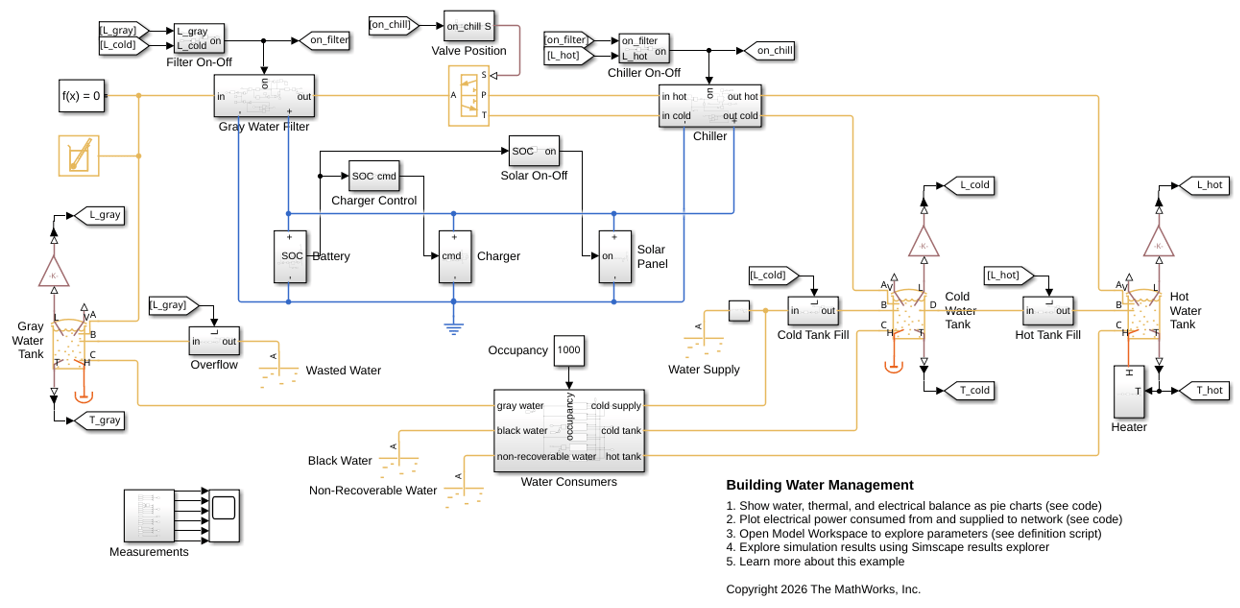
The model consists of the water consumers, three water tanks, the filter system, the refrigeration system, and the electrical system.
The gray water tank stores recoverable wastewater from the consumers. The cold and hot water tanks store treated cold and hot water for the consumers. An external cold water supply makes up for nonrecoverable or lost water.
When water is available in the gray water tank, the filtering system pumps water through its filter so that the water can be reused. The treated gray water is warm because it is a mix of used hot and cold water. To be reused it needs to be converted into cold and hot treated water.
The chiller is a refrigeration system that takes the warm treated water and cools it for reuse as treated cold water. In doing so, the chiller recovers the heat contained in the warm treated water for reuse as treated hot water. This recovery reduces the amount of heat that the hot water tank heater needs to produce.
If the hot water tank level is low, it is replenished from the cold water tank. If the cold water tank level is low, it is replenished from the water supply.
A solar panel, charger, and battery provide the electrical power required to run the filtering system and chiller. The electrical components are simplified abstract models that only estimate the overall electrical power consumed and do not simulate the electrical system in detail.
Water Consumers Subsystem
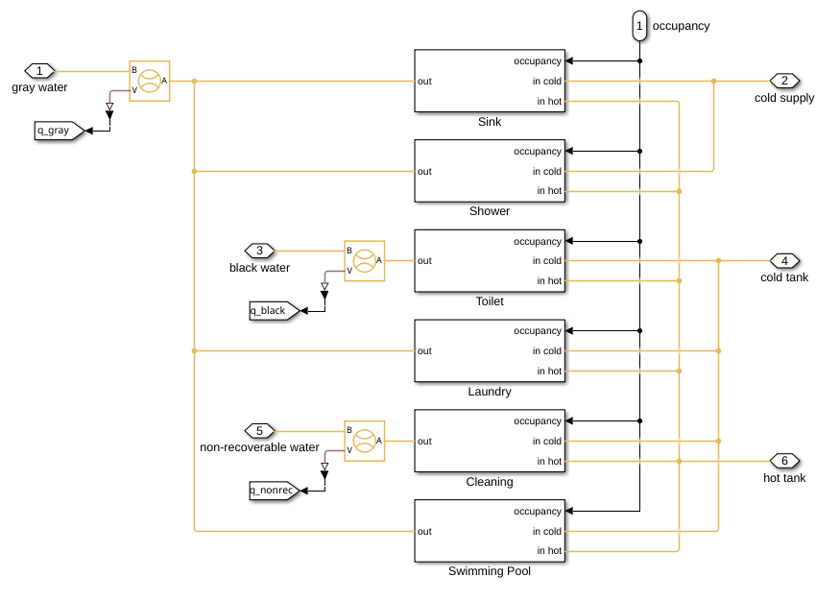
This example considers six types of water consumers: sink, shower, toilet, laundry, cleaning, and swimming pool. Cold water for the sink and shower comes directly from the external water supply, while cold water for the toilet, laundry, cleaning, and swimming comes from the treated cold water. Hot water for all consumers comes from the treated hot water. Wastewater from the sink, shower, laundry, and swimming pool is recovered as gray water. Wastewater from the toilet and cleaning is not recovered.
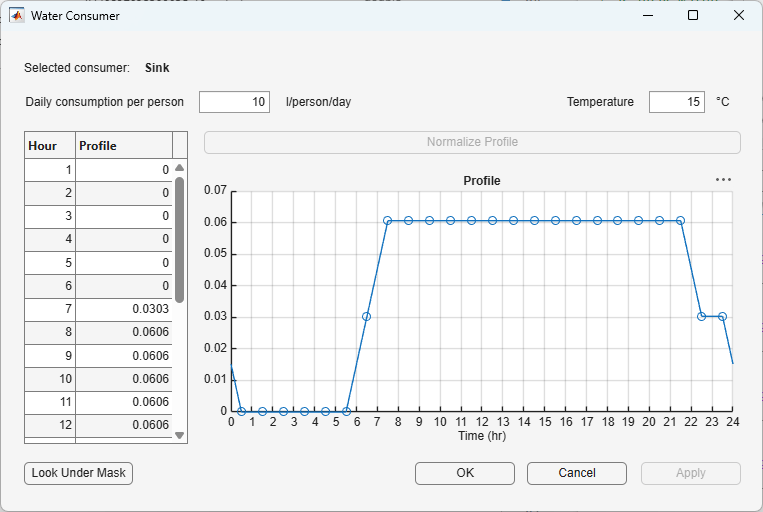
Each type of water consumer consumes water at a specified temperature. The amount consumed is based on a normalized consumption profile over the course of a day, multiplied by the daily water consumption per person. Double-clicking on one of the water consumers opens an app dialog created with App Designer where you can specify and visualize the consumption data.
Sink Subsystem
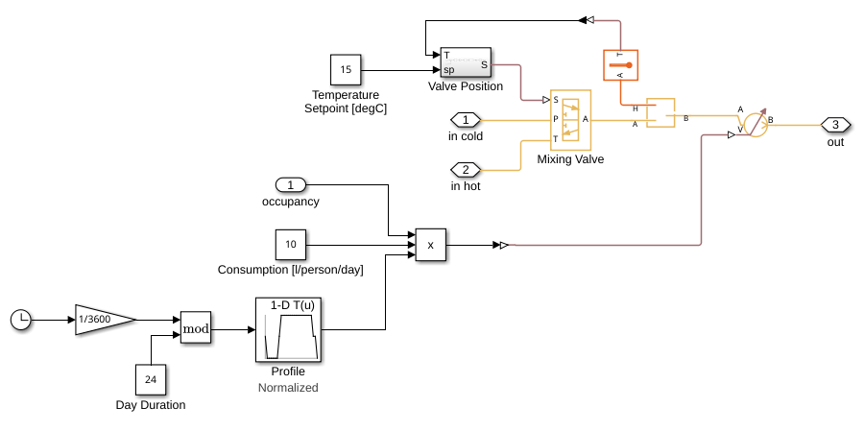
Water consumption is represented by the flow rate source that pulls in cold and hot water. A mixing valve determines the balance between cold and hot water based on the desired temperature setpoint.
The shower, toilet, laundry, cleaning, and swimming pool subsystems are the same as the sink subsystem.
Gray Water Filter Subsystem
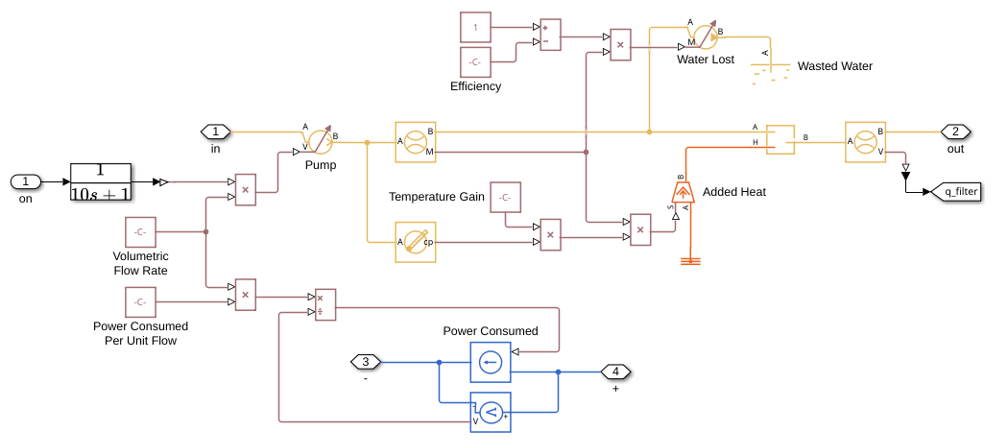
The gray water filter is modeled abstractly as a flow rate source with heat generation. The actual filtration process and water quality monitoring is not modeled.
Some water is lost during the process, as specified by the filter efficiency. The heat from the process is estimated to add about 2 K to the water temperature.
Electricity consumption is based on a conversion factor between flow rate and power.
Chiller Subsystem
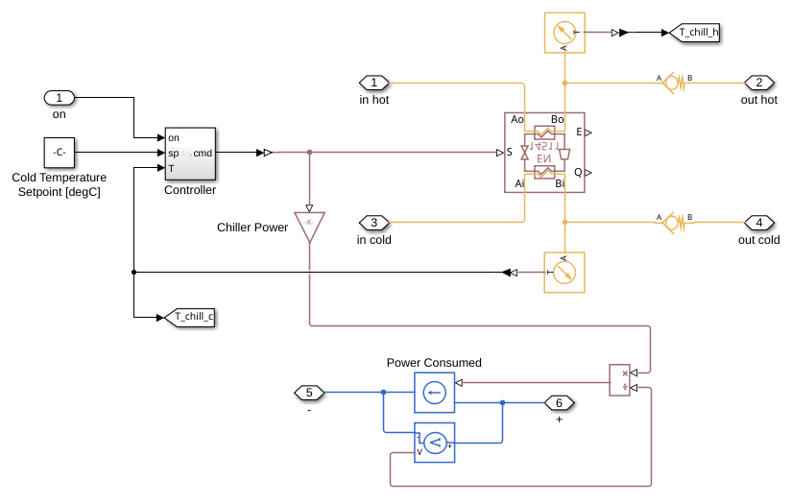
A 3-way valve separates the warm treated gray water into two streams prior to the chiller subsystem. The chiller is a refrigeration system that moves heat from one stream to the other, resulting in a cold treated water stream and a hot treated water stream.
The chiller is modeled with the EN14511 heat pump, which is based on the European standard EN 14511. The controller adjusts the chiller power to maintain a cold treated water temperature of 15 degC.
Battery Subsystem
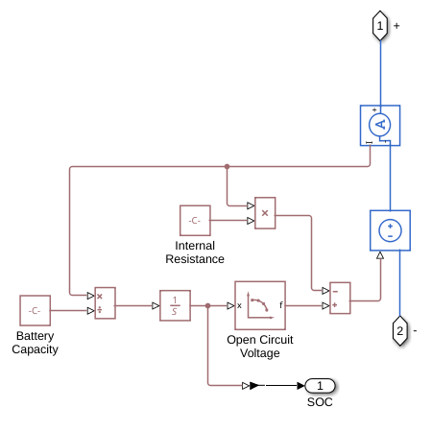
The battery is modeled abstractly as a source of voltage based on a tabulated open source voltage as a function of the state of charge and an internal resistance.
Charger Subsystem
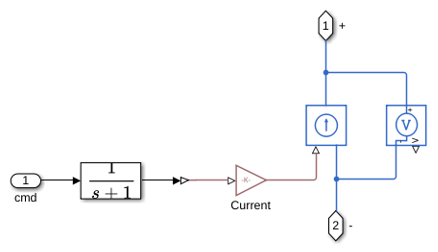
The charger is modeled abstractly as controlled current source that provides power when the battery state of charge falls below 50%.
Solar Panel Subsystem
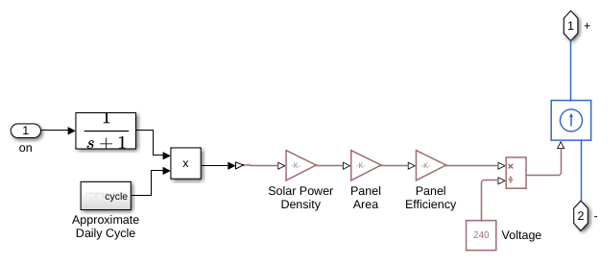
The solar panel is modeled abstractly as a current source based on the solar power density, modulated by a half sinusoidal function to represent the daily fluctuation.
Simulation Results from Scopes
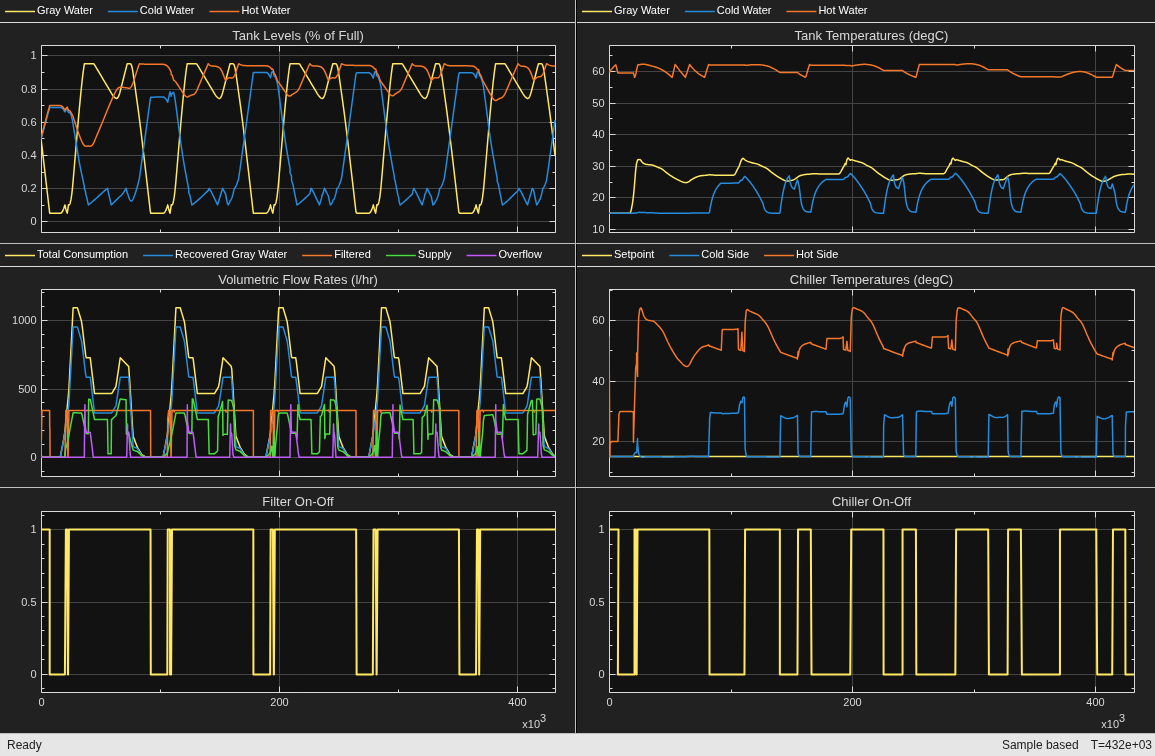
The scope shows the water tank levels, volumetric flow rates, water temperature in the tanks, and water temperature in the chiller outputs. It also shows the on-off status of the filter system and the chiller.
In this example, the tanks are undersized in order to trigger the filter system and the chiller to turn on and off periodically and to engage the overflow mechanism in the gray water tank. A more robust system would require larger tanks.
The supply volumetric flow rate indicates the amount of new water that the system requires, which is less than the total water consumption.
The hot water tank is maintained at around 60 degC. When the chiller turns on, it recovers enough heat from the treated gray water stream to produce treated hot water at around 50 to 60 degC. Therefore, the heater only needs to provide a relatively small amount of additional heat.
Simulation Results from Simscape Logging
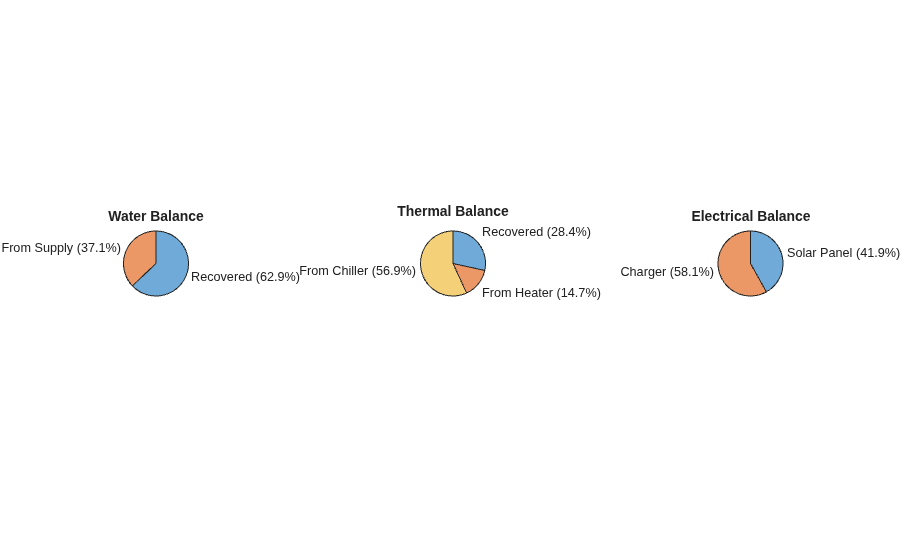
This figure shows the water, thermal, and electrical balance over the course of the simulation. The water balance pie chart shows that more than half of the water used is recovered. The thermal balance pie chart shows that the heater only needs to heat a small fraction of the hot water demanded by the consumers. A majority of the heat is recovered by the chiller. However, the chiller requires electricity to operate. The electrical balance pie chart shows that there is room to increase the solar panel proportion of the electrical power balance.
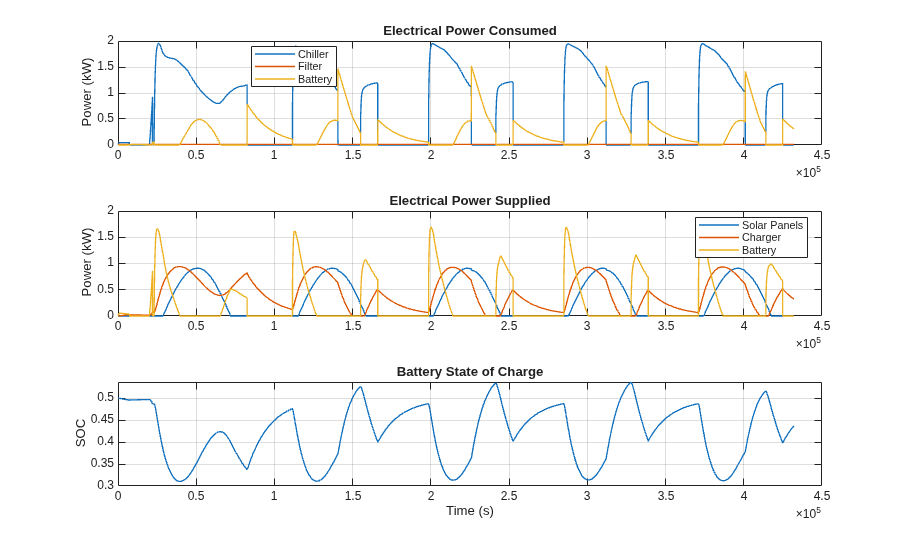
This figure plots the electrical power consumed, electrical power supplied, and the battery state of charge. The vast majority of the power consumed is due to the chiller operation. The battery also consumes power to recharge itself during peak solar periods and during periods when the chiller is off.
The battery supplies power to the system during the morning and evening periods when the solar panel is not producing power.