CT Integrator
R2026bCT Integrator block
To add a block to a model, double-click the canvas and start typing the block name. Then, select the block from the list.
Libraries:
Mixed-Signal Blockset /
ADC /
Building Blocks
Description
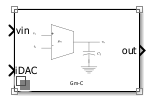
Use the CT Integrator block to accurately model the behavior of continuous-time delta-sigma modulators (CT DSMs). The block provides anti-aliasing benefits and supports higher bandwidth and lower power designs compared to its discrete-time counterpart. The block allows you to choose from three different implementation models: Gm-MC (OTA coupled with Miller capacitance), Gm-C (OTA-C integrator), and active-RC integrator.
To support realistic system‑level simulation, the block includes a range of practical circuit‑level non-idealities such as finite gain or bandwidth, pole-zero behavior, saturation, slew-rate limiting, distortion, and optional thermal and amplifier noises.
Ports
Input
Input voltage, specified as a scalar in V.
Dependencies
To enable this port, set the Type of integrator parameter
to Gm-C or Gm-MC.
Data Types: double
Input current from a DAC, specified as a scalar in A.
Dependencies
To enable this port, set the Type of integrator parameter
to Gm-C.
Data Types: double
Input voltage, specified as a scalar in V.
Dependencies
To enable this port, set the Type of integrator parameter
to Active-RC and Number of inputs
to 1, 2, or
3.
Data Types: double
Input voltage, specified as a scalar in V.
Dependencies
To enable this port, set the Type of integrator parameter
to Active-RC and Number of inputs
to 2 or 3.
Data Types: double
Input voltage, specified as a scalar in V.
Dependencies
To enable this port, set the Type of integrator parameter
to Active-RC and Number of inputs
to 3.
Data Types: double
Output
Integrator output voltage, returned as a scalar in V.
Data Types: double
Parameters
To edit block parameters interactively, use the Property Inspector. From the Simulink® Toolstrip, on the Simulation tab, in the Prepare gallery, select Property Inspector.
Integrator implementation model, specified as:
Gm-MC— Miller capacitance integrator with switchable poles, signal distortion, and optional thermal white noise.Gm-C— OTA‑C integrator with one or two-pole configuration, output saturation, signal distortion, and optional thermal noise.Active-RC— Active-RC integrator with fixed two-pole configuration, transistor-level effects, signal distortion, and amplifier and resistor noise.
Programmatic Use
Block parameter:
TypeofCTIntegrator |
| Type: character vector |
Values:
Gm-MC | Gm-C |
Active-RC |
Default:
Gm-C |
Data Types: char
Distortion mode, specified as:
| Distortion Mode | Integrator Type | Parameter Name | |
|---|---|---|---|
None | No nonlinearity model | Gm-C | distortionModegmC |
| Gm-MC | DistortionMode | ||
| Active-RC | distMode | ||
Large-signal | Saturation-based nonlinearity model | Gm-C | distortionModegmC |
| Saturation-based nonlinearity model | Gm-MC | DistortionMode | |
| Gain-compression and slew-rate based nonlinearity model | Active-RC | distMode | |
Small-signal | Polynomial nonlinearity model | Gm-C | distortionModegmC |
| Gm-MC | DistortionMode | ||
| Active-RC | distMode |
Programmatic Use
Block parameter:
distortionModegmC |
| Type: character vector |
Values:
None | Large-signal |
Small-signal |
Default:
Small-signal |
Data Types: char
Number of poles in the integrator transfer function. For Gm-C and Gm-MC type
integrators, you can switch the number of poles between
Single and Double. For the
active-RC integrator, the number of poles is fixed at two.
Dependencies
To enable this parameter, set Type of integrator to
Gm-C or Gm-MC.
Programmatic Use
Block parameter:
NumPole |
| Type: character vector |
Values:
Single | Double |
Default:
Single |
Location of the second parasitic pole when you select the double-pole model,
specified as a positive real scalar. For Gm-C type integrator, the default value is
1e5. For Gm-MC type integrator, the default value is
1e11.
Dependencies
To enable this parameter, set Type of integrator to
Gm-C or Gm-MC.
Programmatic Use
Block parameter:
HighFreqPolegmC | HighFreqPole |
| Type: character vector |
| Values: positive real scalar |
Default:
1e5 |
Data Types: double
Lower and upper output voltage clamp values, specified as a 2-element vector.
Dependencies
To enable this parameter, set Type of integrator to
Gm-C.
Programmatic Use
Block parameter:
OutputSatLim |
| Type: character vector |
| Values: 2-element vector |
Default:
[-5,5] |
Data Types: double
Option to include thermal noise in the integrator model. By default, this option is deselected.
Dependencies
To enable this parameter, set Type of integrator to
Gm-C.
Lower and upper input voltage clamp values for large-signal distortion, specified as a 2-element vector.
Dependencies
To enable this parameter, set Type of integrator to
Gm-C and Distortion mode to
Large-signal.
Programmatic Use
Block parameter:
InputSatLim |
| Type: character vector |
| Values: 2-element vector |
Default:
[-3,3] |
Data Types: double
Second-order polynomial distortion coefficient, specified as a real scalar.
Dependencies
To enable this parameter, set Type of integrator to
Gm-C or Gm-MC and
Distortion mode to
Small-signal.
Programmatic Use
Block parameter:
NonlinCoeff2gmC | NonlinCoeff2 |
| Type: character vector |
| Values: real scalar |
Default:
0 |
Data Types: double
Third-order polynomial distortion coefficient, specified as a real scalar.
Dependencies
To enable this parameter, set Type of integrator to
Gm-C or Gm-MC and
Distortion mode to
Small-signal.
Programmatic Use
Block parameter:
NonlinCoeff3gmC | NonlinCoeff3 |
| Type: character vector |
| Values: real scalar |
Default:
1e-3 | 1e-5 |
Data Types: double
Absolute temperature used to calculate the thermal noise power, specified as a positive real scalar.
Dependencies
To enable this parameter, set Type of integrator to
Gm-C or Gm-MC.
Programmatic Use
Block parameter:
OperatingTemp | OpTemp |
| Type: character vector |
| Values: positive real scalar |
Default:
300 |
Data Types: double
Sampling rate of the discrete noise source driving the continuous-time model, specified as a positive real scalar.
Dependencies
To enable this parameter, set Type of integrator to
Gm-C.
Programmatic Use
Block parameter:
SamplingFrequency |
| Type: character vector |
| Values: positive real scalar |
Default:
1e4 |
Data Types: double
OTA
Transconductance of the OTA setting in the integrator gain, specified as a positive real scalar.
Dependencies
To enable this parameter, set Type of integrator to
Gm-C.
Programmatic Use
Block parameter:
Transconductance |
| Type: character vector |
| Values: positive real scalar |
Default:
1e-3 |
Data Types: double
DC voltage gain of the transconductor, specified as a positive real scalar.
Dependencies
To enable this parameter, set Type of integrator to
Gm-C.
Programmatic Use
Block parameter:
DCVoltageGain |
| Type: character vector |
| Values: positive real scalar |
Default:
1e3 |
Data Types: double
Capacitance
Integration capacitance, specified as a positive real scalar. The block uses this value to determine the time-constant τ.
Dependencies
To enable this parameter, set Type of integrator to
Gm-C.
Programmatic Use
Block parameter:
IntegratorCap |
| Type: character vector |
| Values: positive real scalar |
Default:
5e-12 |
Data Types: double
Fractional random mismatch applied to the integrator capacitance, specified as a nonnegative real scalar.
Dependencies
To enable this parameter, set Type of integrator to
Gm-C.
Programmatic Use
Block parameter:
CapTolerance |
| Type: character vector |
| Values: nonnegative real scalar |
Default:
0.1 |
Data Types: double
Lower and upper output clamp values for the integrator, specified as a 2-element vector.
Dependencies
To enable this parameter, set Type of integrator to
Gm-MC.
Programmatic Use
Block parameter:
IntegrationLimits |
| Type: character vector |
| Values: 2-element vector |
Default:
[-5,5] |
Data Types: double
OTA transconductance for calculating the small-signal distortion coefficients, specified as a positive real scalar.
Dependencies
To enable this parameter, set Type of integrator to
Gm-MC and Distortion mode to
Small-signal.
Programmatic Use
Block parameter:
Gm |
| Type: character vector |
| Values: positive real scalar |
Default:
2e-4 |
Data Types: double
Positive output voltage clamp for the large-signal distortion model, specified as a positive real scalar in V.
Dependencies
To enable this parameter, set Type of integrator to
Gm-MC and Distortion mode to
Large-signal.
Programmatic Use
Block parameter:
VoltageLimPos |
| Type: character vector |
| Values: positive real scalar |
Default:
3 |
Data Types: double
Negative output voltage clamp for the large-signal distortion model, specified as a real scalar in V.
Dependencies
To enable this parameter, set Type of integrator to
Gm-MC and Distortion mode to
Large-signal.
Programmatic Use
Block parameter:
VoltageLimNeg |
| Type: character vector |
| Values: real scalar |
Default:
-3 |
Data Types: double
Option to include thermal noise in the integrator model. By default, this option is deselected.
Dependencies
To enable this parameter, set Type of integrator to
Gm-MC.
Amplifiers
Finite DC voltage gain of the OTA, specified as a positive real scalar.
Dependencies
To enable this parameter, set Type of integrator to
Gm-MC.
Programmatic Use
Block parameter:
DCGainOTA |
| Type: character vector |
| Values: positive real scalar |
Default:
10 |
Data Types: double
Finite DC voltage gain of the operational amplifier on the feedback path, specified as a positive real scalar.
Dependencies
To enable this parameter, set Type of integrator to
Gm-MC.
Programmatic Use
Block parameter:
DCGainOpAmp |
| Type: character vector |
| Values: positive real scalar |
Default:
100 |
Data Types: double
Unity gain bandwidth of the first and second amplifier stages, specified as a 2-element vector.
Dependencies
To enable this parameter, set Type of integrator to
Gm-MC.
Programmatic Use
Block parameter:
UnityGainBW |
| Type: character vector |
| Values: 2-element vector |
Default:
[1e3, 1e4] |
Data Types: double
Capacitance
Fractional mismatch of the parasitic capacitance from its nominal value, specified as a nonnegative real scalar.
Dependencies
To enable this parameter, set Type of integrator to
Gm-MC.
Programmatic Use
Block parameter:
EpsilonCapPar |
| Type: character vector |
| Values: nonnegative real scalar |
Default:
1e-2 |
Data Types: double
Fractional mismatch of the load capacitance from its nominal value, specified as a nonnegative real scalar.
Dependencies
To enable this parameter, set Type of integrator to
Gm-MC.
Programmatic Use
Block parameter:
EpsilonCapLoad |
| Type: character vector |
| Values: nonnegative real scalar |
Default:
1e-2 |
Data Types: double
Fractional mismatch in the ratio of integration capacitance to parasitic capacitance, specified as a nonnegative real scalar.
Dependencies
To enable this parameter, set Type of integrator to
Gm-MC.
Programmatic Use
Block parameter:
EpsilonCapRatio |
| Type: character vector |
| Values: nonnegative real scalar |
Default:
5e-2 |
Data Types: double
Number of signal input ports for the active-RC integrator. You can have between one and three input ports.
Dependencies
To enable this parameter, set Type of integrator to
Active-RC.
Programmatic Use
Block parameter:
numInputs |
| Type: character vector |
Values:
1 | 2 |
3 |
Default:
2 |
Data Types: double
Positive rail supply voltage, specified as a positive real scalar in V. The block uses this parameter to calculate the internal bias and swing limits.
Dependencies
To enable this parameter, set Type of integrator to
Active-RC.
Programmatic Use
Block parameter:
supplyVoltage |
| Type: character vector |
| Values: positive real scalar |
Default:
1.8 |
Data Types: double
Option to include amplifier noise for the active-RC integrator. By default, this option is deselected.
Dependencies
To enable this parameter, set Type of integrator to
Active-RC.
Second-order input polynomial distortion coefficient for the small-signal mode, specified as a real scalar
Dependencies
To enable this parameter, set Type of integrator to
Active-RC and Distortion mode to
Small-signal.
Programmatic Use
Block parameter:
secondOrderDistortionCoeff |
| Type: character vector |
| Values: real scalar |
Default:
0 |
Data Types: double
Third-order input polynomial distortion coefficient for the small-signal mode, specified as a real scalar
Dependencies
To enable this parameter, set Type of integrator to
Active-RC and Distortion mode to
Small-signal.
Programmatic Use
Block parameter:
thirdOrderDistortionCoeff |
| Type: character vector |
| Values: real scalar |
Default:
0 |
Data Types: double
Option to include resistor noise for the active-RC integrator. By default, this option is deselected.
Dependencies
To enable this parameter, set Type of integrator to
Active-RC.
Random number generator seed for the noise sources, specified as a positive real scalar
Dependencies
To enable this parameter, set Type of integrator to
Active-RC and either Enable amplifier
noise or Enable resistor noise parameter to
on.
Programmatic Use
Block parameter:
noiseSeed |
| Type: character vector |
| Values: positive real scalar |
Default:
123 |
Data Types: double
Sampling rate of the discrete noise source driving the continuous-time integrator, specified as a positive real scalar.
Dependencies
To enable this parameter, set Type of integrator to
Active-RC and either Enable amplifier
noise or Enable resistor noise parameter to
on.
Programmatic Use
Block parameter:
samplingFreq |
| Type: character vector |
| Values: positive real scalar |
Default:
1e-3 |
Data Types: double
Amplifier
Open loop DC gain of the operational amplifier, specified as a positive real scalar in dB.
Dependencies
To enable this parameter, set Type of integrator to
Active-RC.
Programmatic Use
Block parameter:
opAmpDCGain |
| Type: character vector |
| Values: positive real scalar |
Default:
80 |
Data Types: double
Frequency at which the op-amp gain drops to unity or 0 dB, specified as a positive real scalar in Hz.
Dependencies
To enable this parameter, set Type of integrator to
Active-RC.
Programmatic Use
Block parameter:
opAmpUnityGainBandwidth |
| Type: character vector |
| Values: positive real scalar |
Default:
500e6 |
Data Types: double
Maximum single-ended output voltage swing of the amplifier, specified as a nonnegative real scalar.
Dependencies
To enable this parameter, set Type of integrator to
Active-RC.
Programmatic Use
Block parameter:
maxOutputSwing |
| Type: character vector |
| Values: nonnegative real scalar |
Default:
1 |
Data Types: double
Phase margin at the unity gain frequency, specified as a positive real scalar in degrees. It affects the stability and pole placement.
Dependencies
To enable this parameter, set Type of integrator to
Active-RC.
Programmatic Use
Block parameter:
phaseMargin |
| Type: character vector |
| Values: positive real scalar |
Default:
60 |
Data Types: double
Maximum rate of change of the amplifier output voltage, specified as a positive real scalar.
Dependencies
To enable this parameter, set Type of integrator to
Active-RC.
Programmatic Use
Block parameter:
slewRate |
| Type: character vector |
| Values: positive real scalar |
Default:
4e11 |
Data Types: double
RC Network
Input resistor values for each integrator branch, specified as a scalar, a 2-element vector, or a 3-element vector.
Dependencies
To enable this parameter, set Type of integrator to
Active-RC.
Programmatic Use
Block parameter:
integratingRes |
| Type: character vector |
| Values: scalar | 2-element vector | 3-element vector |
Default:
[1e4, 1e4, 1e4] |
Data Types: double
RC time constant that sets the unity gain frequency, specified as a positive real scalar in seconds.
Dependencies
To enable this parameter, set Type of integrator to
Active-RC.
Programmatic Use
Block parameter:
integratorTimeConstants |
| Type: character vector |
| Values: positive real scalar |
Default:
5e-08 |
Data Types: double
Output load resistance of the second amplifier stage, specified as a positive real scalar.
Dependencies
To enable this parameter, set Type of integrator to
Active-RC.
Programmatic Use
Block parameter:
loadRes |
| Type: character vector |
| Values: positive real scalar |
Default:
5e3 |
Data Types: double
Parasitic capacitance at the amplifier input, specified as a nonnegative real scalar in F.
Dependencies
To enable this parameter, set Type of integrator to
Active-RC.
Programmatic Use
Block parameter:
parasiticInputCap |
| Type: character vector |
| Values: nonnegative real scalar |
Default:
1e-14 |
Data Types: double
Parasitic capacitance at the amplifier output, specified as a nonnegative real scalar in F.
Dependencies
To enable this parameter, set Type of integrator to
Active-RC.
Programmatic Use
Block parameter:
parasiticOutputCap |
| Type: character vector |
| Values: nonnegative real scalar |
Default:
1e-14 |
Data Types: double
Transistor Effects
MOSFET channel length modulation parameter, specified as a nonnegative real scalar. It affects the output resistance.
Dependencies
To enable this parameter, set Type of integrator to
Active-RC.
Programmatic Use
Block parameter:
channelLenModulation |
| Type: character vector |
| Values: nonnegative real scalar |
Default:
0.02 |
Data Types: double
Gate-to-source voltage above threshold for bias transistors, specified as a positive real scalar in V.
Dependencies
To enable this parameter, set Type of integrator to
Active-RC.
Programmatic Use
Block parameter:
gateODVoltage |
| Type: character vector |
| Values: positive real scalar |
Default:
0.3 |
Data Types: double
Minimum drain-to-source voltage to keep the current source transistors in saturation, specified as a positive real scalar.
Dependencies
To enable this parameter, set Type of integrator to
Active-RC.
Programmatic Use
Block parameter:
currentSourceSaturationVoltage |
| Type: character vector |
| Values: positive real scalar |
Default:
0.3 |
Data Types: double
Version History
Introduced in R2026b
MATLAB Command
You clicked a link that corresponds to this MATLAB command:
Run the command by entering it in the MATLAB Command Window. Web browsers do not support MATLAB commands.


选择网站
选择网站以获取翻译的可用内容,以及查看当地活动和优惠。根据您的位置,我们建议您选择:。
您也可以从以下列表中选择网站:
如何获得最佳网站性能
选择中国网站(中文或英文)以获得最佳网站性能。其他 MathWorks 国家/地区网站并未针对您所在位置的访问进行优化。
美洲
- América Latina (Español)
- Canada (English)
- United States (English)
欧洲
- Belgium (English)
- Denmark (English)
- Deutschland (Deutsch)
- España (Español)
- Finland (English)
- France (Français)
- Ireland (English)
- Italia (Italiano)
- Luxembourg (English)
- Netherlands (English)
- Norway (English)
- Österreich (Deutsch)
- Portugal (English)
- Sweden (English)
- Switzerland
- United Kingdom (English)