Amplifier
Complex baseband model of amplifier with noise

Description
The Amplifier block generates a complex baseband model of an amplifier with thermal noise. This block provides six methods for modeling nonlinearity and three ways to specify noise.
Note
This block assumes a nominal impedance of 1 ohm.
Examples
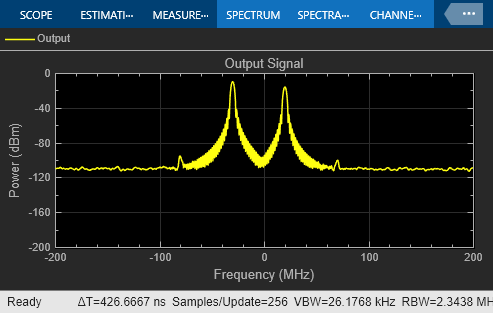
Intermodulation Analysis of Mathematical Amplifier
Uses a baseband-equivalent multitone signal as input to the Amplifier block. A Simulink® Slider Gain block enables you to vary the gain from 1 to 10.
Parameters
Algorithms
Use the Method parameter in the block dialog box to specify the method for modeling amplifier nonlinearity. The options for the Method parameter are
LinearCubic polynomialHyperbolic tangentSaleh modelGhorbani modelRapp model
The linear method is implemented by a Gain block. The other nonlinear methods are implemented by subsystems underneath the block's mask. Each subsystem has the same basic structure, as shown in the following figure.
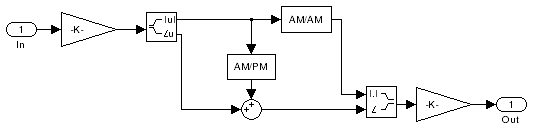
The subsystems for the nonlinear methods implement the AM/AM and AM/PM conversions differently, according to the nonlinearity method you specify. To see exactly how the Amplifier block implements the conversions for a specific method, you can view the AM/AM and AM/PM subsystems that implement these conversions as follows:
Right-click the Amplifier block.
In the View Mask row, pause on the arrow, and then click Look inside mask. This displays the block's configuration underneath the mask. The block contains five subsystems corresponding to the five nonlinearity methods.
Double-click the subsystem for the method in which you are interested. A subsystem displays similar to the one shown in the preceding figure.
Double-click one of the subsystems labeled AM/AM or AM/PM to view how the block implements the conversions.
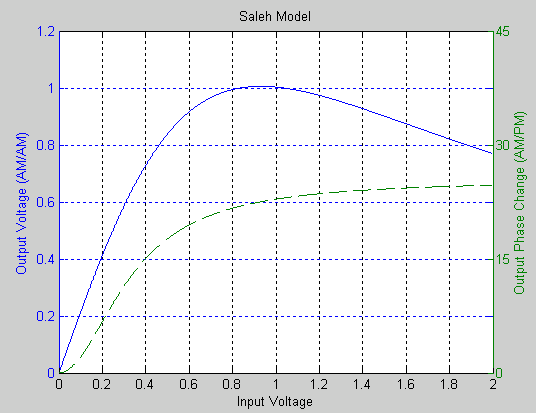
The following figure shows, for the Saleh method, plots of
Output voltage against input voltage for the AM/AM conversion
Output phase against input voltage for the AM/PM conversion
References
[1] Ghorbani, A. and M. Sheikhan, “The Effect of Solid State Power Amplifiers (SSPAs) Nonlinearities on MPSK and M-QAM Signal Transmission,” Sixth Int'l Conference on Digital Processing of Signals in Comm., 1991, pp. 193-197.
[2] Rapp, C., “Effects of HPA-Nonlinearity on a 4-DPSK/OFDM-Signal for a Digital Sound Broadcasting System,” in Proceedings of the Second European Conference on Satellite Communications, Liege, Belgium, Oct. 22-24, 1991, pp. 179-184.
[3] Saleh, A.A.M., “Frequency-independent and frequency-dependent nonlinear models of TWT amplifiers,” IEEE Trans. Communications, vol. COM-29, pp.1715-1720, November 1981.
Version History
Introduced before R2006a

