Dynamic Load
R2026bDynamic load for DC or AC supply
Dynamic Load block
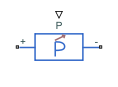
To add a block to a model, double-click the canvas and start typing the block name. Then, select the block from the list.
Libraries:
Simscape /
Electrical /
Passive
Description
The Dynamic Load block implements a dynamic load for a DC or AC supply.
If you set the Load type parameter to
DC:
The consumed power of the block is equal to the P port as long as it is greater than the value of the Minimum consumed power parameter and the voltage from the DC supply is equal to or greater than the value specified for the Minimum supply voltage parameter.
When the voltage from the DC supply drops below the Minimum supply voltage, the load behavior changes and the block acts as a resistive load. If the supply voltage becomes negative, the block acts as an open circuit conductance.
To ensure smooth transitions between these behaviors, the block uses a third-order polynomial spline with continuous derivatives. You can specify the width of this transition using the Transition voltage width parameter.
If you set the Load type parameter to AC,
this table shows how the block calculates the consumed active and reactive power based
on the voltage from the supply, V.
| Range of V Values | Consumed Active and Reactive Power |
|---|---|
| The block models a load with an impedance equal to: |
In these equations:
Vmin is the value of the Minimum supply voltage (RMS) parameter.
Pin is the input active power of the Dynamic Load block, determined by external input port P.
Pactual is the consumed active power of the Dynamic Load block.
Qin is the input reactive power of the Dynamic Load block, determined by external input port Q.
Qactual is the consumed reactive power of the Dynamic Load block.
The Dynamic Load block consumes or generates active power depending on the polarity of input active power Pin. If Pin is greater than 0, the block consumes active power. If Pin is less than 0, the block generates active power.
Faults
To model a fault in the Dynamic Load block, in the Faults section, click Add fault next to the fault that you want to model. For more information about fault modeling, see Fault Behavior Modeling and Fault Triggering.
The Dynamic Load block allows you to model an electrical fault as an open circuit. The block can trigger fault events at a specific time.
Load-Flow Analysis
If the block is in a network that is compatible with the frequency-time simulation mode, you can perform a load-flow analysis on the network. A load-flow analysis provides steady-state values that you can use to initialize a machine.
For more information, see Perform a Load-Flow Analysis Using Simscape Electrical and Frequency and Time Simulation Mode.
Assumptions and Limitations
The Dynamic Load block reports thermal dissipation using DQ-averaged quantities but the
energy accounting framework computes port power instantaneously. The block uses a
harmonic estimator that integrates the supply voltage over one full cycle of the rated
frequency to extract the voltage amplitude. This integration window fills after
approximately the reciprocal of the rated frequency plus the voltage time constant. When
you set the Load type parameter to AC
and get energy information for this block using the getEnergyInfo function, the energy accounting results are inaccurate
during this initial transient period. Once the estimator converges, the ports and
external energy align on a cycle-averaged basis and the results are accurate at steady
state. To reduce the duration of the inaccuracy, set the Rated
frequency parameter to a larger value. When you set the Load
type parameter to DC, energy accounting is
accurate at all times.

