主要内容

Circuit Breaker (Three-Phase)

Three-phase circuit breaker controlled by external signal
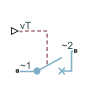
  • Circuit Breaker (Three-Phase) block

Libraries:
Simscape / Electrical / Switches & Breakers

Description

The Circuit Breaker (Three-Phase) block models a three-phase circuit breaker that uses an external signal and phase current information to break an electrical circuit.

The table shows how the external signal vT and the Breaker Behavior parameter control the block behavior.

ConditionBlock BehaviorResistance Parameter Used
vT < ThresholdThe breaker is closed. Each phase in the composite three-phase port ~1 connects to the corresponding phase in the port ~2.Closed Resistance
vT ThresholdOpen when current crosses zero after vT >= Threshold

When the current in any phase of the composite port ~1 crosses zero, the phase disconnects from the corresponding phase at port ~2. The breaker is open.

Open Conductance
Open when vT >= ThresholdThe breaker is open.

Examples

Ports

Input

expand all

Scalar physical signal control port.

Dependencies

To enable this port, set the Control port parameter to PS.

Conserving

expand all

Electrical conserving port representing the three phases of side 1. For more information, see Three-Phase Ports.

Dependencies

To enable this port, set the Electrical connection parameter to Composite three-phase ports.

Electrical conserving port representing the three phases of side 2. For more information, see Three-Phase Ports.

Dependencies

To enable this port, set the Electrical connection parameter to Composite three-phase ports.

Electrical conserving port associated with the phase a of side 1.

Dependencies

To enable this port, set the Electrical connection parameter to Expanded three-phase ports.

Electrical conserving port associated with the phase b of side 1.

Dependencies

To enable this port, set the Electrical connection parameter to Expanded three-phase ports.

Electrical conserving port associated with the phase c of side 1.

Dependencies

To enable this port, set the Electrical connection parameter to Expanded three-phase ports.

Electrical conserving port associated with the phase a of side 2.

Dependencies

To enable this port, set the Electrical connection parameter to Expanded three-phase ports.

Electrical conserving port associated with the phase b of side 2.

Dependencies

To enable this port, set the Electrical connection parameter to Expanded three-phase ports.

Electrical conserving port associated with the phase c of side 2.

Dependencies

To enable this port, set the Electrical connection parameter to Expanded three-phase ports.

Positive electrical conserving port.

Dependencies

To enable this port, set the Control port parameter to Electrical.

Negative electrical conserving port.

Dependencies

To enable this port, set the Control port parameter to Electrical.

Parameters

expand all

Since R2026a

Whether to model composite or expanded three-phase ports.

Composite three-phase ports represent three individual electrical conserving ports with a single block port. You can use composite three-phase ports to build models that correspond to single-line diagrams of three-phase electrical systems.

Expanded three-phase ports represent the individual phases of a three-phase system using three separate electrical conserving ports.

Programmatic Use

To set the block parameter value programmatically, use the set_param function.

Parameter: port_option
Values: "ee.enum.threePhasePort.composite" (default) | "ee.enum.threePhasePort.expanded"

Since R2026a

Option to choose between a physical signal input port, vT, or electrical conserving ports, + and -.

Programmatic Use

To set the block parameter value programmatically, use the set_param function.

Parameter: control_port_option
Values: "ee.enum.controlport.ps" (default) | "ee.enum.controlport.elec"

Resistance between ports ~1 and ~2 when the breaker is closed.

Conductance between ports ~1 and ~2 when the breaker is open.

Threshold voltage for the control port vT. The block uses the threshold voltage and the value of vT at the start of the simulation to determine whether the breaker is initially open or closed. If you set Breaker Behavior to Open when current crosses zero after vT >= Threshold, when the voltage rises above the threshold, the breaker opens each phase as its current crosses zero. If you set Breaker Behavior to Open when vT >= Threshold, the breaker opens each phase as soon as the voltage rises above the threshold. When the control port voltage falls below the threshold, the breaker closes.

Breaker Behavior when the value at the control port vT is greater than or equal to the value of the Threshold parameter. The breaker can open either as soon as the voltage rises above the threshold, or when its current also crosses zero.

Extended Capabilities

expand all

C/C++ Code Generation
Generate C and C++ code using Simulink® Coder™.

Version History

Introduced in R2013b

expand all