sinc
R2026b归一化正弦函数
语法
描述
示例
创建符号变量 x 的 sinc 函数。
syms x
sinc(x)
ans =
证明 sinc 在输入为 0 时返回 1,在输入为其他整数时返回 0,在输入为其他值时返回精确的符号值。
V = sym([-1 0 1 3/2]);
S = sinc(V)
S =
使用 vpa 将精确的符号输出转换为高精度浮点数。
vpa(S)
ans =
尽管 sinc 可能出现在傅里叶变换表中,但 fourier 不会在输出中返回 sinc。
证明脉冲的 fourier 变换可以用 sin 和 cos 表示。
syms x
fourier(rectangularPulse(x))
ans =
证明 sinc 的 fourier 变换可以用 heaviside 表示。
fourier(sinc(x))
ans =
使用 fplot 绘制正弦函数。
syms x
fplot(sinc(x))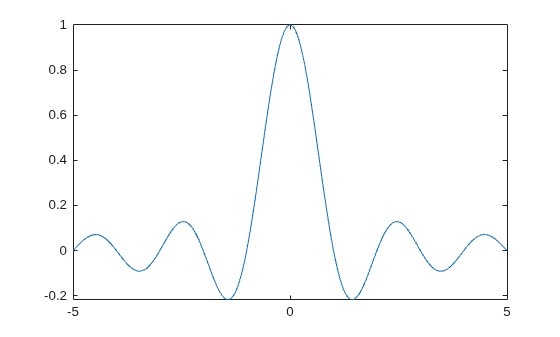
使用 rewrite 将 sinc 函数重写为指数函数 exp。
syms x
rewrite(sinc(x),'exp')
ans =
分别使用函数 diff、int 和 taylor 对 sinc 进行求导、积分和展开。
对 sinc 求导。
syms x
diff(sinc(x))
ans =
计算 sinc 从 -Inf 到 Inf 的积分。
int(sinc(x),[-Inf Inf])
ans =
计算 sinc 从 -Inf 到 x 的积分。
int(sinc(x),-Inf,x)
ans =
求 sinc 的泰勒展开式。
taylor(sinc(x))
ans =
将恒等式定义为一个条件,并使用 isAlways 函数来检查该条件,从而证明该恒等式。
证明恒等式 。
syms x
cond = sinc(x) == 1/(gamma(1+x)*gamma(1-x));
isAlways(cond)
ans = logical
1
输入参数
版本历史记录
在 R2018b 中推出

