pat2cwav
R2026bBuild wavelet from pattern
Description
[
returns an admissible wavelet psi,xval,nc] = pat2cwav(ypat,method,poldegree,regularity)psi for the continuous wavelet transform
(CWT) adapted to the pattern ypat. The wavelet psi is
evaluated at xval, a regular grid in the interval [0,1], and has
L2-norm equal to 1.
The constant nc is such that nc×psi approximates
ypat on the interval [0,1] by least-squares fitting using the method
specified by method, and a polynomial of degree
poldegree with boundary constraints specified by
regularity.
Examples
This example illustrates how to generate a new wavelet starting from a pattern.
The principle for designing a new wavelet for CWT is to approximate a given pattern using least-squares optimization under constraints leading to an admissible wavelet well suited for the pattern detection using the continuous wavelet transform [1].
Load and plot a pattern.
load ptpssin1
plot(X,Y)
grid on
title('Original Pattern')
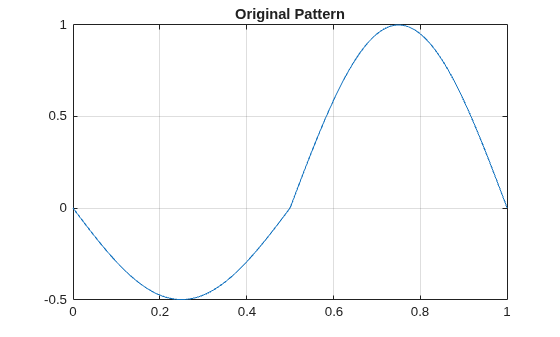
Integrate the pattern over the interval. The integral does not equal 0. However, the pattern is a good candidate since it oscillates like a wavelet.
dX = X(2)-X(1);
patternInt = dX*sum(Y);
disp(['Integral: ',num2str(patternInt)]);
Integral: 0.15915
To synthesize a new wavelet adapted to the given pattern, use a least-squares polynomial approximation of degree 6 with constraints of continuity at the beginning and the end of the pattern.
[psi,xval,nc] = pat2cwav(Y,'polynomial',6,'continuous');
Plot the new wavelet.
plot(X,Y,'-',xval,nc*psi,'--')
grid on
legend('Original Pattern','Adapted Wavelet','Location','NorthWest')
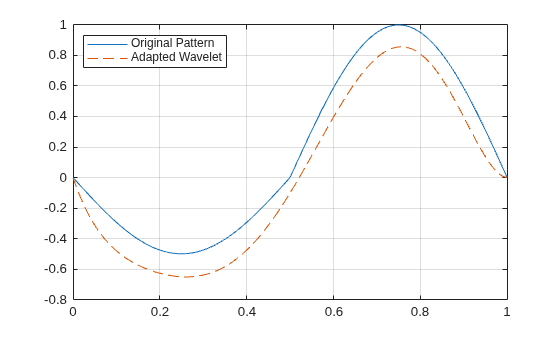
Check that psi satisfies the definition of a wavelet by confirming that it integrates to zero and has norm is equal to 1.
dxval = xval(2)-xval(1);
psiIntegral = dxval*sum(psi);
disp(['Integral: ',num2str(psiIntegral)])
Integral: 1.9626e-05
psiSqN = dxval*sum(psi.^2);
disp(['L2-norm: ',num2str(psiSqN)])
L2-norm: 1
Input Arguments
Output Arguments
References
[1] Misiti, M., Y. Misiti, G. Oppenheim, and J.-M. Poggi. Les ondelettes et leurs applications. France: Hermes Science/Lavoisier, 2003.

