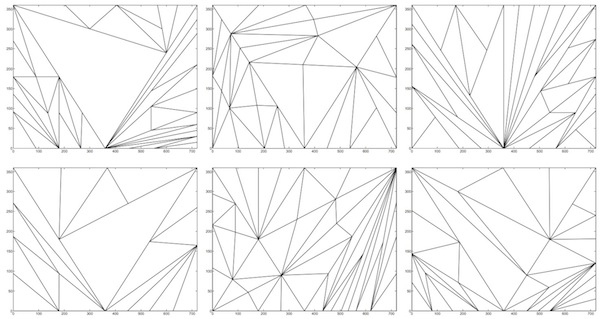
Here a specific generative algorithm, known as cellular division or an L-system, is used as an abstraction layer between a genetic algorithm genotype and phenotype. This approach is applied to the design of a structural truss. For each given truss topology, the optimal size problem is solved using sequential linear programming based on a finite element analysis model. Advantages include the ability to explore trusses with a variety of dimensions using a fixed-dimension genotype, and the automatic generation of designs that satisfy truss stability requirements.
The code is supplementary material for the following publication:
James T. Allison, Ashish Khetan, Danny Lohan. 'Managing Variable-Dimension Structural Optimization Problems using Generative Algorithms.' In the Proceedings of the 10th World Congress on Structural and Multidisciplinary Optimization. May 19–May 24 2013.
which can be obtained by going to:
http://systemdesign.illinois.edu/publications/All13c.pdf
Please see the readme file for usage details.
引用格式
James Allison (2026). Truss Design Optimization Based on Generative Algorithms (https://ww2.mathworks.cn/matlabcentral/fileexchange/41780-truss-design-optimization-based-on-generative-algorithms), MATLAB Central File Exchange. 检索时间: .
| 版本 | 已发布 | 发行说明 | Action |
|---|---|---|---|
| 1.0.0.0 |
