Operational Modal Analysis using NEXT-LSCE algorithm

版本 1.0.4 (10.3 MB) 作者: Baptiste Chomette
Operational modal analysis using Natural Excitation Technique (NEXT) coupled to the Linear Square Complex Exponential (LSCE) method
573.0 次下载
更新时间 2020/4/25

查看许可证

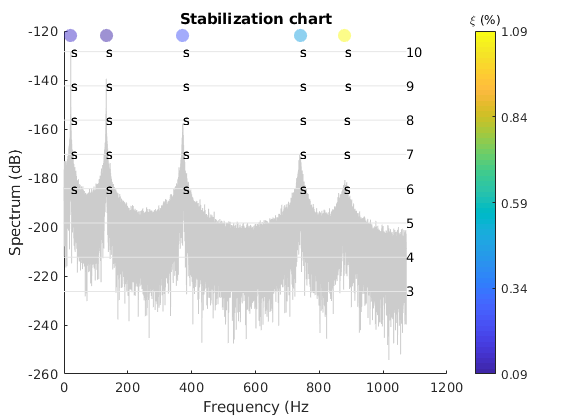
LSCE_NEXT permits to identify modal parameters (frequency and modal damping) using the Natural Excitation Technique (NEXT) coupled to the Linear Square Complex Exponential (LSCE) method. This operational modal analysis algorithm is based only on sensors measurements and requires at least three sensors. This method is well adapted for multiple degrees of freedom systems in the case of white noise or ambient excitation particularly when the excitation cannot be measured. The choice of the identification order and the selection of the physical poles are assisted by a stabilization chart using frequency and damping convergence criteria. For more information, run the example file 'LSCE_NEXT_file_test.m'.

Some works using the proposed function can be found in the following references:
* B. Chomette and J-L. Le Carrou, Operational modal analysis applied to the concert harp, Mechanical Systems and Signal Processing 56, 81-91, 2015.
* J-L. Le Carrou, A. Paté and B. Chomette, Influence of the instrumentalist on the dynamics of the electric guitare, Journal of the Acoustical Society of America 146 (5), 3123-3130, 2019

引用格式

Baptiste Chomette (2026). Operational Modal Analysis using NEXT-LSCE algorithm (https://ww2.mathworks.cn/matlabcentral/fileexchange/73489-operational-modal-analysis-using-next-lsce-algorithm), MATLAB Central File Exchange. 检索时间: .

MATLAB 版本兼容性
创建方式 R2018b
兼容任何版本
平台兼容性
Windows macOS Linux
类别
Help CenterMATLAB Answers 中查找有关 Vibration Analysis 的更多信息
版本 已发布 发行说明
1.0.4

The function add_poles.m has been added to add poles to the stabilization chart using round marker with color
proportional to the modal damping factor.

1.0.3

A few corrections in the description

1.0.2

Some corrections in the description.

1.0.1

New description

1.0.0