Simulate Ear Drum
R2026bIn this example, you model the response of an average human ear incorporating the lumped element impedance of both the eardrum and a portion of the ear canal.
The model in this example follows the IEC 60318-4 Standard (formerly IEC 60711), which defines the typical human ear response up to 10 kHz. It can be integrated with other acoustic models to simulate physical measurement conditions, such as testing inserted earbuds.
In consumer audio device evaluations, fixtures that replicate human hearing are often used, and this model provides a more accurate response.
Ear Drum Equivalent Circuit
Open the ear drum simulator model. This model shows the equivalent circuit of the ear drum impedance using basic acoustic elements (resistances, compliances, and inertances).
model = "EarDrumSimulator";
open_system(model);

sim(model,1);
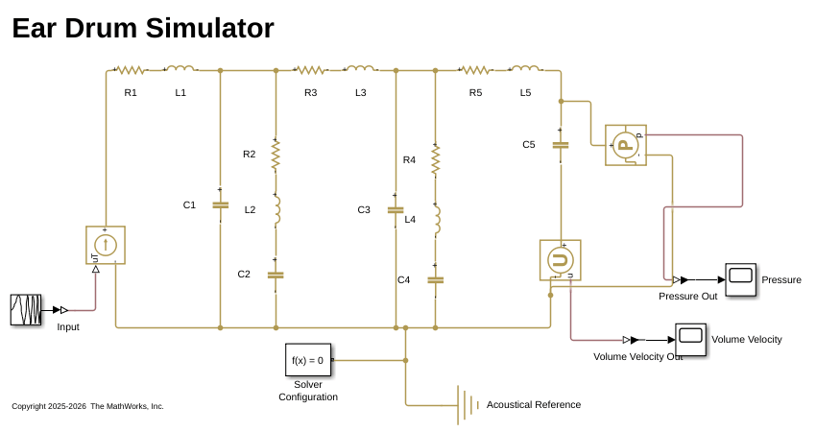
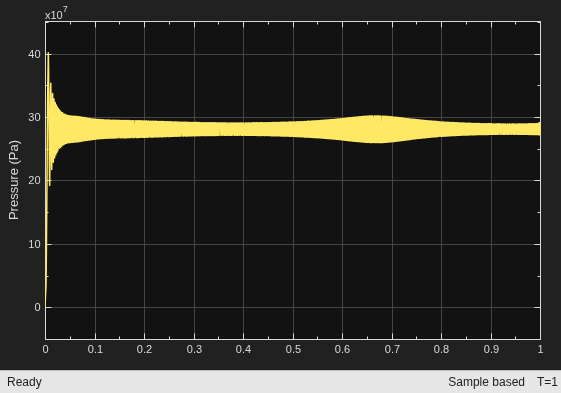
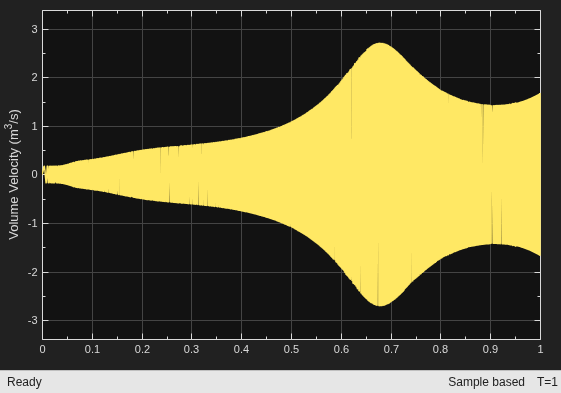
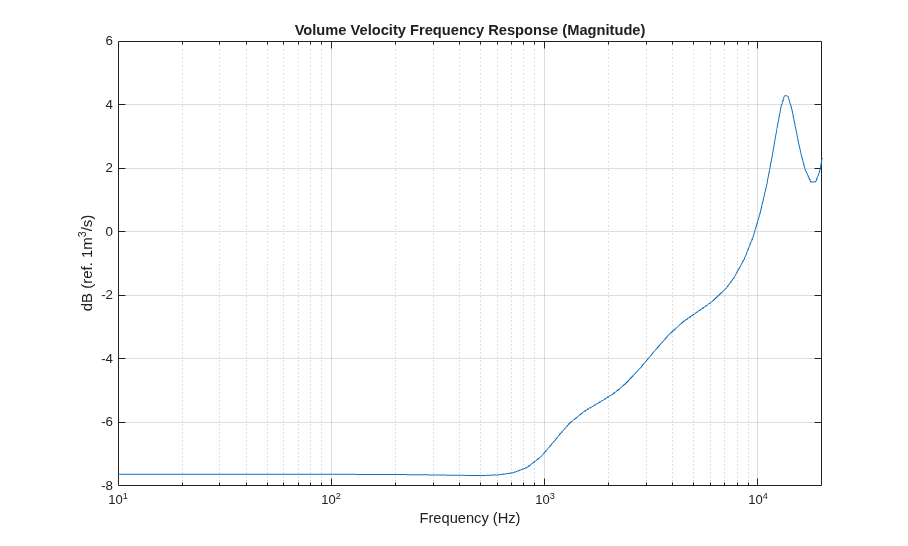
This model applies a flow source as the input so that the volume velocity plot in the linearized response is the shape of the impedance response. The output pressure is measured across the compliance labeled "C5".
Each RLC branch is intended to model the resonance frequencies in the human hearing system. The default values are directly employed from the references. Together, they simulate the response that fits the IEC60318-4 Standard limits.
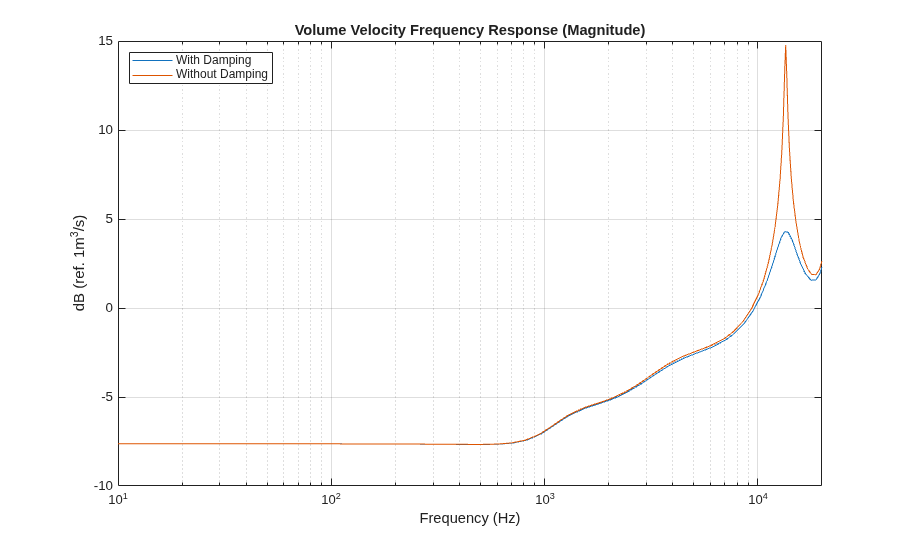
Note that R1, R3, R5 are usually not included. Their purpose is to smooth the resonance response around 13.5kHz, which is not specified by the IEC standard. The damped response is more realistic compared to measured response.
Ear Drum Block Model
The Ear Drum Impedance block from the Simscape Acoustics library encapsulates the entire equivalent circuit shown above into a single block. This simplifies the model while providing the same functionality.
bdclose(model);
model = "EarDrumSimulatorBlock";
open_system(model);
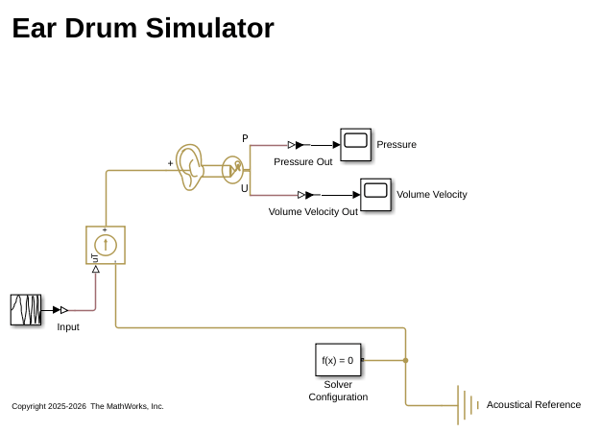
The Ear Drum Impedance block accepts the same parameters as the individual R, L, C components in the equivalent circuit model. Additionally, the block provides parameters to enable or disable the optional damping resistances (R1, R3, R5) without needing to comment blocks through.
Linearize Model
This example sets the input perturbation point and output measurement point for analysis to be done in the frequency domain instead of time domain. Extracting the real time simulation outputs and performing Fourier Transform also returns similar results. In this example, the volume velocity plot is observed.
Set the model linearizing points.
io(1) = linio(model + "/Chirp Signal", 1, "input");
io(2) = linio(model + "/Volume Velocity Out", 1, "output");
Use the linearize function to linearize the model and the bode function to extract the magnitude, phase, and frequency information.
linsys = linearize(model, io);
[mag, ~, wout] = bode(linsys);
freq = wout./(2*pi);
Plot the results.
figure(1)
semilogx(freq, 10*log10(mag(:)));
xlim([10 20e3]);
title("Volume Velocity Frequency Response (Magnitude)");
xlabel("Frequency (Hz)");
ylabel("dB (ref. 1m^3/s)");
grid on
hold on
Remove Damping
As mentioned in the previous section, most literature and simulations do not include the additional damping, namely R1, R3, and R5. The Ear Drum Impedance block allows disabling these resistances by setting the damping parameters to false.
earDrum = model + "/Ear Drum Impedance";
set_param(earDrum, "damping1", "false");
set_param(earDrum, "damping3", "false");
set_param(earDrum, "damping5", "false");
Rerun the model to compare the results.
linsys = linearize(model, io);
[mag, ~, wout] = bode(linsys);
freq = wout./(2*pi);

semilogx(freq, 10*log10(mag(:)));
xlim([10 20e3]);
title("Volume Velocity Frequency Response (Magnitude)");
xlabel("Frequency (Hz)");
ylabel("dB (ref. 1m^3/s)");
legend("With Damping", "Without Damping", 'Location','northwest');
grid on
hold on
Close the system.
bdclose(model)
References
[1] C. Gazzola, V. Zega, A. Corigliano, P. Lotton, and M. Melon, "Lumped-parameters equivalent circuit for piezoelectric MEMS speakers modeling," 2023, doi:10.61782/fa.2023.0485.
[2] C. Gazzola, V. Zega, A. Corigliano, P. Lotton, and M. Melon, "A reduced-order-model-based equivalent circuit for piezoelectric micro-electro-mechanical-system loudspeakers modeling," Journal of the Acoustical Society of America, vol. 155, pp. 1503-1514, 2024, doi:10.1121/10.0024939.
Copyright 2025-2026 The MathWorks, Inc.
See Also
Ear Canal with Ear Drum | Ear Drum Impedance | bodelinearize

