HuygensMTF
R2026bDescription
Add-On Required: This feature requires the Optical Design and Simulation Library for Image Processing Toolbox add-on.
A HuygensMTF object stores a wave-optics modulation transfer
function (MTF) result for one field point in an optical system. A Huygens MTF is computed
from a Huygens point spread function (PSF), including diffraction and phase effects. Use a
Huygens MTF when the optical system operates near the diffraction limit or when wave-optics
effects are important.
Creation
Create a HuygensMTF object by using the mtf object
function of an opticalSystem
object. To return a HuygensMTF object, specify the
Method name-value argument as "Huygens".
Properties
Object Functions
contrastAtFrequency | Compute MTF contrast at spatial frequencies |
frequencyAtContrast | Compute spatial frequency at MTF contrast level |
show | Plot analysis result |
Examples
Load the sample Double Gauss lens system using zmximport.
opsys = zmximport("DoubleGaussLens.zmx");Compute the Huygens MTF across all default system field points and wavelengths. Set the Method name-value argument to "Huygens" to enable wave-optics propagation modeling.
mtfr = mtf(opsys, Method="Huygens")mtfr = 1×3 HuygensMTF array with properties:
Tangential
Sagittal
FieldPoint
Wavelengths
FFTLength
Because mtfr is an array of objects, access a single field point by its index before querying nested structural data. Extract the tangential spatial frequency and its corresponding multi-wavelength contrast matrix for the first field point.
% Isolate the MTF result object for the first field point (e.g., on-axis field)
targetFieldMTF = mtfr(1);

% Access the nested properties of the single result object
spatialFreqTan = targetFieldMTF.Tangential.SpatialFrequency;
tangentialMTF  = targetFieldMTF.Tangential.MTF;
Load the sample Double Gauss lens system using zmximport. Compute the Huygens MTF across all preconfigured field points in the system. Set MaximumFrequency to 150 cycles/mm to restrict the evaluation domain, and specify an FFTLength of 512 to achieve denser, high-resolution frequency sampling for smoother curve rendering.
opsys = zmximport("DoubleGaussLens.zmx");
mtfr = mtf(opsys, Method="Huygens", MaximumFrequency=150, FFTLength=512);
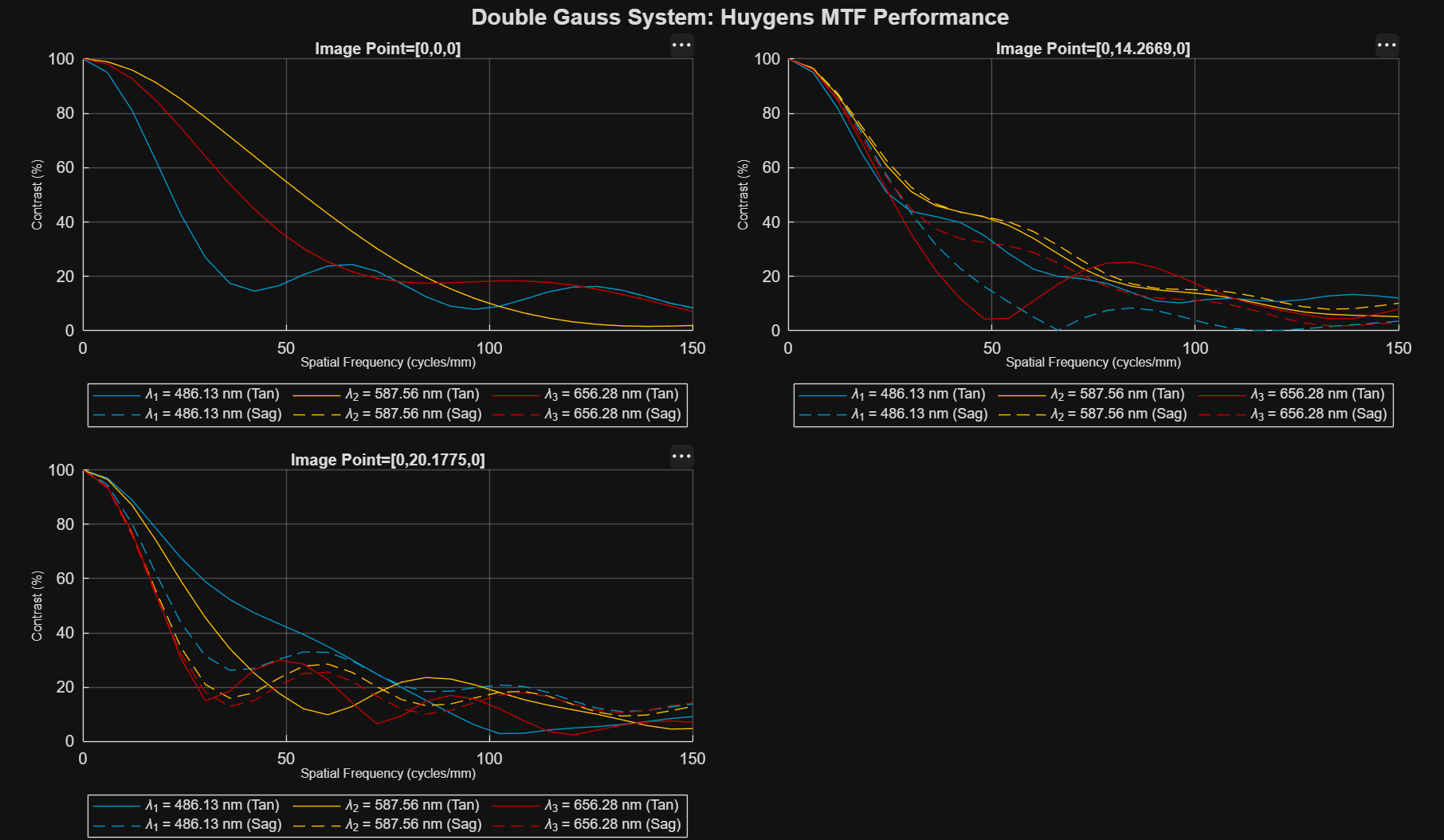
Visualize the complete spatial frequency performance using the show method. Because mtfr contains data for multiple field points, the function automatically generates a tiled layout with linked axes, displaying one subplot per field point.
hMTF = show(mtfr);
hMTF.Title = "Double Gauss System: Huygens MTF Performance";
hMTF.Grid = "major";
More About
Version History
Introduced in R2026b
See Also
mtf | GeometricMTF | psf | HuygensPSF | contrastAtFrequency | frequencyAtContrast | opticalSystem | fieldPoint | MTFChart

