WiFi UDP Receive
R2026bReceive data from UDP host on wireless network
WiFi UDP Receive block
To add a block to a model, double-click the canvas and start typing the block name. Then, select the block from the list.
Libraries:
Simulink Support Package for Arduino Hardware /
WiFi
Description
Add-On Required: This feature requires the Simulink Support Package for Arduino Hardware add-on.
The WiFi UDP Receive block receives data from a UDP host on a wireless network. At each sample time, the block outputs data as a vector of the size specified in the Data size (N) parameter. The block receives data on the port number specified in the Local IP Port parameter. Match the port number specified in the Local IP Port parameter with the remote port number on the sending host.
The block supports reception of both fixed and variable-length UDP packets. The block also supports blocking mode, allowing you to wait for incoming UDP data up to a specified timeout.
Note
If you are having trouble using UDP to communicate with a computer, antivirus or firewall software might be blocking UDP traffic. If so, configure the software to allow the traffic for a specific IP port number.
You can run a model containing WiFi UDP Receive block in connected IO mode on Arduino® boards.
For more information about the fixed ports and the allocated pins for the block, see Pin Mapping for Arduino Timer-Independent Blocks.
Supported Hardware
You can use the WiFi UDP Receive block only with the following hardware:
ESP8266
WiFi Shield
MKR1000
MKR WIFI 1010
Nano 33 IoT
ESP32–S3 series (Arduino compatible)
ESP32–WROOM (Arduino compatible)
ESP32–WROVER (Arduino compatible)
Limitations
When using ESP8266 hardware, a model can have only one of these blocks: WiFi TCP/IP Receive, WiFi TCP/IP Send, WiFi UDP Send, WiFi UDP Receive block.
The maximum number of connections allowed for different ports on WiFi UDP Receive and WiFi TCP/IP Send blocks in a model is two for WiFi shield, four for boards with on-board Wi-Fi®, and one for ESP8266. If the model uses external mode over Wi-Fi or includes a WiFi ThingSpeak Read or WiFi ThingSpeak Write block, one UDP port is reserved for each from the maximum allowed connections.
Ports
Output
Parameters
More About
The WiFi UDP Receive block can operate in either blocking mode or non-blocking mode, depending on whether Enable blocking mode is selected.
This flow chart summarized how the block decides when to output data, when to hold the previous data values, and how the Status port reflects packet availability at the Data port.
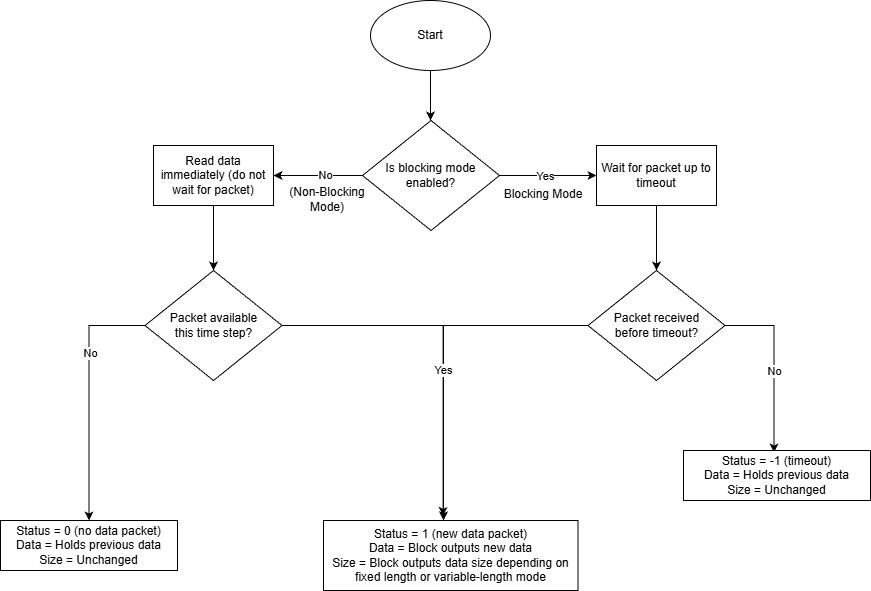
Non-Blocking Mode — The block does not wait for UDP data. At each time step, it immediately checks if a packet is available.
If a packet is available, the block outputs the new packet and sets Status to
1.If no packet is available, the block holds the previous data and sets Status to
0.
Blocking Mode — The block waits for a packet to arrive for up to the duration specified in Timeout (ms).
If a packet arrives before the timeout, the block outputs data and sets Status to
1.If no packet arrives before the timeout, the block holds the previous data, sets Status to
-1, completes the step.
This section explains the values at the output ports, with the following block parameters specified as:
| Block Parameter | Value |
|---|---|
| Data type | uint8 |
| Enable variable length data | off |
| Data size (N) | 4 |
The values at the output ports vary depending on whether the length of the data received is less than, greater than, or equal to the length of requested data.
Length of UDP message received = Data size (N)
The Data port outputs data as a vector of the size specified in the Data size (N) parameter. The Size port outputs the number of data bytes received.
Suppose that the length of the data received is 4. In this case, the Data port outputs a data vector of size 4. The Size port outputs
4.
Length of UDP message received < Data size (N)
The Data port outputs data as a vector of the size specified in the Data size (N) parameter. All the empty spaces in the vector are filled with zeros. The Size port outputs the number of data bytes received (excluding zeros added to fill the vector).
Suppose that the length of data received is 3. In this case, the Data port outputs a data vector of size 4. The first three values in the vector are the bytes from the received data. The remaining space is filled with zero. The Size port outputs
4.
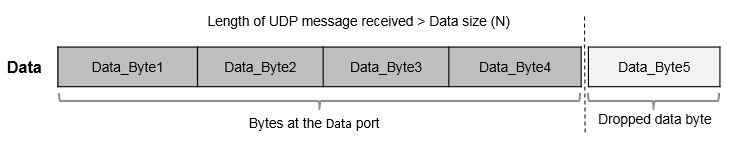
Length of UDP message received > Data size (N)
The Data port outputs a data vector of the size specified in the Data size (N) parameter. The vector contains only the first N bytes from the received data. The remaining data bytes are dropped. The Size port outputs the number of data bytes received (including the output data bytes and the dropped data bytes).
Suppose that the length of data received is 5. In this case, the Data port outputs a data vector of size 4. The vector contains only the first 4 bytes from the received data. The remaining data byte is dropped. The Size port outputs
4.