CompactRegressionEnsemble
R2026bCompact regression ensemble
Description
CompactRegressionEnsemble is a compact version of a
regression ensemble. The compact version does not include the data used to train the
regression ensemble. Therefore, you cannot perform some tasks, such as cross-validation,
using the compact regression ensemble. Use a compact regression ensemble to make
predictions for new data.
Creation
Create a CompactRegressionEnsemble object from a full RegressionEnsemble or RegressionBaggedEnsemble model object by using the compact
object function.
Properties
Object Functions
gather | Gather properties of Statistics and Machine Learning Toolbox object from GPU |
lime | Local interpretable model-agnostic explanations (LIME) |
loss | Regression error for regression ensemble model |
partialDependence | Compute partial dependence |
plotPartialDependence | Create partial dependence plot (PDP) and individual conditional expectation (ICE) plots |
predict | Predict responses using regression ensemble model |
predictorImportance | Estimates of predictor importance for regression ensemble of decision trees |
removeLearners | Remove members of compact regression ensemble |
shapley | Shapley values |
Examples
Create a compact regression ensemble for efficiently making predictions on new data.
Load the carsmall data set. Consider a model that explains a car's fuel economy (MPG) using its weight (Weight) and number of cylinders (Cylinders).
load carsmall
X = [Weight Cylinders];
Y = MPG;
Train a boosted ensemble of 100 regression trees using the default LSBoost method. Specify that Cylinders is a categorical variable.
Mdl = fitrensemble(X,Y,PredictorNames=["W","C"], ...
    CategoricalPredictors=2)
Mdl =
  RegressionEnsemble
           PredictorNames: {'W'  'C'}
             ResponseName: 'Y'
    CategoricalPredictors: 2
        ResponseTransform: 'none'
          NumObservations: 94
               NumTrained: 100
                   Method: 'LSBoost'
             LearnerNames: {'Tree'}
     ReasonForTermination: 'Terminated normally after completing the requested number of training cycles.'
                  FitInfo: [100×1 double]
       FitInfoDescription: {2×1 cell}
           Regularization: []


  Properties, Methods
Mdl is a RegressionEnsemble model object that includes the training data.
Create a compact version of Mdl.
CMdl = compact(Mdl)
CMdl =
  CompactRegressionEnsemble
           PredictorNames: {'W'  'C'}
             ResponseName: 'Y'
    CategoricalPredictors: 2
        ResponseTransform: 'none'
               NumTrained: 100


  Properties, Methods
CMdl is a CompactRegressionEnsemble model object. CMdl is similar to Mdl, but does not store the training data.
Compare the amount of memory used by Mdl and CMdl.
mdlInfo = whos("Mdl");
cMdlInfo = whos("CMdl");
[mdlInfo.bytes cMdlInfo.bytes]
ans = 1×2

      511340      485035
Mdl uses more memory than CMdl.
CMdl.Trained stores the trained regression trees (CompactRegressionTree model objects) that compose Mdl.
Display a graph of the first tree in the compact ensemble.
view(CMdl.Trained{1},Mode="graph");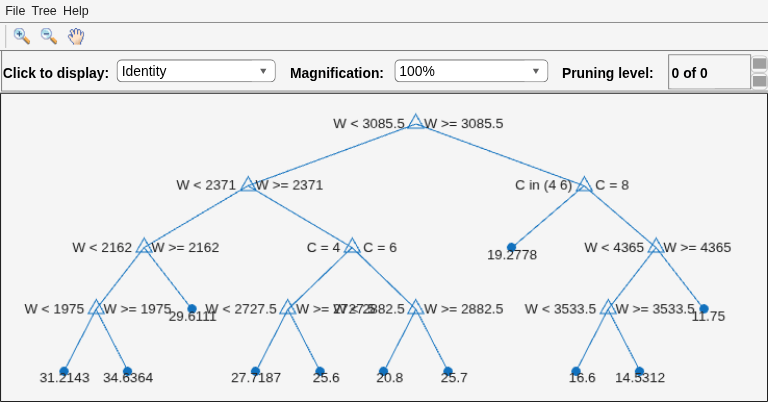
By default, fitrensemble grows shallow trees for boosted ensembles of trees.
Predict the fuel economy of a typical car using the compact ensemble.
typicalX = [mean(X(:,1)) mode(X(:,2))];
predMeanX = predict(CMdl,typicalX)
predMeanX =
26.2520
Tips
For a compact ensemble of regression trees
Mdl, theTrainedproperty contains a cell vector ofMdl.NumTrainedCompactRegressionTreemodel objects. For a textual or graphical display of treetin the cell vector, enterview(Mdl.Trained{t})
Extended Capabilities
Version History
Introduced in R2011a
See Also
fitrensemble | RegressionEnsemble | RegressionBaggedEnsemble | predict | compact | templateTree | view

