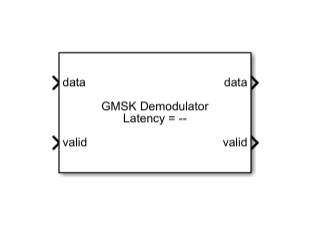
GMSK Demodulator
Libraries:
Wireless HDL Toolbox /
Modulation
Description
The GMSK Demodulator block demodulates Gaussian minimum shift keying (GMSK) modulated symbols to a set of log-likelihood ratio (LLR) values or data bits. The block accepts complex data symbols and outputs demodulated LLR values or data bits. The block accepts scalar and vector inputs and returns a scalar output. The block interface and architecture are suitable for HDL code generation and hardware deployment.
You can implement GMSK demodulation in systems where efficient bandwidth and power usage are essential, as GMSK modulation is specifically designed to address these requirements. By integrating a GMSK demodulator into such a system, you enable the receiver to take advantage of the modulation’s spectral and power efficiency, ensuring accurate recovery of transmitted data. You can use this block in applications such as global system for mobile communications (GSM), Bluetooth, and satellite communications, where optimizing resources is critical.
Examples

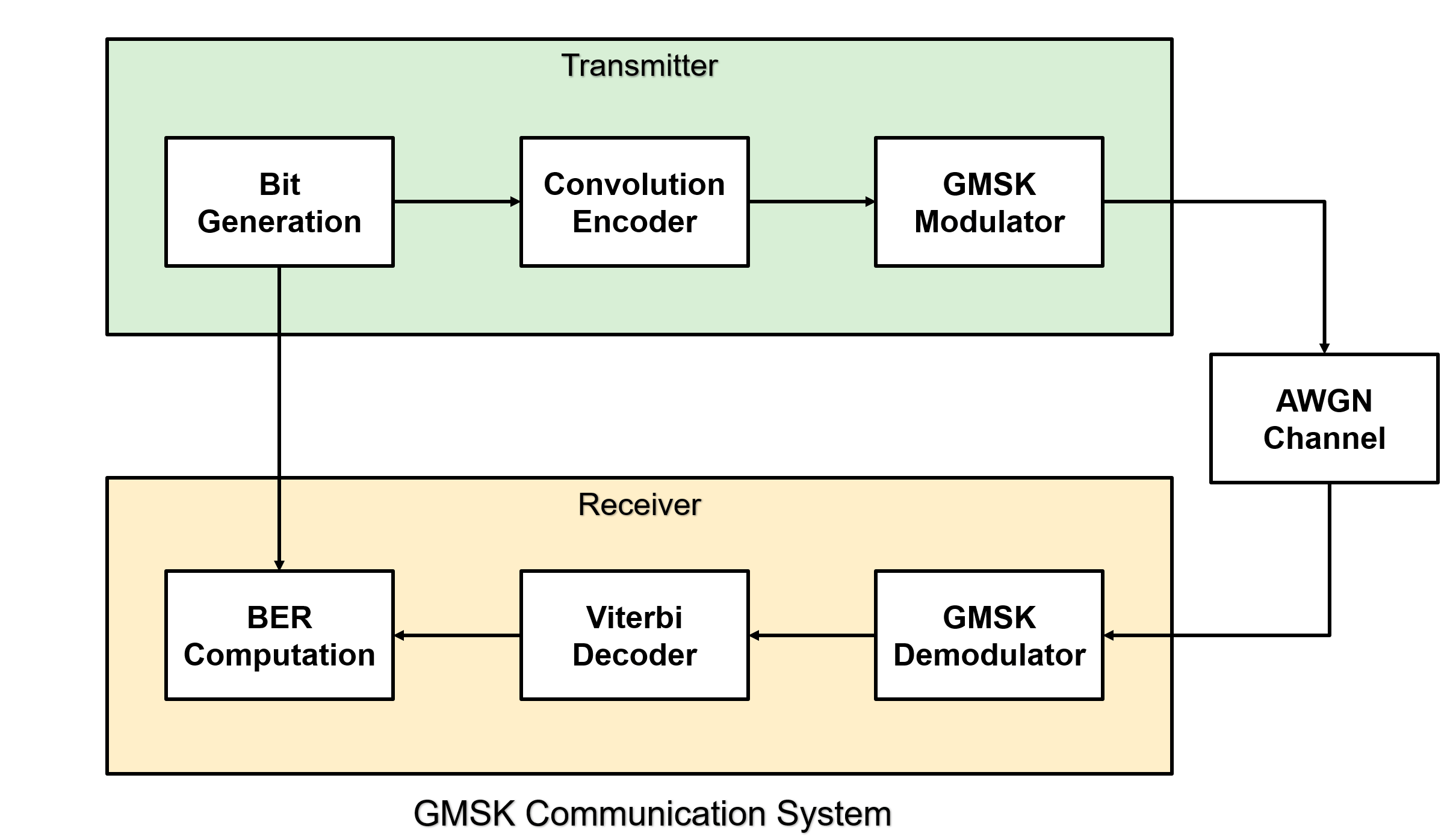
Recover Data Bits with GMSK Modulation and Demodulation
Convert data bits into modulated symbols and then recover the original bits through demodulation.
- Since R2026a
- Open Script
Accelerate BER Simulations of GMSK System Using FPGA-in-the-Loop Workflow
Accelerate BER simulations of GMSK system using FPGA-in-loop workflow.
- Since R2026a
- Open Live Script
Ports
Input
Data symbols, specified as a complex scalar or as a complex column vector. For vector inputs, the vector size must be equal to the number of samples per symbol.
The block supports double and single data
types for simulation but not for HDL code generation. For HDL code generation, the
input data type must be fixdt(1, WL, FL) with word length
WL and fraction length FL not equal to zero.
The maximum output word length the block supports is 32 bits.
Data Types: single | double | fixed point
Complex Number Support: Yes
Signal to indicate valid input data, specified as a Boolean
scalar.
This control signal at this port indicates when the sample from the
data input port is valid. When the value at this port is
1, the block captures the values on the data
input port. When the value at this port is 0, the block ignores the
values on the data input port.
Data Types: Boolean
Signal to clear internal states, specified as a Boolean scalar.
When the value at this port is 1, the block stops the current
calculation and clears all internal states.
Dependencies
To enable this port, select the Enable reset input port parameter.
Data Types: Boolean
Output
Output data bits, returned as a real scalar of LLR values or data bits.
When you set the Decision type parameter to
Soft, the output is a scalar of LLR values. For soft-decision type, the output word length depends on the pulse length and the number of samples per symbol.When you set the Decision type parameter to
Hard, the output is a scalar of data bits.
Data Types: single | double | signed fixed point
Signal to indicate valid output data, returned as a scalar.
This port is a control signal that indicates when the data
output port is valid. When the value at this port is 1, the output
data samples are available on the data output port.
Data Types: Boolean
Parameters
To edit block parameters interactively, use the Property Inspector. From the Simulink® Toolstrip, on the Simulation tab, in the Prepare gallery, select Property Inspector.
Product of the signal bandwidth and symbol time for the Gaussian pulse shape, specified as a positive scalar value.
Pulse length, specified as a positive integer in the range from 1 to 8. The pulse length parameter specifies the duration of the Gaussian pulse shape measured in symbol intervals.
Symbol prehistory, specified as a scalar or vector of –1s or 1s. The block uses the symbol prehistory before the start of the simulation to estimate the most likely sequence of transmitted data.
For a scalar value, the block expands it to a vector of length L – 1, where L represents the pulse length. You can specify the L value using the Pulse length (symbol intervals) parameter.
For example, if you specify a scalar value
-1and set the Pulse length (symbol intervals) parameter to4, the block expands this value as[-1 -1 -1].For a vector value, the block considers the elements in the vector in a reverse chronological order. The vector length must be L – 1.
For example, if you specify a vector input of
[-1 1 1]and set the Pulse length (symbol intervals) parameter to4, the block considers this value as[1 1 -1].
Phase offset of the modulated waveform in radians, specified as a numeric scalar in the range from –2*π to 2*π.
Number of samples per symbol, specified as a positive integer in the range 1 to 8. The number of samples per symbol represents the upsampling factor from input samples to output samples.
Traceback depth, specified as a positive integer. The traceback depth specifies the number of trellis branches that the maximum-a-posteriori (MAP) decoding algorithm uses to construct each traceback path.
For GMSK, the number of correlative states is equal to 2L – 1 and there are four phase states, which are 0, π/2, π, 3π/2. Here, L is the pulse length. For a pulse length of 3, you compute the total number of states as 4 × 2L – 1, which equals 16.
Decision type, specified as Soft or
Hard.
When you set the Decision type parameter to
Soft, the output is a scalar of LLR values.When you set the Decision type parameter to
Hard, the output is a scalar of data bits.
Select this parameter to enable the reset input port.
Algorithms
The GMSK Demodulator block uses either hard or soft-decision techniques. Hard demodulation makes a firm choice for each received symbol, while soft demodulation provides likelihood information that enhances error correction, especially in noisy environments. For narrowband, low-throughput systems where GMSK is commonly used, soft demodulation offers significant performance advantages. It typically relies on sequence estimation algorithms such as the soft Viterbi or maximum-a-posteriori (MAP) decoding. Among these, MAP decoding is preferred over the soft output Viterbi algorithm (SOVA) due to its superior error-correcting capability. This block implements the max-log-MAP variant, which achieves an effective balance between computational complexity and decoding accuracy, making it well-suited for hardware-based systems.
To compute soft log-likelihood ratios (LLRs) using the Max-Log-MAP algorithm, calculate and store branch metrics (γ), forward metrics (α), and reverse metrics (β).
Branch Metric Calculation: You compute the branch metrics γ according to the following equation:
Forward Metric Calculation: Next, you use the γ values to compute the forward metrics α as follows:
You initialize α with:
Reverse Metric Calculation: To calculate the reverse metrics β, you store the γ values and access them as needed:
Log-Likelihood Ratio Calculation: You then calculate the LLR from the stored α and γ values, along with the computed β values:
You can further simplify this calculation as:
Here, S0 and S1 represent the sets of state transitions corresponding to bit 0 and bit 1, respectively.
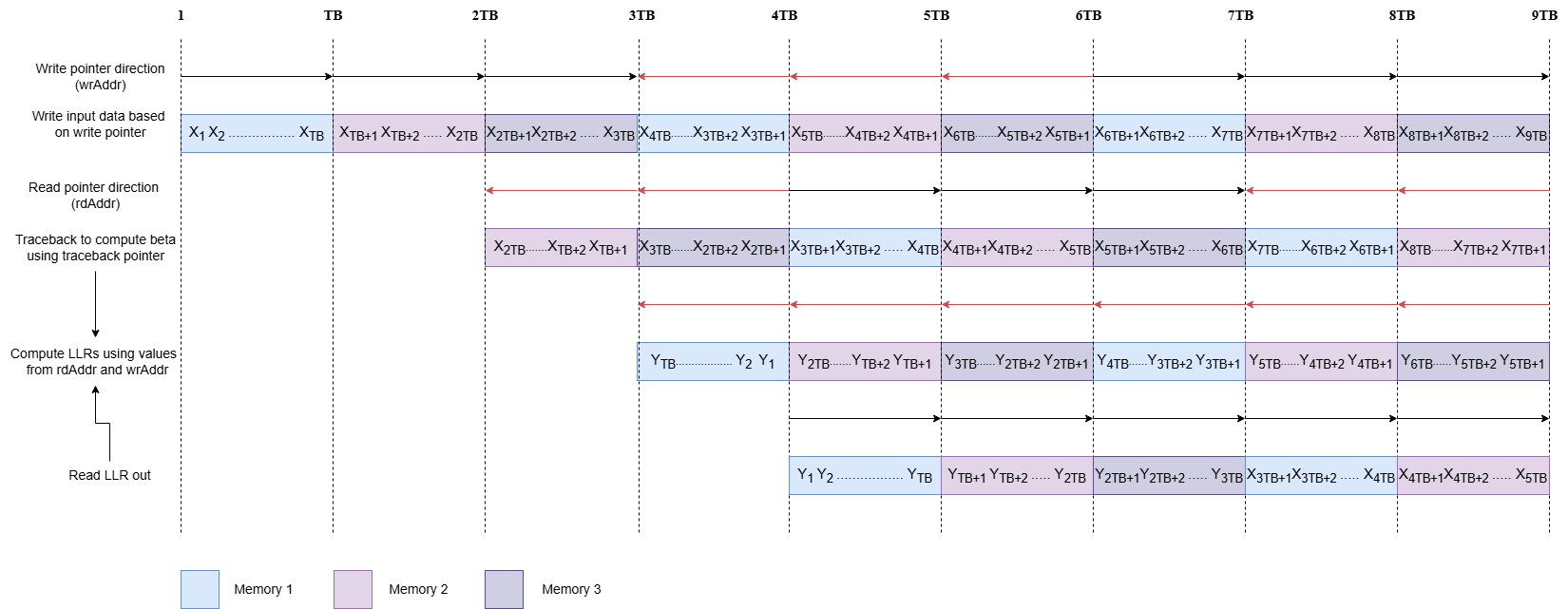
To ensure that these computations work efficiently, you must store both γ and α values according to the specified traceback depth. To optimize hardware efficiency, you implement the K-pointer algorithm, where K is the number of read pointers required in the algorithm. You allocate three memory blocks, each sized according to the traceback depth, to store the input data. You perform the traceback operation to compute the β values required for LLR computation. This approach allows you to read and write in reverse order based on the pointer and the demodulator state, which conserves memory resources.
The following figure illustrates the process of writing, reading, and performing traceback across different input windows during data decoding. While you encounter an initial latency of 4TB cycles, the output data stream is continuous thereafter, ensuring that throughput remains unaffected.
For more information about K-pointer algorithm, see Algorithms.
This approach enables efficient and reliable soft LLR computation in hardware implementations of the Max-Log-MAP algorithm. Hard-decision bit values are defined by rounding the LLR outputs resulting from soft-decision decoding.
The latency of the block varies with the pulse length, traceback depth, and the input size.
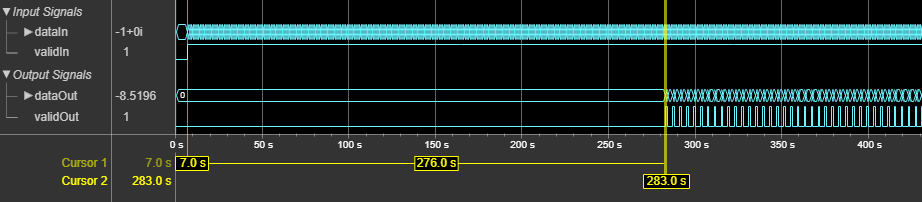
This figure shows a sample output and latency of the GMSK Demodulator block for a scalar input with default configuration. The latency of the block is 276 clock cycles.
This figure shows a sample output and latency of the GMSK Demodulator block for a vector input with default configuration. The latency of the block is 84 clock cycles.
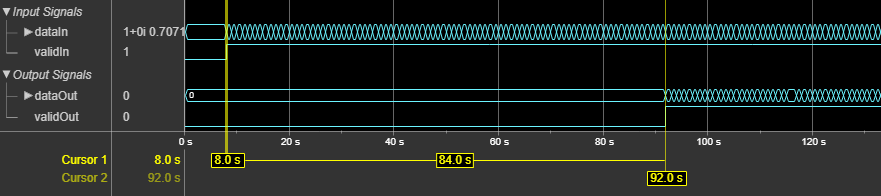
The performance of the synthesized HDL code varies with your target and synthesis options. It also varies based on the pulse length, traceback depth, and the input size.
This table shows the resource and performance data synthesis results of the block for a 4-by-1 vector input and a scalar input, respectively, in the default configuration. The generated HDL code targets to the AMD® Zynq® UltraScale+™ MPSoC - ZCU102 Evaluation Board.
| Input Type | CLB LUTs | CLB Registers | DSPs | Block RAMs | Maximum Frequency in MHz |
|---|---|---|---|---|---|
| Scalar | 6228 | 3631 | 12 | 0 | 272.33 |
| Vector (4-by-1) | 6947 | 4461 | 39 | 0 | 272.33 |
References
[1] Anderson, John B., Tor Aulin, and Carl-Erik Sundberg. Digital Phase Modulation. New York: Plenum Press, 1986.
Extended Capabilities
This block supports C/C++ code generation for Simulink accelerator and rapid accelerator modes and for DPI component generation.
HDL Coder™ provides additional configuration options that affect HDL implementation and synthesized logic.
This block has one default HDL architecture.
| ConstrainedOutputPipeline | Number of registers to place at
the outputs by moving existing delays within your design. Distributed
pipelining does not redistribute these registers. The default is
|
| InputPipeline | Number of input pipeline stages
to insert in the generated code. Distributed pipelining and constrained
output pipelining can move these registers. The default is
|
| OutputPipeline | Number of output pipeline stages
to insert in the generated code. Distributed pipelining and constrained
output pipelining can move these registers. The default is
|
| SynthesisAttributes |
Specifies the synthesis attributes for the blocks and block output signals in the model. The generated HDL code contains these attributes. For more information, see SynthesisAttributes (HDL Coder). |
You cannot generate HDL for this block inside a Resettable Synchronous Subsystem (HDL Coder).
Version History
Introduced in R2026a
MATLAB Command
You clicked a link that corresponds to this MATLAB command:
Run the command by entering it in the MATLAB Command Window. Web browsers do not support MATLAB commands.
选择网站
选择网站以获取翻译的可用内容,以及查看当地活动和优惠。根据您的位置,我们建议您选择:。
您也可以从以下列表中选择网站:
如何获得最佳网站性能
选择中国网站(中文或英文)以获得最佳网站性能。其他 MathWorks 国家/地区网站并未针对您所在位置的访问进行优化。
美洲
- América Latina (Español)
- Canada (English)
- United States (English)
欧洲
- Belgium (English)
- Denmark (English)
- Deutschland (Deutsch)
- España (Español)
- Finland (English)
- France (Français)
- Ireland (English)
- Italia (Italiano)
- Luxembourg (English)
- Netherlands (English)
- Norway (English)
- Österreich (Deutsch)
- Portugal (English)
- Sweden (English)
- Switzerland
- United Kingdom (English)