主要内容

wlanUHRELRConfig

R2026b

Configure Wi-Fi 8 enhanced long range transmission

Since R2026b

Description

The wlanUHRELRConfig object is a configuration object for the WLAN ultra high-reliability enhanced long range (UHR ELR) packet format.

Creation

Description

cfgUHRELR = wlanUHRELRConfig creates a configuration object that initializes transmit parameters for an IEEE® 802.11bn™ (Wi-Fi® 8) UHR ELR PPDU. For a detailed description of the UHR ELR format, see IEEE P802.11bn [1].

example

cfgUHRELR = wlanUHRELRConfig(PropertyName=Value) sets properties using one or more name-value arguments. For example, wlanUHRELRConfig(MCS=1) specifies modulation and coding scheme 1.

Properties

expand all

Aggregated MPDU (A-MPDU) pre-end-of-frame (pre-EOF) padding (APEP) length, in bytes, specified as an integer in the range [0, 2241].

The object uses this property to determine the number of OFDM symbols in the data field. For more information, see IEEE P802.11bn [1].

Data Types: double

Modulation and coding scheme (MCS) used for transmission, specified as 0 or 1. Specify 0 for binary phase-shift keying (BPSK) and 1 for quadrature phase-shift keying (QPSK). The coding rate is 1/2 in both cases.

Data Types: double

Forward-error-correction (FEC) coding type for the UHR-Data field, specified as "ldpc" for low-density parity-check (LDPC) coding or "bcc" for binary convolutional coding (BCC).

You can set this property to "bcc" only when all of these conditions are satisfied:

  • The size of any RU is less than or equal to 242. Obtain the RU sizes by using the ruInfo object function.

  • The NumSpaceTimeStreams property is less than or equal to 4.

Data Types: char | string | enumeration

Number of transmit antennas, specified as a positive integer.

Data Types: double

Cyclic shift values, in nanoseconds, of additional transmit antennas for the pre-UHR fields of the waveform. The first eight antennas use the cyclic shift values specified in Table 21-10 of IEEE Std 802.11™-2024 [3]. The remaining L antennas use the values that you specify in this property, where L = NumTransmitAntennas – 8. Specify this property as one of these values:

  • An integer in the range [–200, 0] — the wlanUHRELRConfig object uses this cyclic shift value for each of the L additional antennas.

  • A row vector of length L of integers in the range [–200, 0] — the wlanUHRELRConfig object uses the kth element as the cyclic shift value for the (k + 8)th transmit antenna.

    Note

    If you specify this property as a row vector of length greater than L, the wlanUHRELRConfig object uses only the first L elements. For example, if you set the NumTransmitAntennas property to 16, the wlanUHRELRConfig object uses only the first L = 16 – 8 = 8 elements of this vector.

Dependencies

To enable this property, set the NumTransmitAntennas property to a value greater than 8.

Data Types: double

Spatial mapping scheme, specified as "direct", "hadamard", "fourier", or "custom".

The default value, "direct", applies only when you set the NumTransmitAntennas property equal to the sum of the number of space-time streams for all users assigned to the RU.

Data Types: char | string | enumeration

Spatial mapping matrix, specified as one of these values:

  • A complex-valued scalar. This value applies to all the subcarriers.

  • A complex-valued row vector of length  NT, where NT is the number of transmit antennas. In this case, the spatial mapping matrix applies to all the subcarriers.

  • A complex-valued 3-D array of size NST-by-1-by-NT, NST where is the number of subcarriers. In this case, each occupied subcarrier has its own spatial mapping matrix.

Use this property to rotate and scale the output vector of the constellation mapper. The spatial mapping matrix controls beamforming and mixing space-time streams over the transmit antennas. The calling function normalizes the spatial mapping matrix for each subcarrier.

Example: [0.6 0.2; 0.5 0.4; 0.5 0.9] represents a spatial mapping matrix with three space-time streams and two transmit antennas.

Dependencies

This property applies only when you set the SpatialMapping property to "Custom".

Data Types: double
Complex Number Support: Yes

Station (STA) identifier, specified as an integer in the range [0, 2047]. The value of this property determines the station association identifier (AID) field as defined in Section 37.13.1.1 of 802.11bn [1]. The 11 least significant bits (LSBs) of the AID field are used to address the STA. When you set this property to 2046, the associated RU carries no data.

Data Types: double

Uplink indication, specified as a numeric or logical 1 (true) or 0 (false). To indicate that the PPDU is sent on a downlink transmission, set this property to 0 (false). To indicate that the PPDU is sent on an uplink transmission, set this property to 1 (true).

Data Types: logical

Basic service set (BSS) color identifier, specified as an integer in the range [1, 63].

Data Types: double

Duration information for transmit opportunity (TXOP) protection, specified as an integer in the range [0, 8448]. This property represents a duration in microseconds. In the TXOP subfield of the U-SIG field, these durations are represented by integers in the range [0, 127]. Therefore, a duration in microseconds must be converted using the procedure given in Table 38-1 of 802.11bn [1]. The default, [], indicates that no information is specified. In this case, the TXOP subfield of the U-SIG field is set to 127.

Data Types: double

This property is read-only.

Channel bandwidth, represented as 'CBW20'. The only possible channel bandwidth for ELR transmissions is 20 MHz.

Data Types: char | string

This property is read-only.

Number of space-time streams, represented as 1. The only possible number of space-time streams for ELR transmissions is one.

Data Types: double

This property is read-only.

Guard range (cyclic prefix) duration for the data field within a packet, in microseconds, represented as 1.6. The only possible guard range duration for ELR transmissions is 1.6 μs.

Data Types: double

This property is read-only.

UHR long training field (UHR-LTF) compression mode, represented as 2. This value corresponds to the 2 × UHR-LTF compression mode, which is the only possible compression mode for ELR transmissions. The UHR-LTF type is defined in Table 38-18 of 802.11bn [1]. The duration of each OFDM symbol including guard interval in the UHR-LTF field is equal to 6.4+1.6 = 8μs.

For more information on the UHR-LTF, see Section 38.3.15.11 of 802.11bn [1].

Data Types: double

This property is read-only.

Number of UHR-LTF symbols, represented as 2 In ELR transmissions, the only possible number of UHR-LTF symbols is two.

Data Types: double

Object Functions

psduLengthPSDU length
packetFormat WLAN packet format
ruInfoResource unit allocation information
showAllocationResource unit allocation
transmitTimePacket transmission time
compressionModeCompression mode of UHR or EHT configuration

Examples

collapse all

Create a UHR ELR configuration object with default parameters.

cfg = wlanUHRELRConfig;

Display the resource unit allocation. This packet format increases reliability at the expense of the data rate by using fourfold repetitions of resource units.

showAllocation(cfg)
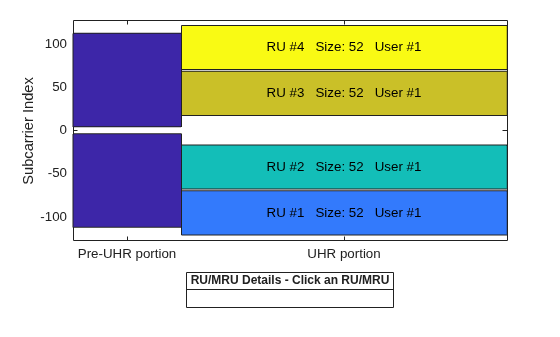
Figure RU/MRU Assignment and Occupied Subcarriers contains an axes object. The axes object with ylabel Subcarrier Index contains 11 objects of type patch, line, text. This object represents .

References

[1] IEEE P802.11bn/D1.4. “Part 11: Wireless LAN Medium Access Control (MAC) and Physical Layer (PHY) Specifications. Amendment 6: Enhancements for ultra high reliability (UHR).” Draft Standard for Information Technology — Telecommunications and Information Exchange between Systems — Local and Metropolitan Area Networks — Specific Requirements

[2] IEEE Std 802.11be™-2024 “IEEE Standard for Information Technology — Telecommunications and Information Exchange between Systems — Local and Metropolitan Area Networks — Specific Requirements — Part 11: Wireless LAN Medium Access Control (MAC) and Physical Layer (PHY) Specifications. Amendment 2: Enhancements for Extremely High Throughput (EHT).” https://ieeexplore.ieee.org/document/11090080

[3] IEEE Std 802.11-2024 (Revision of IEEE Std 802.11-2020). “Part 11: Wireless LAN Medium Access Control (MAC) and Physical Layer (PHY) Specifications.” IEEE Standard for Information Technology — Telecommunications and Information Exchange between Systems — Local and Metropolitan Area Networks — Specific Requirements. https://ieeexplore.ieee.org/document/10979691

Version History

Introduced in R2026b