主要内容

wlanUHRTBConfig

R2026b

Configure Wi-Fi 8 trigger-based transmission

Since R2026b

Description

The wlanUHRTBConfig object is a configuration object for the WLAN ultra high-reliability trigger-based (UHR TB) packet format.

Creation

Description

cfgUHRTB = wlanUHRTBConfig creates a configuration object that initializes parameters for an IEEE® 802.11™ UHR TB PPDU. For a detailed description of the UHR WLAN formats, see IEEE P802.11bn™ [1].

example

cfgUHRTB = wlanUHRTBConfig(PropertyName=Value) sets properties using one or more name-value arguments.

example

Properties

expand all

Channel bandwidth of PPDU transmission, specified as one of these values.

  • "CBW20" — Channel bandwidth of 20 MHz

  • "CBW40" — Channel bandwidth of 40 MHz

  • "CBW80" — Channel bandwidth of 80 MHz

  • "CBW160" — Channel bandwidth of 160 MHz

  • "CBW320" — Channel bandwidth of 320 MHz

Data Types: char | string

Resource unit size, specified as a positive integer or a row vector of positive integers. If the resource unit (RU) is a multiple resource unit (MRU), RUSize is a vector with entries given by the sizes of the RUs that compose the MRU. Otherwise, RUSize is a scalar. The possible RU sizes are 26, 52, 106, 242, 484, 996, 1992, and 3984.

If the RU is an MRU, each element of the row vector must be equal to one of 26, 52, 106, 242, 484, or 996.

Data Types: double

Resource unit index, specified as an integer in the range [1, 148] or a row vector of such integers. If the RU is an MRU, RUIndex is a vector with entries given by the indices of the RUs that compose the MRU. Otherwise, RUIndex is a scalar. Use this property to indicate the location of the RU within the channel.

Example: An 80 MHz transmission has four possible 242-tone RUs, one in each 20 MHz subchannel. RU 242-1 (RUSize = 242, RUIndex = 1) is the RU occupying the lowest absolute frequency within the 80MHz, and RU 242-4 (RUSize = 242, RUIndex = 4) is the RU occupying the highest absolute frequency.

Data Types: double

Enable distributed resource units (DRUs) by setting this property to true or 1. In regular RUs (RRUs), all tones are contiguous. DRUs contain non-contiguous tones distributed over the whole channel bandwidth. DRUs must have an RUSize of 26, 52, 106, 242, or 484. See the Wi-Fi 8 Packet Error Rate Simulation for Uplink Trigger-Based Format with DRUs example for more information.

Data Types: logical

Distribution bandwidth for DRUs, specified as one of these values:

  • "DBW20" — Tones distributed over bandwidth of 20 MHz

  • "DBW40" — Tones distributed over bandwidth of 40 MHz

  • "DBW60" — Tones distributed over bandwidth of 60 MHz

  • "DBW80" — Tones distributed over bandwidth of 80 MHz

Dependencies

This property applies only when you specify the DRU property as true.

Data Types: char | string | enumeration

Power scaling factor for pre-UHR fields, specified as a real scalar in the range [1/√2, 1].

Data Types: double

Number of transmit antennas, specified as a positive integer.

Data Types: double

Cyclic shift values, in nanoseconds, of additional transmit antennas for the pre-UHR fields of the waveform. The first eight antennas use the cyclic shift values specified in Table 21-10 of IEEE Std 802.11-2024 . The remaining L antennas use the values that you specify in this property, where L = NumTransmitAntennas – 8. Specify this property as one of these values:

  • An integer in the range [–200, 0] — the wlanUHRTBConfig object uses this cyclic shift value for each of the L additional antennas.

  • A row vector of length L of integers in the range [–200, 0] — the wlanUHRTBConfig object uses the kth element as the cyclic shift value for the (k + 8)th transmit antenna.

    Note

    If you specify this property as a row vector of length greater than L, the wlanUHRTBConfig object uses only the first L elements. For example, if you set the NumTransmitAntennas property to 16, the wlanUHRTBConfig object uses only the first L = 16 – 8 = 8 elements of this vector.

Dependencies

To enable this property, set the property to a value greater than 8.

Data Types: double

Number of space-time streams in the transmission, specified as an integer in the interval [1, 8].

Data Types: double

Starting space-time stream index, in one-based form, specified as an integer in the interval [1, 8]. In a multi-user multiple-input multiple-output (MU-MIMO) configuration with multiple users on the same RU, each user must transmit on a distinct space-time stream. In this case, you must set this property and the NumSpaceTimeStreams property to ensure that each space-time stream transmits at most one user.

Data Types: double

Spatial mapping scheme, specified as "direct", "hadamard", "fourier", or "custom".

The default value, "direct", applies only when NumTransmitAntennas is equal to NumSpaceTimeStreams.

Data Types: char | string | enumeration

Spatial mapping matrix, specified as one of these values:

  • A complex-valued scalar. This value applies to all the subcarriers.

  • A complex-valued matrix of size NSTSTotal -by-NT, where:

    • NSTSTotal is the sum of the number of the space-time streams for all users assigned to the RU.

    • NT is the number of transmit antennas.

    In this case, the spatial mapping matrix applies to all the subcarriers.

  • A complex-valued 3-D array of size NST-by-NSTSTotal-by-NT, where NST is the number of occupied carriers. In this case, each occupied subcarrier has its own spatial mapping matrix.

    • If you specify the DRU property as false, NST is the number of occupied subcarriers in the RRU and is determined by the RUSize property.

    • If you specify the DRU property as true, NST is the number of occupied subcarriers in the distribution bandwidth and is determined by the DistributionBandwidth property.

Use this property to rotate and scale the output vector of the constellation mapper. The spatial mapping matrix is used for beamforming and mixing space-time streams over the transmit antennas. The calling function normalizes the spatial mapping matrix for each subcarrier.

Example: [0.6 0.2; 0.5 0.4; 0.5 0.9] represents a spatial mapping matrix with three space-time streams and two transmit antennas.

Dependencies

This property applies only when you set the SpatialMapping property to "custom".

Data Types: double
Complex Number Support: Yes

Phase rotation values for the pre-UHR portion of the waveform, specified as a row vector of length 16 with entries equal to 1 or –1. This property applies only when the channel bandwidth is 320 MHz. The 16 entries of this property correspond to 20 MHz subchannels in ascending order of frequency, as defined in Equation 36-12 of IEEE Std 802.11be™-2024 [2].

Data Types: double

Modulation and coding scheme (MCS) used for transmission, specified as an integer in the range [0, 13], 15, 17, 19, 20, or 23. This table shows the modulation type and coding rate for each valid value of MCS:

MCSModulationDual Carrier ModulationCoding Rate
0Binary phase-shift keying (BPSK)

Not applicable

1/2
1Quadrature phase-shift keying (QPSK)1/2
23/4
316-point quadrature amplitude modulation (16-QAM)1/2
43/4
564-QAM2/3
63/4
75/6
8256-QAM3/4
95/6
101024-QAM3/4
115/6
124096-QAM3/4
135/6
15BPSK-DCMIn use1/2
17QPSK

Not applicable

2/3
1916-QAM2/3
2016-QAM5/6
23256-QAM2/3

Data Types: double

Forward-error-correction (FEC) coding type for the UHR-Data field, specified as "ldpc" for low-density parity-check (LDPC) coding, "bcc" for binary convolutional coding (BCC), or "ldpc2x" for LDPC coding with double codeword length.

You can set this property to "bcc" only when all of these conditions are satisfied:

  • The size of any RU is less than or equal to 242. Obtain the RU sizes by using the ruInfo object function.

  • The NumSpaceTimeStreams property is less than or equal to 4.

Data Types: char | string | enumeration

Pre-FEC padding factor, specified as 1, 2, 3, or 4.

Data Types: double | single

Extra OFDM symbol segment indicator, specified as 1 (true) or 0 (false). To indicate the presence of an extra OFDM symbol segment for LDPC coding, set this property to 1 (true). Otherwise, set this property to 0 (false).

Dependencies

To enable this property, set the ChannelCoding property to "ldpc" or "ldpc2x".

Data Types: logical

PE-Disambiguity subfield value, specified as 1 (true) or 0 (false). For more information, see Section 27.3.12 of IEEE Std 802.11-2024 [3].

Data Types: logical

Length of L-SIG field, in OFDM symbols, specified as an integer in the range [1, 4093]. The L-SIG length must satisfy mod(LSIGLength,3) = 1, where mod(a,m) returns the remainder after dividing a by m. For more information, see mod.

Data Types: double

Guard interval (cyclic prefix) duration for the data field within a packet, in microseconds, specified as 3.2, 1.6, or 0.8.

Data Types: double

UHR-LTF compression mode, specified as 1, 2, or 4. These values correspond to the 1× UHR-LTF, 2× UHR-LTF, and 4× UHR-LTF compression modes. The UHR-LTF type is enumerated in Table 38-40 of 802.11bn:

  • 1× UHR-LTF — Duration of 3.2 μs with a guard range duration of 1.6 μs

  • 2× UHR-LTF — Duration of 6.4 μs with a guard range duration of 0.8 μs or 1.6 μs

  • 4× UHR-LTF — Duration of 12.8 μs with a guard range duration of 0.8 μs or 3.2 μs

For more information on the UHR-LTF, see Section 38.3.15.11 of 802.11bn [1].

Data Types: double

Number of UHR-LTF symbols in the PPDU, specified as 1, 2, 4, 6, or 8.

Data Types: double

Basic service set (BSS) color identifier, specified as an integer in the interval [0, 63].

Data Types: double

Value of Spatial Reuse 1 subfield in the U-SIG field, specified as an integer in the range [0, 15]. For more information, see Table 38-25 of 802.11bn [1].

Data Types: double

Value of Spatial Reuse 2 subfield in the U-SIG field, specified as an integer in the range [0, 15]. For more information, see Table 28-25 of 802.11bn [1].

Data Types: double

Duration information for transmit opportunity (TXOP) protection in microseconds, specified as an integer in the interval [0, 8448]. This table describes the correspondence between the value you set for this property and the value of the seven-bit TXOP subfield in the U-SIG field.

TXOPDuration PropertyTXOP Subfield
[]127
Integer less than 5122TXOPDuration8
Integer greater than or equal to 5122(TXOPDuration512128)+1

Data Types: double

Channelization for a 320 MHz channel bandwidth, specified as 1 or 2. A 320 MHz channel has three possible locations for the channel center frequencies. In accordance with Section 36.3.23.2 of 802.11be [2], when you specify 1, these locations are numbers 31, 95, and 159. When you specify 2, the locations are numbers 63, 127 and 191.

Dependencies

This property applies only when you specify the ChannelBandwidth property as "CBW320".

Data Types: double

Disregard bits in the first U-SIG symbol, specified as a binary column vector of length 6. The default is a column vector of length 6 with all entries equal to 1.

Data Types: double | int8

Validate bit in the second U-SIG symbol, specified as 1 or 0.

Data Types: double | int8

Disregard bits in the second U-SIG symbol, specified as a binary column vector of length 5.

Data Types: double | int8

Post-FEC padding bit source used by the wlanWaveformGenerator function, specified as one of these values:

  • "mt19937arwithseed" — Generate normally distributed random bits by using the mt19937ar algorithm with seed specified in the PostFECPaddingSeed property.

  • "globalstream" — Generate normally distributed random bits by using the current global random number stream.

  • "userdefined" — Use the bits specified in the PostFECPaddingBits property as the post-FEC padding bits.

Data Types: char | string | enumeration

Post-FEC padding bit seed for the mt19937ar algorithm, specified as a nonnegative integer.

Dependencies

To enable this property, set the PostFECPaddingSource property to "mt19937ar with seed".

Data Types: double

Post-FEC padding bits, specified as a binary-valued scalar or column vector.

To generate a waveform, the wlanWaveformGenerator function requires n bits, where n depends on the specified configuration. To calculate n, use the numPostFECPaddingBits object function with the specified configuration object as the input argument and specify this property as a vector of length n. Alternatively, specify this input as a binary-valued scalar or column vector of arbitrary length. If the length of this property is less than n, the waveform generator loops the vector to create a vector of length n. If the length of this property is greater than n, the function uses only the first n entries as the post-FEC padding bits.

Data Types: single | double | int8

Object Functions

psduLengthPSDU length
packetFormat WLAN packet format
ruInfoResource unit allocation information
showAllocationResource unit allocation
transmitTimePacket transmission time
compressionModeCompression mode of UHR or EHT configuration
numPostFECPaddingBitsRequired number of post-FEC padding bits

Examples

collapse all

Create a trigger-based UHR configuration object of RRUs. Specify an RU size of 26. Show the RU allocation of the configuration.

cfg = wlanUHRTBConfig(RUSize=26);
cfg.showAllocation
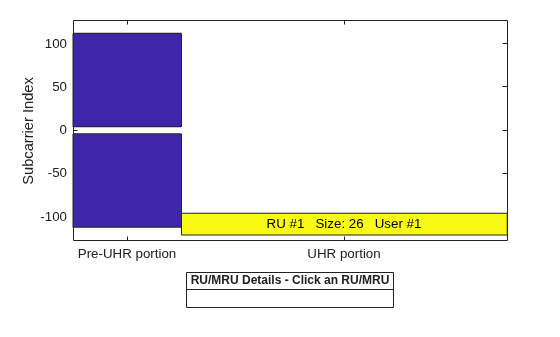
Figure RU/MRU Assignment and Occupied Subcarriers contains an axes object. The axes object with ylabel Subcarrier Index contains 5 objects of type patch, line, text. This object represents .

Now specify the DRU property as true and show the new allocation. The 26 tones are now distributed non-contiguously over the whole 20 MHz channel bandwidth.

cfg.DRU = true;
cfg.showAllocation
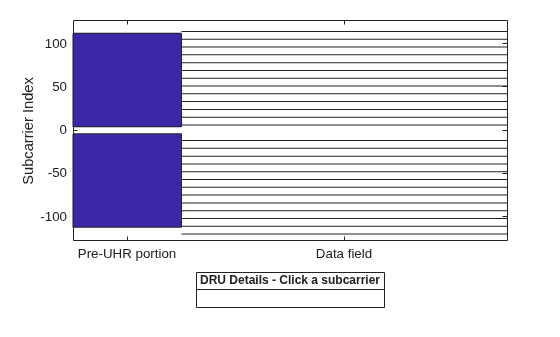
Figure RU/MRU Assignment and Occupied Subcarriers contains an axes object. The axes object with ylabel Subcarrier Index contains 29 objects of type patch, line. This object represents .

References

[1] IEEE P802.11bn/D1.4. “Part 11: Wireless LAN Medium Access Control (MAC) and Physical Layer (PHY) Specifications. Amendment 6: Enhancements for ultra high reliability (UHR).” Draft Standard for Information Technology — Telecommunications and Information Exchange between Systems — Local and Metropolitan Area Networks — Specific Requirements

[2] IEEE Std 802.11be-2024 “IEEE Standard for Information Technology — Telecommunications and Information Exchange between Systems — Local and Metropolitan Area Networks — Specific Requirements — Part 11: Wireless LAN Medium Access Control (MAC) and Physical Layer (PHY) Specifications. Amendment 2: Enhancements for Extremely High Throughput (EHT).” https://ieeexplore.ieee.org/document/11090080

[3] IEEE Std 802.11-2024 (Revision of IEEE Std 802.11-2020). “Part 11: Wireless LAN Medium Access Control (MAC) and Physical Layer (PHY) Specifications.” IEEE Standard for Information Technology — Telecommunications and Information Exchange between Systems — Local and Metropolitan Area Networks — Specific Requirements. https://ieeexplore.ieee.org/document/10979691

Version History

Introduced in R2026b