Condenser Microphone Modeling with Simscape Acoustics
R2026bThis example shows how to model a conventional condenser microphone using the Simscape™ Acoustics library. The model in this example is a lumped-element circuit combining the Acoustic, Mechanical Translational, and Electrical domains in Simscape. Portions of the circuit are encapsulated into the Condenser Microphone block.
Condenser Microphone Equivalent Circuit
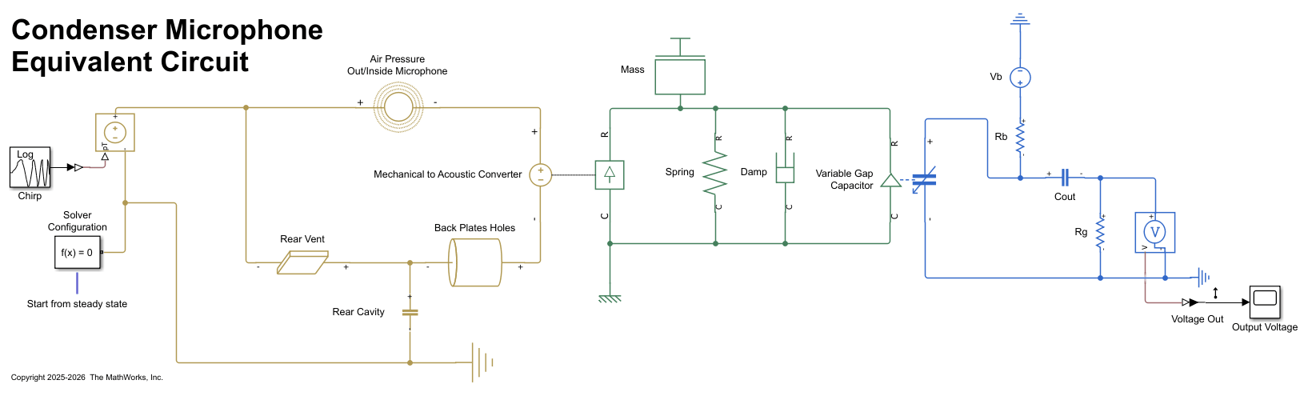
The condenser microphone model consists of three main domains:
Acoustic domain - Pressure outside the microphone and inside the microphone cavity is modeled using a spherical radiation impedance. The model represents rear vent transmission lines as thin rectangular slots and back plate holes as small cylindrical orifices. The microphone cavity is modeled using an acoustic compliance.
Mechanical domain - Acoustic pressure drives diaphragm movement. A mechanical-to-acoustic converter couples pressure and volume velocity to mechanical force and velocity. The diaphragm is modeled as a mass-spring-damper system.
Electrical domain - The diaphragm and back plate form a parallel-plate capacitor. A variable-gap capacitor couples diaphragm movement to electrical capacitance.
Open the condenser microphone equivalent circuit model, which implements the three-domain circuit using Simscape blocks.
eq_circ_model = "CondenserMicrophoneEqCircuit";
open_system(eq_circ_model);
Additional Electrical Components
The model includes additional electrical components that are common in condenser microphones:
Vb is the polarization (bias) voltage, which places a fixed charge on the capacitor. When the diaphragm moves, the capacitance changes and a voltage change appears across the capsule.
Rb is the bias resistor connecting Vb to the microphone capsule. It allows the initial charge to build up on the capsule. Once charged, it effectively isolates the voltage source from the signal.
Rg is the gate/load resistor, representing the preamplifier input impedance (typically a JFET source-follower). Its high resistance prevents capsule discharge that causes signal attenuation.
Cout is the output coupling capacitor, a DC-blocking capacitor that passes the AC audio signal to the electrical output while blocking the DC bias. Cout and Rg form a high-pass filter.
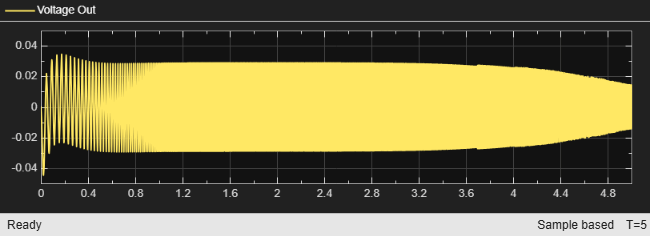
Run the simulation to visualize the microphone voltage in response to an acoustic sinusoidal wave swept logarithmically from frequencies 20 Hz to 20 kHz. The scope shows that the amplitude of the voltage is nearly constant for most of the frequency range, with attenuation noticeable at very high frequencies.
sim(eq_circ_model);
Condenser Microphone Block
The Condenser Microphone block from the Simscape™ Acoustics library encapsulates most of the equivalent circuit, starting after the controlled pressure source and ending after the variable gap converter. Open the model.
bdclose(eq_circ_model);
block_model = "CondenserMicrophoneBlock";
open_system(block_model);
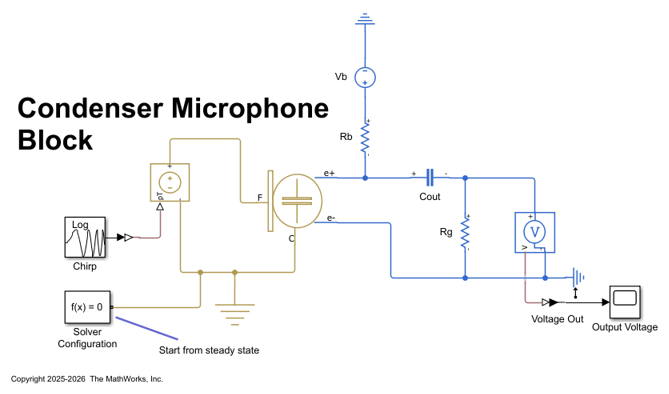
The remaining electrical components from the equivalent circuit are not encapsulated in the block so that you can define alternate microphone circuit topologies.
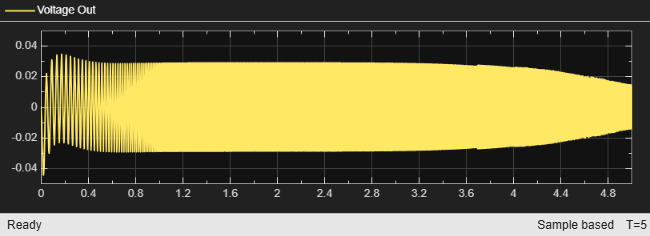
Run the model. Verify that the microphone voltage matches the voltage in the equivalent circuit model.
sim(block_model);
Close the model.
bdclose(block_model);
Acknowledgments
The original version of this model was authored by Dr. Stephen C. Thompson of Penn State University.
References
[1] Esteves, Josue, Libor Rufer, Didace Ekeom, and Skandar Basrour. "Lumped-Parameters Equivalent Circuit for Condenser Microphones Modeling." The Journal of the Acoustical Society of America 142, no. 4 (2017): 2121-32. https://doi.org/10.1121/1.5006905.
[2] Zuckerwar, Allan J. "Theoretical Response of Condenser Microphones." The Journal of the Acoustical Society of America 64, no. 5 (1978): 1278- 85. https://doi.org/10.1121/1.382112.

