Condenser Microphone
R2026bCondenser Microphone block

To add a block to a model, double-click the canvas and start typing the block name. Then, select the block from the list.
Libraries:
Simscape Acoustics /
Applications /
Microphones
Description
Add-On Required: This feature requires the Simscape Acoustics add-on.
This block models the acoustic, mechanical, and electrical elements of a conventional condenser microphone. The block has acoustic conserving ports for the front of the microphone and inside of the microphone cavity, and electrical conserving ports for the electrical signal generated by the interaction of the moving diaphragm and back plate.
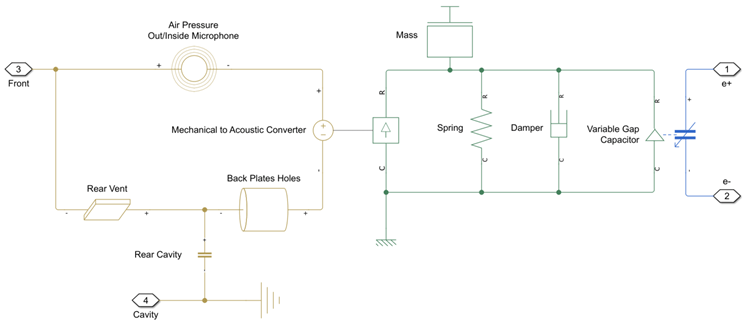
The Condenser Microphone block models the physical properties of a condenser microphone by implementing an equivalent circuit using Simscape™ blocks from the electrical, mechanical translational, and acoustic domains. The equivalent circuit is based on two lumped-element models [1][2]. The block sets the default property values based on the reference [1]. The figure shows the equivalent circuit using the following Simscape blocks in each domain:
Acoustic: The Condenser Microphone block models the radiation impedance at the front of the diaphragm as a Spherical Source Radiation Impedance block. The block models the compliance of air in the chamber using an Acoustic Compliance block. The acoustic impedance of the back plate holes is modeled using a Small Cylindrical Orifice or Tube block. You can model the radiation impedance of the rear vent as either a Small Rectangular Slot block or a Small Cylindrical Orifice or Tube block.
Mechanical Translational: The Condenser Microphone block models the total mass of the moving diaphragm as a mass-spring-damper system. The block uses a Mass (Simscape) block, a Translational Spring (Simscape), and a Translational Damper (Simscape) block, respectively.
Transducers: Changes in acoustic pressure move the microphone diaphragm. The Condenser Microphone block models this interaction using a Mechanical to Acoustic Converter block. The diaphragm and back plate form a parallel-plate capacitor that generates an electrical signal as the diaphragm moves. The block models this interaction using a Variable Gap Capacitor (Simscape) block.
Examples
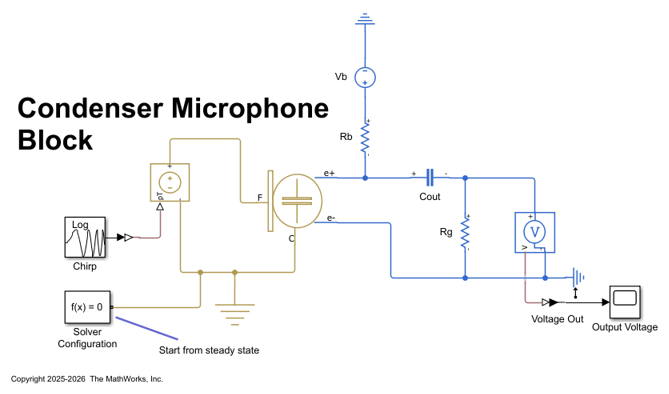
Condenser Microphone Modeling with Simscape Acoustics
Model a conventional condenser microphone using Simscape Acoustics.
Ports
Conserving
Parameters
References
[1] Esteves, Josué, Libor Rufer, Didace Ekeom, and Skandar Basrour. “Lumped-Parameters Equivalent Circuit for Condenser Microphones Modeling.” The Journal of the Acoustical Society of America 142, no. 4 (2017): 2121–32. https://doi.org/10.1121/1.5006905.
[2] Zuckerwar, Allan J. “Theoretical Response of Condenser Microphones.” The Journal of the Acoustical Society of America 64, no. 5 (1978): 1278–85. https://doi.org/10.1121/1.382112.
Version History
Introduced in R2026b

