cordiccos
R2026b基于 CORDIC 的余弦逼近
描述
示例
比较 cordiccos 算法的各种迭代产生的结果与双精度 cos 函数的结果。
创建 [0,2*pi) 之间的 1024 个点。
stepSize = pi/512;
thRadDbl = 0:stepSize:(2*pi - stepSize);
将定点类型设置为有符号 12 位定点数据类型。使用具有双精度输入的 cos 函数作为参考。
thRadFxp = fi(thRadDbl,1,12);
cosThRef = cos(double(thRadFxp));
使用 12 位量化输入并将迭代次数从 2 变为 10。比较定点 CORDIC 结果与双精度三角函数结果。
for niters = 2:2:10
    cdcCosTh  = cordiccos(thRadFxp,niters);
    errCdcRef = cosThRef - double(cdcCosTh);
end
绘制结果。
figure
hold on
axis([0 2*pi -1.25 1.25]);
    plot(thRadFxp,cosThRef,'b');
    plot(thRadFxp,cdcCosTh,'g');
    plot(thRadFxp,errCdcRef,'r');
    ylabel('cos(\Theta)');
    gca.XTick = 0:pi/2:2*pi;
    gca.XTickLabel = {'0','pi/2','pi','3*pi/2','2*pi'};
    gca.YTick = -1:0.5:1;
    gca.YTickLabel = {'-1.0','-0.5','0','0.5','1.0'};
    ref_str = 'Reference: cos(double(\Theta))';
    cdc_str = sprintf('12-bit CORDIC cosine; N = %d',niters);
    err_str = sprintf('Error (max = %f)', max(abs(errCdcRef)));
    legend(ref_str,cdc_str,err_str);
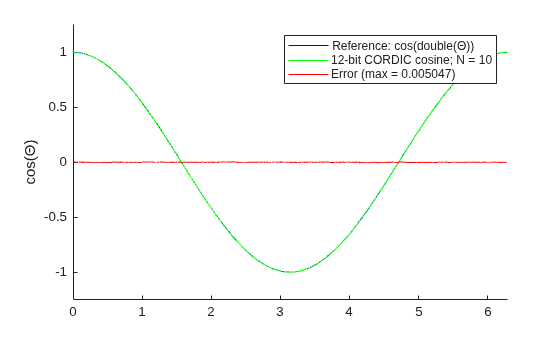
在经过 10 次迭代后,CORDIC 算法将 theta 的余弦逼近到与双精度余弦结果相差 0.005187 的范围内。
输入参数
输出参量
算法
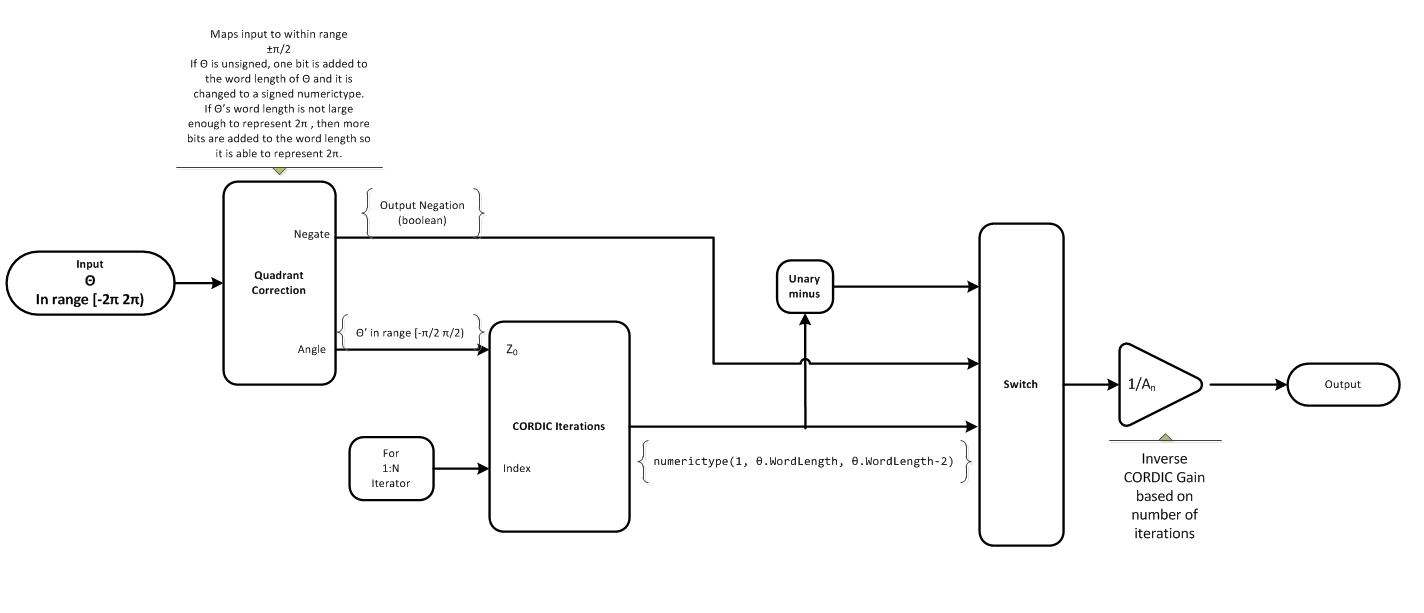
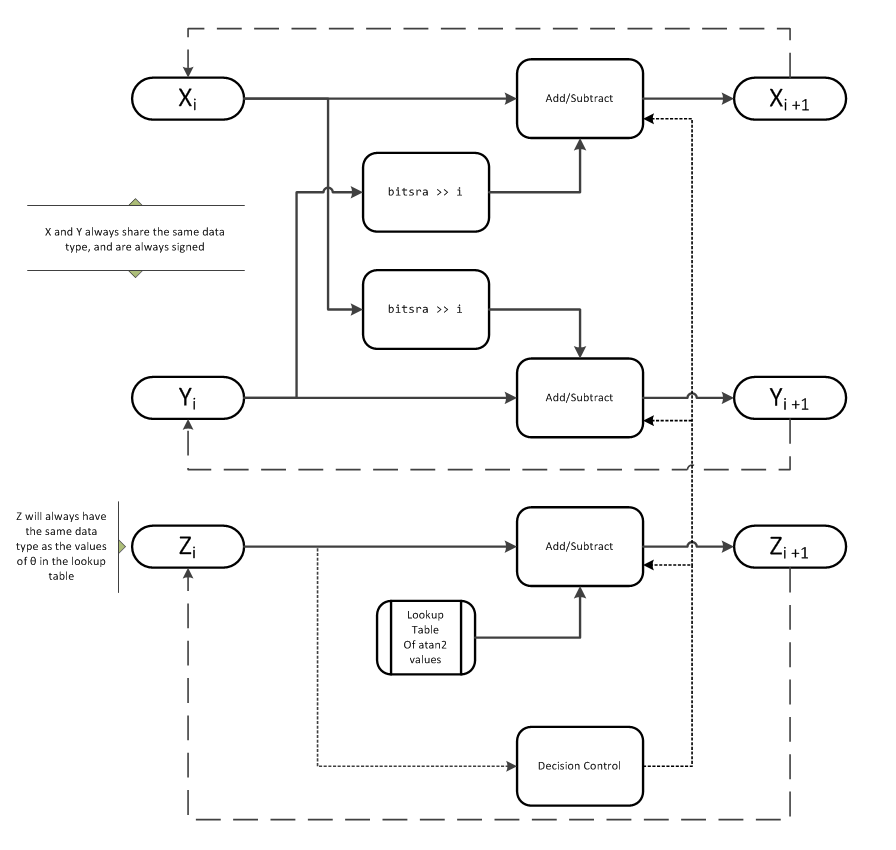
X 表示正弦,Y 表示余弦,Z 表示 theta。CORDIC 旋转核的准确性取决于 X、Y 和 Z 初始值的选择。此算法使用以下初始值:
参考
[1] Volder, Jack E. “The CORDIC Trigonometric Computing Technique.” IRE Transactions on Electronic Computers EC-8, no. 3 (Sept. 1959): 330–34.
[2] Andraka, Ray. “A Survey of CORDIC Algorithm for FPGA Based Computers.” In Proceedings of the 1998 ACM/SIGDA Sixth International Symposium on Field Programmable Gate Arrays, 191–200. https://dl.acm.org/doi/10.1145/275107.275139.
[3] Walther, J.S. “A Unified Algorithm for Elementary Functions.” In Proceedings of the May 18-20, 1971 Spring Joint Computer Conference, 379–86. https://dl.acm.org/doi/10.1145/1478786.1478840.
[4] Schelin, Charles W. “Calculator Function Approximation.” The American Mathematical Monthly, no. 5 (May 1983): 317–25. https://doi.org/10.2307/2975781.
扩展功能
版本历史记录
在 R2010a 中推出

