主要内容

fresnelCoefficients

Compute Fresnel coefficients for optical coating

Since R2026a

Description

Add-On Required: This feature requires the Optical Design and Simulation Library for Image Processing Toolbox add-on.

coeffs = fresnelCoefficients(oc) computes the Fresnel coefficients for an optical coating oc.

example

coeffs = fresnelCoefficients(oc,Name=Value) specifies options for computing Fresnel coefficients using one or more name-value arguments. For example, Wavelengths=300:10:800 specifies to compute the Fresnel coefficients for wavelengths between 300 to 800 nanometers, sampled 10 nanometers apart.

Examples

collapse all

Create a broadband anti-reflective optical coating that contains two alternating TiO2/SiO2 layer stacks.

ocBBAR = opticalCoating(Name="BBAR_4l", ...
CoatingMaterial = ["TiO2", "SiO2"], ...
LayerMaterialIndex = [1 2 1 2], ...
ThicknessUnit = "nm", ...
LayerThickness = [14.6 36.5 129.1 95.5]);

Compute the Fresnel coefficients for the optical coating.

coeffs = fresnelCoefficients(ocBBAR);

Define the wavelength range.

lambda = ocBBAR.WavelengthRange(1):ocBBAR.WavelengthRange(2);

Plot the mean amplitude reflection coefficients for s- and p-polarization, rs and rp, respectively, as a function of the wavelength.

mean_rs = mean(abs(coeffs.rs),1);
mean_rp = mean(abs(coeffs.rp),1);

figure;
plot(lambda,mean_rs,"b-",DisplayName="Mean |r_s|");
hold on;
plot(lambda,mean_rp,"r-",DisplayName="Mean |r_p|");
xlabel("Wavelength (nm)");
ylabel("Mean Amplitude Reflection Coefficient");
legend show;
title("Mean Fresnel Amplitude Reflection Coefficients vs. Wavelength");
hold off;
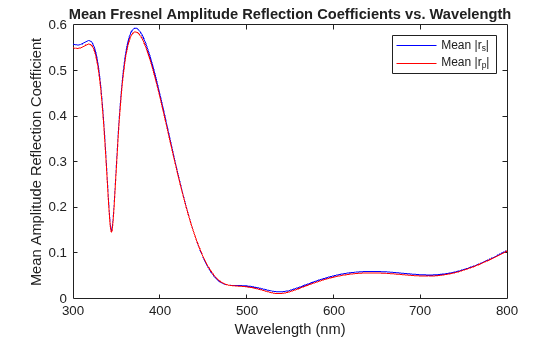
Figure contains an axes object. The axes object with title Mean Fresnel Amplitude Reflection Coefficients vs. Wavelength, xlabel Wavelength (nm), ylabel Mean Amplitude Reflection Coefficient contains 2 objects of type line. These objects represent Mean |r_s|, Mean |r_p|.

Plot the average reflectance as a function of the wavelength for all sampled incidence angles. By default, the sampled incident angle range is between 0 and 15 degrees.

plot(lambda,coeffs.Ra)
xlabel("Wavelength (nm)")
ylabel("R_a")
title("Average Reflectance of Optical Coating vs. Wavelength")
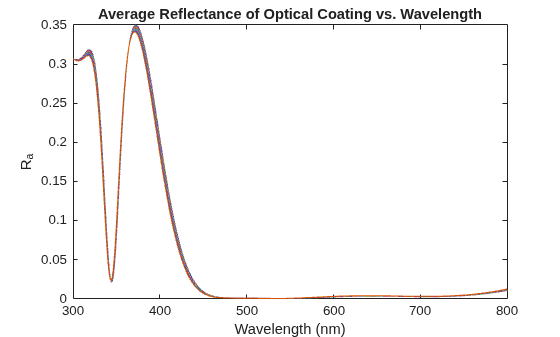
Figure contains an axes object. The axes object with title Average Reflectance of Optical Coating vs. Wavelength, xlabel Wavelength (nm), ylabel R indexOf a baseline R_a contains 16 objects of type line.

Input Arguments

collapse all

Optical coating, specified as an opticalCoating object.

Name-Value Arguments

collapse all

Specify optional pairs of arguments as Name1=Value1,...,NameN=ValueN, where Name is the argument name and Value is the corresponding value. Name-value arguments must appear after other arguments, but the order of the pairs does not matter.

Example: fresnelCoefficients(Wavelengths=300:10:800) specifies to compute the Fresnel coefficients for wavelengths between 300 to 800 nanometers, sampled 10 nanometers apart.

Wavelengths for which to compute Fresnel coefficients, specified as an M-element numeric vector. M is the number of wavelengths, and each element of the vector represents a wavelength, in nanometers. By default, the Wavelengths value is the wavelength range specified by oc.WavelengthRange(1):oc.WavelengthRange(2).

Incident light angles for which to compute Fresnel coefficients, specified as an N-element row vector. N is the number of incident angles. The angles must be in the range [0, 90]. Units are in degrees. If you do not specify the IncidentAngles name-value argument, the function computes Fresnel coefficients at the incident angles specified by the IncidentAngleRange property of the opticalCoating object oc.

Incident light direction with respect to the coating, specified as one of these options:

  • "medium2substrate" – Incoming incident light rays travel from the direction of the medium through the substrate.

  • "substrate2medium" – Incoming incident light rays travel from the direction of the substrate through the medium.

Output Arguments

collapse all

Fresnel coefficients, returned as a structure containing these fields:

  • rs – Reflection amplitude coefficient, or complex ratio, for s-polarized incident light, stored as a N-by-M complex-valued matrix.

  • rp – Reflection amplitude coefficient, or complex ratio, for p-polarized incident light, stored as a N-by-M complex-valued matrix.

  • ts – Transmission amplitude coefficient, or complex ratio, for s-polarized incident light, stored as a N-by-M complex-valued matrix.

  • tp – Transmission amplitude coefficient, or complex ratio, for p-polarized incident light, stored as a N-by-M complex-valued matrix.

  • Rs – Reflection power coefficient, which signifies the reflectance, for s-polarized incident light, stored as a N-by-M matrix.

  • Rp – Reflection power coefficient, which signifies the reflectance, for p-polarized incident light, stored as a N-by-M matrix.

  • Ra – Average reflection power coefficient, stored as a N-by-M matrix. It is the average of the s-polarized and p-polarized power coefficients, Rs and Rp.

  • Ts – Transmission power coefficient, which signifies the transmittance, for s-polarized incident light, stored as a N-by-M matrix.

  • Tp – Transmission power coefficient, which signifies the transmittance, for p-polarized incident light, stored as a N-by-M matrix.

  • Ta – Average transmission power coefficient, stored as a N-by-M matrix. It is the average of the s-polarized and p-polarized power coefficients, Ts and Tp.

  • As - Absorbance coefficient for s-polarized incident light, stored as a N-by-M matrix.

  • Ap - Absorbance coefficient for p-polarized incident light, stored as a N-by-M matrix.

N is the number of incident angles, and M is the number of wavelengths.

For s-polarized incident light, the electromagnetic field is in the plane perpendicular to the incident coating surface. For p-polarized incident light, the electromagnetic field is in the plane parallel to the incident coating surface.

Version History

Introduced in R2026a