Customize Code Analyzer Checks Using Configuration File
R2026bThe Code Analyzer checks code and reports errors, warnings, and informational messages. You can identify potential coding issues and enforce project-specific coding standards by configuring the Code Analyzer. For example, you can improve code readability by setting limits on line length or function size, and by enforcing naming conventions. To customize Code Analyzer checks, create a configuration file and apply it to your code.
Create Configuration File
To configure the Code Analyzer, create a file named
codeAnalyzerConfiguration.json in a
resources folder. Within this configuration file, you can
modify existing Code Analyzer checks and add custom checks. Place the
resources folder in the folder where you want to apply the
configured checks. This file configures the Code Analyzer checks for the
resources folder's parent folder and all subfolders of that
parent folder.
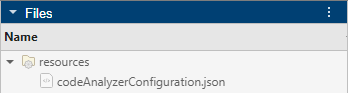
You can create multiple configuration files. For each file it analyzes, the Code
Analyzer searches up the folder hierarchy and uses the first configuration file it
finds in a resources folder.
Sample Configuration File
This code shows the contents of a sample configuration file. The file uses
JSON format, and // designates the text that follows as a
comment.
{
    // Basic File Information
    "name": "Acme Corp Guideline",
    "guidelineVersion": "1.0.0",

    // Base Configuration Setting
    "baseConfiguration": "factory",

    // Modified and New Checks
    "checks": {
        "GVMIS": {
            // Do not use global variables
            "severity": "error"
        },
        "MyFunctionCheck": {
            // Disallow use of evalin function
            "rule": {
                "template": "functionCall",
                "functionNames": "evalin"
            },
            "severity": "error",
            "messageText": "Do not use evalin.",
            "enabled": true
        }
    },

    // Naming Conventions
    "naming": {
        // Set naming conventions for functions and variables
        "function": {
            "maxLength": 32,
            "casing": ["lowerCamelCase","lowercase"]
        },
        "variable": {
            "maxLength": 32,
            "regularExpression": "(^[a-z][a-zA-Z0-9]*$)|(^[A-Z][a-z0-9]*$)"
        }
    }
}
Basic File Information
You can optionally include basic file information at the start of the configuration file. Specify one or more of the following properties as a string containing the relevant file information. These properties do not affect the configuration.
| Property Name | Description | Example |
|---|---|---|
"name" (optional) | Name of the configuration file |
"name": "Acme Corp Guideline" |
"description" (optional) | Description of the configuration file |
"description": "Internal Acme Coding Guidelines" |
"author" (optional) | Author name |
"author": "Alex" |
"schemaVersion" (optional) | Schema version in the format
"1.2.3" |
"schemaVersion": "1.1.0" |
"guidelineVersion" (optional) | Guideline version in the format
"1.2.3" |
"guidelineVersion": "1.0.0" |
Base Configuration Setting
You can set your configuration file to inherit rules from the standard
MATLAB® Code Analyzer configuration or from another base configuration
file located in the resources folder of the closest parent
folder. Use the property "baseConfiguration" to specify which
file to inherit rules from.
| Property Name | Description | Example |
|---|---|---|
"baseConfiguration" (optional) | Base configuration file to inherit rules from, specified as one of these values:
|
"baseConfiguration": "factory" |
For more consistent Code Analyzer behavior, set
"baseConfiguration" to "factory" for a
configuration file at the root of your code base, and set
"baseConfiguration" to
"closestParentFolder" for configuration files nested deeper in
your code base.
Ignored Files Setting
Since R2026b
You can optionally set your configuration file to ignore certain files or
folders during analysis. Use the property "ignoredFiles" to
specify files and folders to ignore.
| Property Name | Description | Example |
|---|---|---|
"ignoredFiles" (optional) | Files and folders to ignore, specified as one of these values:
Like other properties, you can
inherit the |
"ignoredFiles": ["**/*_template.m","src/","tmp.m"] |
Note
When you specify a configuration file using the
CodeAnalyzerConfiguration name-value argument in
codeIssues, relative paths for
"ignoredFiles" in the configuration file are
interpreted relative to your current folder, not the parent folder of the
resources folder that contains the configuration
file.
Configure Custom Checks
Within the codeAnalyzerConfiguration.json file, specify your
custom checks by adding the "checks" and
"naming" properties. You can:
Modify existing Code Analyzer checks and create new checks in the
"checks"property.Specify checks for naming conventions in the
"naming"property.
For example, this code changes the severity of the existing global variable check
"GVMIS" from a warning to an error:
    "checks": {
        "GVMIS":
        {
            // Increase severity of the default global variable check
            "severity": "error"
        }
    }
Note
Changing the severity of a Code Analyzer message does not affect code
execution. Code is still executed even if the severity of a check has been set
to "error". However, syntax errors continue to prevent
execution even if their severity is changed or the message disabled.
Using the "checks" property, you can also change message text,
disable checks, or configure checks to detect code that exceeds specified limits for
line length, function size, nesting depth, or number of function arguments. In
addition, you can flag the use of specific functions or variables by creating custom
checks. For more information, see Modify Existing Code Analyzer Checks or Create New Checks.
Using the "naming" property, you can enforce a consistent
coding style by defining naming conventions for different types of MATLAB
identifiers. For more information, see Check for Certain Naming Conventions in Your Code.
Refresh and Verify Configuration
When you add a new configuration file to a resources folder or
update an existing configuration file during a MATLAB session, the MATLAB Editor
does not automatically get the latest configuration because the configuration is
cached only at the start of a MATLAB session.
To apply the new or updated configuration file to the current MATLAB session, call
matlab.codeanalysis.refreshConfiguration to refresh the
cache.
You can verify that the file is a valid JSON configuration file using the
matlab.codeanalysis.validateConfiguration function.

