Rigid Body Tree
R2026brigid body tree block block
To add a block to a model, double-click the canvas and start typing the block name. Then, select the block from the list.
Libraries:
Robotics System Toolbox /
Collision Detection
Description
The Rigid Body Tree block outputs a rigid body tree robot model. A rigid body tree is a representation of the connectivity of rigid bodies with joints.
A rigid body tree model is represented in MATLAB® as a rigidBodyTree object, made up of rigid bodies
as rigidBody objects. Each rigid body has a rigidBodyJoint object associated with it that defines how it can move relative to
its parent body.
You can use the loadrobot
function to load a rigid body tree model from the Robot Library, or use the importrobot function to import robot models from Simscape™
Multibody™ models or robot model files such as URDFs.
Examples
Use the loadrobot function to load a robot model from the Robot Library and set up the collision environment.
robot = loadrobot("abbIrb120",DataFormat="row");
rad = 0.08;
len = 0.75;
pose1 = trvec2tform([0.4 -0.35 0.3]);
pose2 = trvec2tform([0 0.3 0.5]);
cylinder = collisionCylinder(rad,len,Pose=pose1);
sphere = collisionSphere(rad,Pose=pose2);
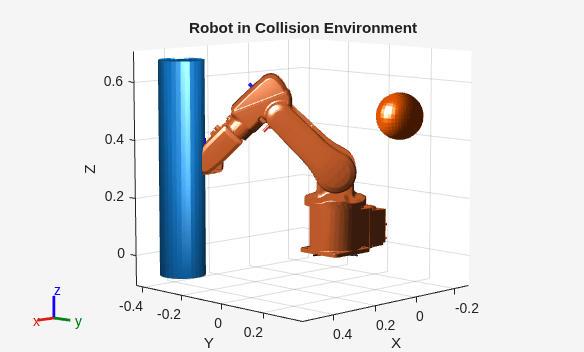
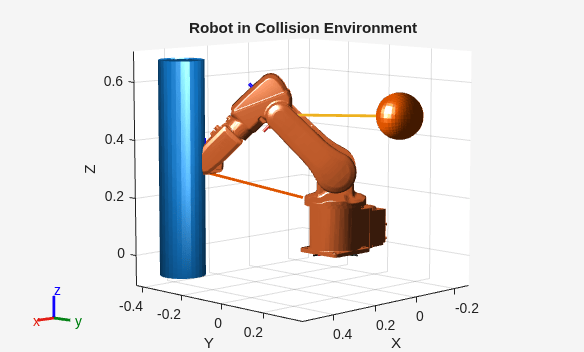
Show the robot with the collision environment. In this case, you can see the robot collides with the cylinder.
show(robot,[-pi/4 pi/4 0 0 -pi/4 0]);
hold on
showCollisionArray({cylinder,sphere});
title("Robot in Collision Environment")
hold on
open_system("RBTCheckCollisionModel");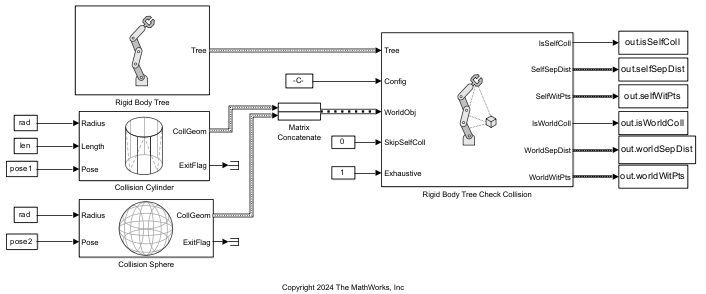
out = sim("RBTCheckCollisionModel");Self-Collision Data
Check the self-collision status for the robot at the first time step.
isSelfColliding = out.isSelfColl.Data(1)
isSelfColliding = logical
   0
Get the self-separation distance and self-witness points matrices for the first time step.
selfSepDist = out.selfSepDist.Data{1}selfSepDist = 9×9
Inf Inf Inf Inf Inf Inf Inf Inf Inf
Inf Inf Inf 0.1485 0.2616 0.2919 0.4135 Inf Inf
Inf Inf Inf Inf 0.0956 0.1848 0.2968 Inf 0.0401
Inf 0.1485 Inf Inf Inf 0.0730 0.1731 Inf 0.2777
Inf 0.2616 0.0956 Inf Inf Inf 0.0149 Inf 0.3136
Inf 0.2919 0.1848 0.0730 Inf Inf Inf Inf 0.3196
Inf 0.4135 0.2968 0.1731 0.0149 Inf Inf Inf 0.4398
Inf Inf Inf Inf Inf Inf Inf Inf Inf
Inf Inf 0.0401 0.2777 0.3136 0.3196 0.4398 Inf Inf
selfWitPts = out.selfWitPts.Data{1}selfWitPts = 27×18
Inf Inf Inf Inf Inf Inf Inf Inf Inf Inf Inf Inf Inf Inf Inf Inf Inf Inf
Inf Inf Inf Inf Inf Inf Inf Inf Inf Inf Inf Inf Inf Inf Inf Inf Inf Inf
Inf Inf Inf Inf Inf Inf Inf Inf Inf Inf Inf Inf Inf Inf Inf Inf Inf Inf
Inf Inf Inf Inf Inf Inf 0.0371 0.1129 0.0517 0.2244 0.0797 0.2790 0.0797 0.3625 Inf Inf Inf Inf
Inf Inf Inf Inf Inf Inf -0.0309 -0.1015 -0.0516 -0.2213 -0.0797 -0.2707 -0.0797 -0.3625 Inf Inf Inf Inf
Inf Inf Inf Inf Inf Inf 0.3377 0.4441 0.2877 0.3867 0.1909 0.2858 0.1909 0.2959 Inf Inf Inf Inf
Inf Inf Inf Inf Inf Inf Inf Inf 0.1695 0.2246 0.1579 0.2645 0.1752 0.3649 Inf Inf -0.0048 -0.0047
Inf Inf Inf Inf Inf Inf Inf Inf -0.1702 -0.2253 -0.1839 -0.2905 -0.1703 -0.3600 Inf Inf 0.0044 0.0044
Inf Inf Inf Inf Inf Inf Inf Inf 0.4586 0.4034 0.4608 0.3539 0.4644 0.3376 Inf Inf 0.1662 0.2062
Inf Inf 0.0371 0.1129 Inf Inf Inf Inf Inf Inf 0.2261 0.2645 0.2709 0.3649 Inf Inf 0.0638 0.1257
Inf Inf -0.0309 -0.1015 Inf Inf Inf Inf Inf Inf -0.2580 -0.2905 -0.2681 -0.3600 Inf Inf -0.0669 -0.1260
Inf Inf 0.3377 0.4441 Inf Inf Inf Inf Inf Inf 0.4067 0.3539 0.4501 0.3376 Inf Inf 0.1660 0.4302
Inf Inf 0.0517 0.2244 0.1695 0.2246 Inf Inf Inf Inf Inf Inf 0.3376 0.3481 Inf Inf 0.0634 0.2244
Inf Inf -0.0516 -0.2213 -0.1702 -0.2253 Inf Inf Inf Inf Inf Inf -0.3664 -0.3769 Inf Inf -0.0673 -0.2213
Inf Inf 0.2877 0.3867 0.4586 0.4034 Inf Inf Inf Inf Inf Inf 0.3147 0.3147 Inf Inf 0.1660 0.3867
⋮
Get the separation distance and corresponding witness points between link_1 and link_6. Use find and strcmp functions to get the indices of these bodies in the rigid body tree.
body1Idx = find(strcmp(robot.BodyNames,"link_1"));
body2Idx = find(strcmp(robot.BodyNames,"link_6"));
link1_link6_dist = selfSepDist(body1Idx,body2Idx)
link1_link6_dist =
0.4135
row = body1Idx*3-2; % body index * three dimensions (XYZ), -2 to get starting index of the submatrix
col = body2Idx*2-1; % body index * two witness points, -1 to get starting index of the submatrix
link1_link6_witpts = selfWitPts(row:row+2,col:col+1)
link1_link6_witpts = 3×2

    0.0797    0.3625
   -0.0797   -0.3625
    0.1909    0.2959
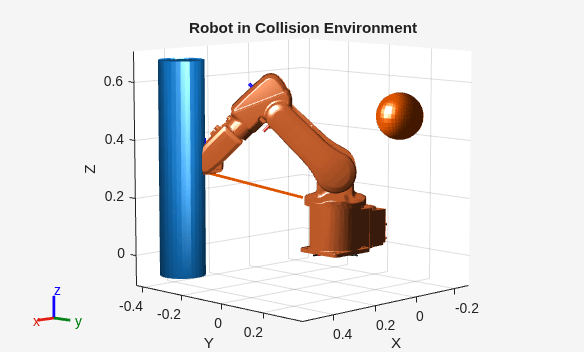
Plot a line between the witness points.
plot3(link1_link6_witpts(1,:),link1_link6_witpts(2,:),link1_link6_witpts(3,:),LineWidth=2);
World-Collision Data
Check the world-collision status for the robot at the first time step.
isWorldColliding = out.isWorldColl.Data(1)
isWorldColliding = logical
   1
Get the separation distances and witness points between the robot and the world objects for the first time step.
worldSepDist = out.worldSepDist.Data{1}worldSepDist = 9×2
Inf Inf
0.3385 0.1980
0.2003 0.1672
0.0647 0.3016
NaN 0.4826
NaN 0.5670
NaN 0.6898
Inf Inf
0.3279 0.3133
worldWitPts = out.worldWitPts.Data{1}worldWitPts = 27×4
Inf Inf Inf Inf
Inf Inf Inf Inf
Inf Inf Inf Inf
0.0920 0.3411 0.0122 0.0036
-0.0666 -0.2959 0.0726 0.2346
0.1634 0.1634 0.3405 0.4541
0.2018 0.3433 0.0258 0.0083
-0.1518 -0.2935 0.1245 0.2431
0.4918 0.4918 0.3278 0.4444
0.2819 0.3347 0.1426 0.0300
-0.2664 -0.3037 -0.0537 0.2259
0.4579 0.4579 0.4868 0.4972
NaN NaN 0.2664 0.0378
NaN NaN -0.1837 0.2312
NaN NaN 0.3924 0.4847
⋮
Get the separation distance and corresponding witness points between link_4 and the sphere collision geometry.
bodyIdx = find(strcmp(robot.BodyNames,"link_3"));
worldObjIdx = 2;
link2_sphere_dist = worldSepDist(bodyIdx,worldObjIdx)
link2_sphere_dist = 0.3016
row = bodyIdx*3-2;     % body index * three dimensions (XYZ), -2 to get starting index of the submatrix
col = worldObjIdx*2-1; % body index * two witness points, -1 to get starting index of the submatrix
link2_sphere_witpts = worldWitPts(row:row+2,col:col+1)
link2_sphere_witpts = 3×2

    0.1426    0.0300
   -0.0537    0.2259
    0.4868    0.4972
Plot a line between the witness points.
plot3(link2_sphere_witpts(1,:),link2_sphere_witpts(2,:),link2_sphere_witpts(3,:),LineWidth=2);
Ports
Output
Parameters
More About
To configure the maximum number of bodies in a rigid body tree, click
Configure Rigid Body Tree Bus in the block mask to open the Configure
Rigid Body Tree Bus dialog box, and set the Maximum number of bodies in rigid
body tree parameter. The default value is 100.

To configure the maximum number of collisions for rigid bodies of the rigid body tree,
click Configure Rigid Body Bus in the Configure Rigid Body Tree Bus
dialog box to open the Configure Rigid Body Bus dialog box, and set the Maximum
number of collisions in rigid body parameter. The default value is
5.

To configure the maximum number of vertices in the collision geometries of the rigid bodies, click Configure Collision Geometry Bus in the block mask to open the Configure Collision Geometry Bus dialog box. See Configure Collision Geometry Bus for more information.
Extended Capabilities
Version History
Introduced in R2026a

