车辆应用
R2026bSimscape™ Driveline™ 可以对完整的车辆系统进行建模。这些示例演示了各种车辆模型。
精选示例
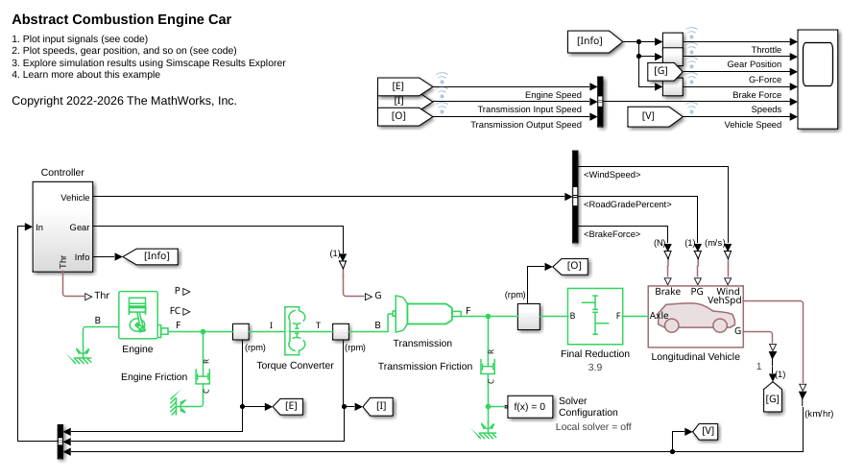
抽象内燃机汽车
此示例展示了一个配备内燃机的抽象乘用车模型。
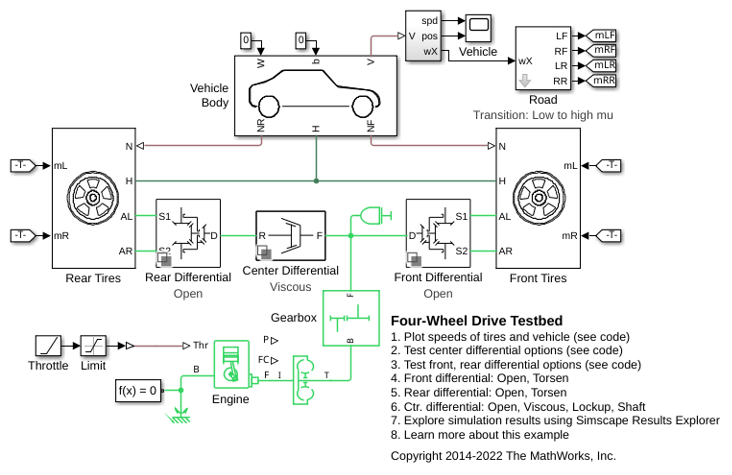
Four-Wheel Drive Testbed
A four-wheel drive vehicle with open and limited slip differentials. The front and rear differentials can be standard or Type I Torsen. The center differential can be a solid shaft, viscous coupling, viscous coupling with a locking clutch, or open with no torque transfer. The differential options are in variant subsystems. The variants can be selected using the hyperlinks embedded in the model.
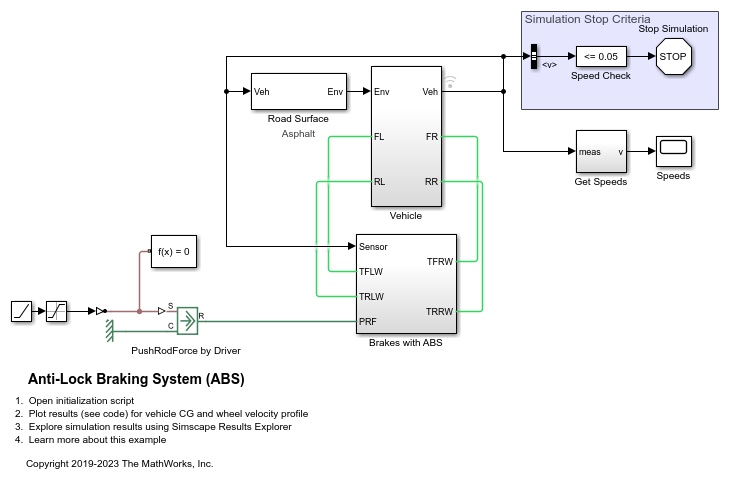
防抱死制动系统 (ABS)
此示例展示了一种对 ABS 制动系统进行建模的简单方法。该模型展示了车辆 CG 和车轮所达到的速度曲线响应。
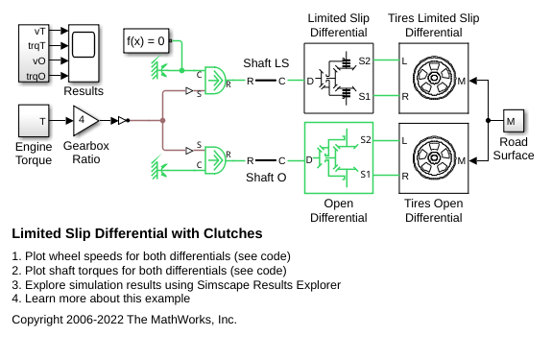
Limited Slip Differential with Clutches
A comparison between the behavior of an open differential and a limited slip differential with clutch packs. The limited slip differential is modeled using components from the Gears library and Clutches library in Simscape™ Driveline™. Wheel slip is limited by clutches that engage when the torque applied to the input of the differential exceeds a threshold. The clutches lock the differential so that the output shafts of the differential spin at the same speed.
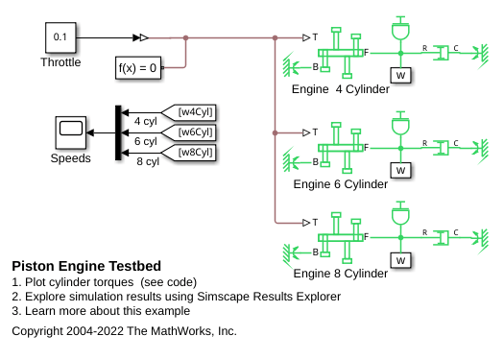
Piston Engine Testbed
The effect of varying the number of cylinders in a piston engine. Four, six, and eight cylinder engines are included with firing offsets evenly distributed about their four-stroke cycles. Piston pressures are normalized by the number of cylinders to emphasize the effect on output vibration.
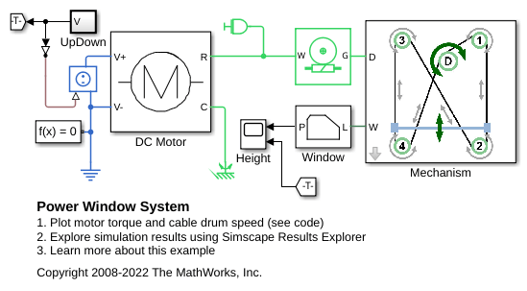
Power Window System
A motor-driven power window system. A DC motor drives the power window mechanism via a self-locking worm gear with the ratio 1 : 50. The power window mechanism consists of a cable drum and four pulleys all connected by a cable. The window is attached to the cable at two points by the lift plate. This ensures both sides of the window move at the same speed and in the same direction, keeping the window level. The model also includes viscous friction in the guide rails.
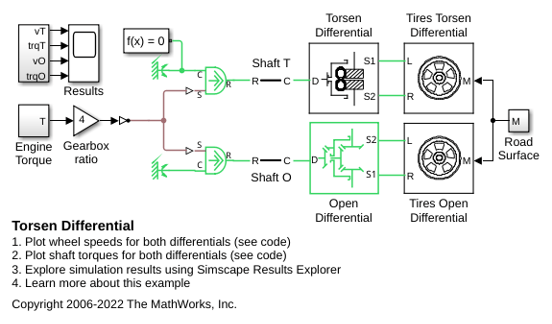
Torsen Differential
A comparison between the behavior of an open differential and a Torsen limited slip differential. The Torsen differential is modeled using components from the Gears library in Simscape™ Driveline™. Slip is limited in the Torsen differential because it uses non-backdrivable worm gears, which are modeled by Sun-Planet Worm Gear components. The result is higher torque applied to the wheel with greater traction, and identical speeds for the left and right axles.
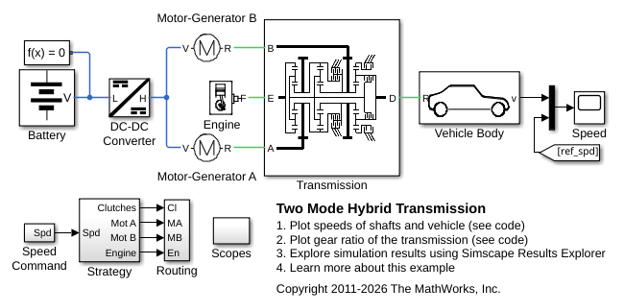
Two Mode Hybrid Transmission
The basic architecture of a two mode hybrid transmission. It consists of three planetary gear sets and four clutches. This combination permits four fixed gear ratios plus two power-split modes. The power split modes are used to transition between fixed gear ratios and for heavy acceleration/deceleration. The fixed ratios help with efficiency when cruising. For the first power split (input-split regime), only Clutch 1 is engaged. For the second power split (compound-split regime), only Clutch 2 is engaged. Engaging two clutches simultaneously removes one degree of freedom and hence results in a fixed ratio.
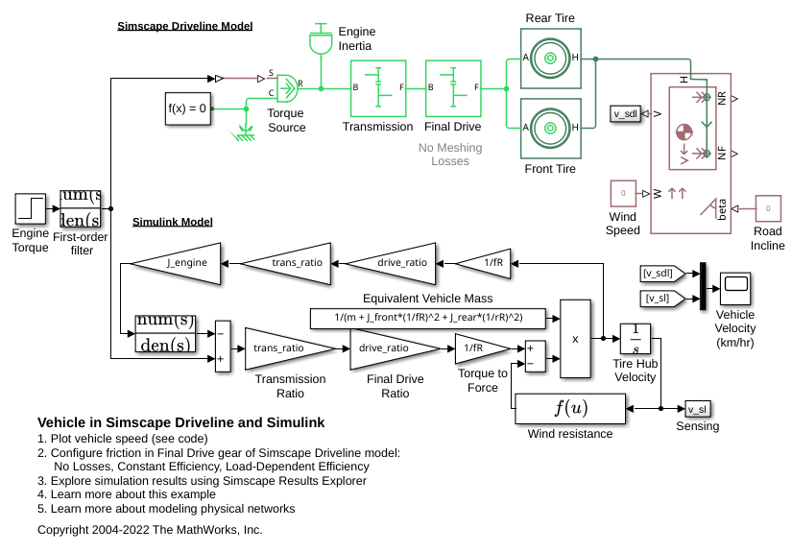
Simscape Driveline 和 Simulink 中的车辆模型
此模型展示了在 Simscape™ Driveline™ 和 Simulink® 中建模的两辆等效的简化车辆。仿真结果完全相同,并且 Simscape Driveline 模型易于扩展,可以包含不同的效应和更高水平的建模保真度。可以在不引入代数环的情况下添加齿轮啮合损耗和更详细的轮胎建模。
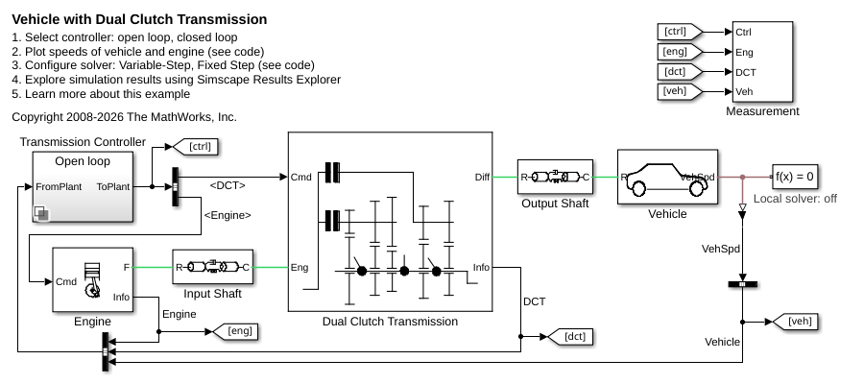
配备双离合变速器的车辆
此示例展示了一辆配备五速双离合变速器的车辆。换挡通过两个离合器实现,一个离合器的压力逐渐增大,同时另一个离合器的压力则逐渐降低。通过爪形离合器进行挡位预选,可确保在接合当前离合器之前,已完全挂入正确的挡位。
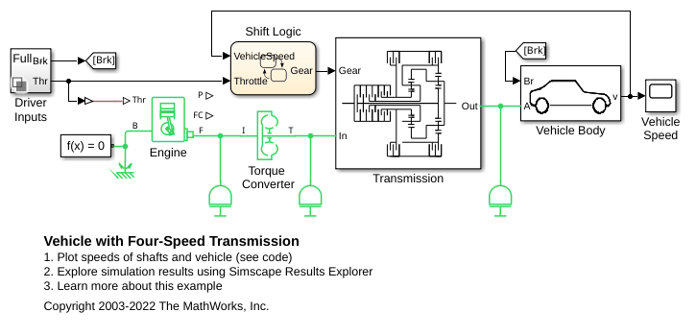
配备四速变速器的车辆
此示例展示了一辆由 Simscape™ Driveline™ 组件表示的完整车辆,包括发动机、动力传动系统、四速变速器、轮胎以及纵向车辆动态特性。变速器控制器在 Stateflow® 中作为状态机实现,根据节气门和车速选择挡位。
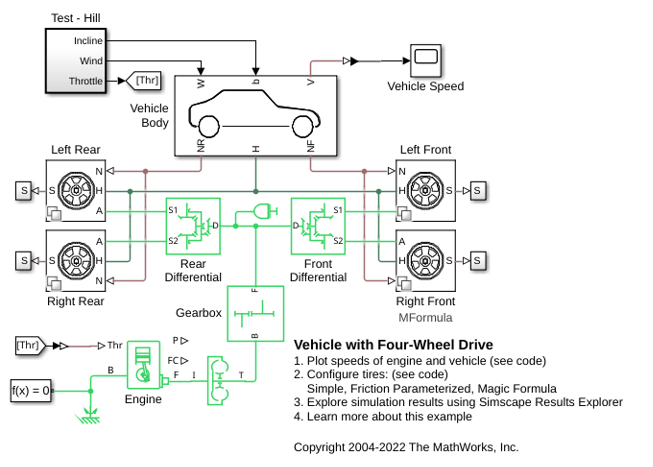
配备四轮驱动的车辆
此模型展示了一辆四轮驱动车辆从静止状态起步,爬升一个 15 度坡道的过程。车辆最初会向后溜车,直到发动机产生足够的扭矩来克服坡道阻力。随着车辆开始加速,可以观察到轮胎的柔性动态特性。通过模型中的超链接,可以将为所有轮胎选择的模型变体设置为“简单”、“摩擦参数化”或“魔术公式”轮胎模型。
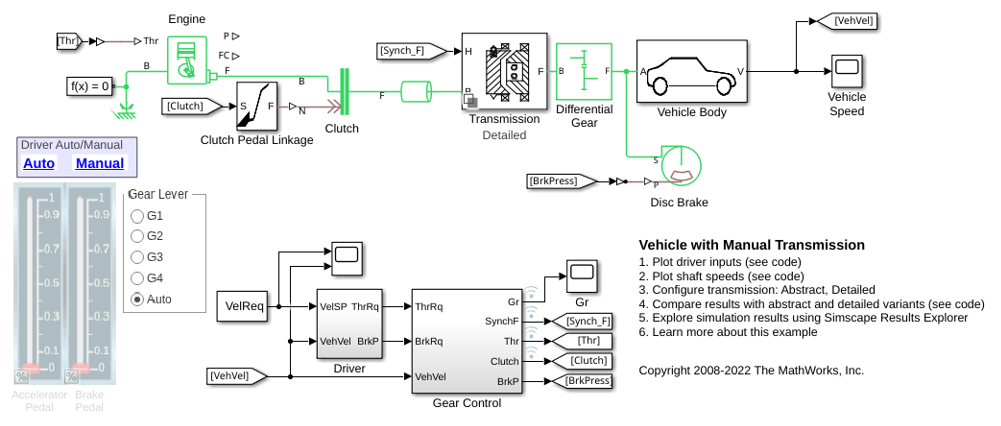
Vehicle with Manual Transmission
A vehicle that has a four-speed manual transmission. The key elements of the transmission are four synchronizers. By engaging or disengaging these synchronizers and associated dog clutches, the transmission provides four ratios 3.581, 2.022, 1.384, and 1, respectively. The synchronizers are modeled using the Cone Clutch and Dog Clutch blocks.
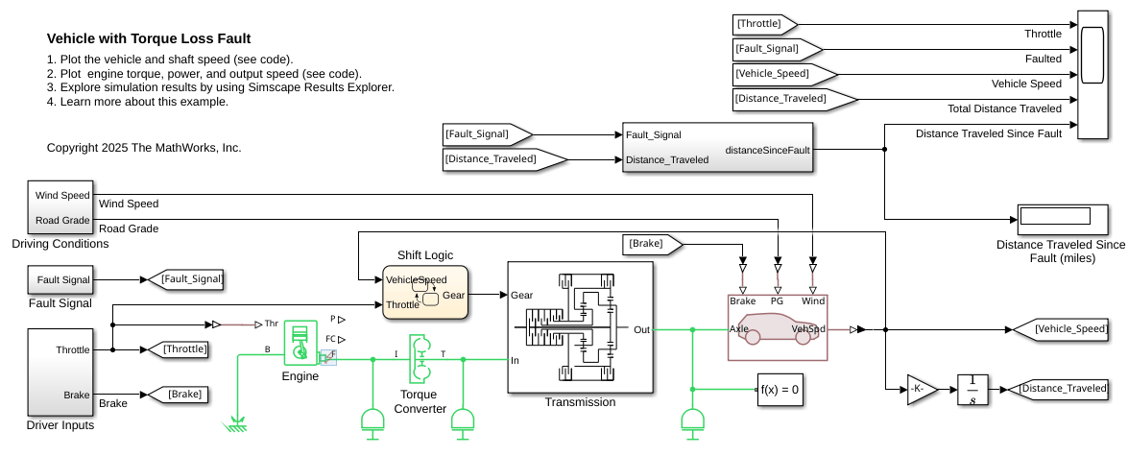
Vehicle with Torque Loss Fault
Effect of engine torque loss on the vehicle speed, clutch states, and engine variables including torque, rotational speed and power. This example includes a model of vehicle with four-speed transmission that experiences engine fault while in motion. The vehicle experiences loss of torque at specific time and the example models the vehicle response under the faulted condition. The engine loses torque while in faulted state. As a result of loss of torque, the engine stops producing power. Even though the driver continues to throttle, the engine does not produce any power after the fault occurs. The model simulates the distance traveled by vehicle from the moment the torque loss occurs until the vehicle comes to a complete stop.
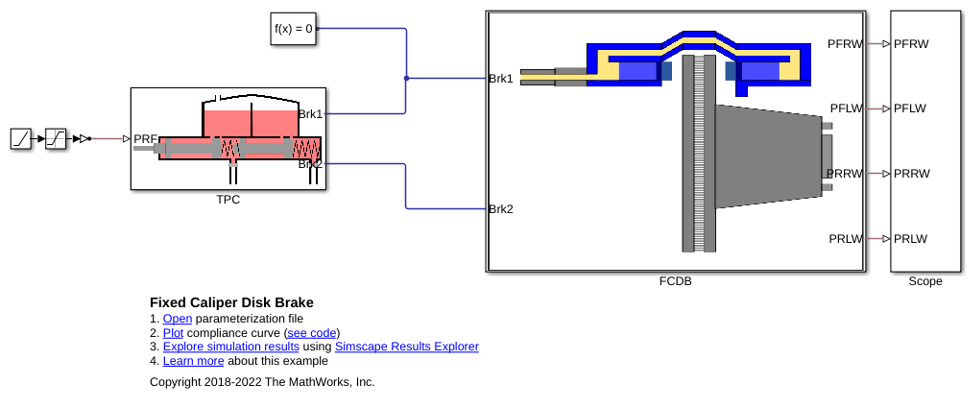
固定式卡钳盘式制动器
此示例展示了如何对卡钳盘式制动器进行建模、参数化和测试。该示例使用从串联主缸数据手册中提取的数值数据来确定卡钳盘式制动器的最佳设计。该示例还展示了如何生成卡钳盘式制动器的柔度曲线。

