Build and Simulate Electronic, Mechatronic, and Electrical Power System Networks
Learn essential modeling and simulation techniques, such as how to:
Switch between composite and expanded three-phase ports
Switch between physical signal and electrical ports
Simulate thermal effects using thermal ports
Topics
- Essential Electrical Modeling Techniques
Apply Simscape™ modeling rules when you build electronic, mechatronic, and electrical power system networks using Simscape Electrical™.
- Three-Phase Ports
Connect three-phase blocks using composite ports for three-phase lines or expanded ports for single-phase lines.
- Switch Between Physical Signal and Electrical Ports
Switch between a physical signal port and an electrical conserving port on a Simscape Electrical block.
- Selecting the Output Model for Logic Blocks
Explore the two output models available for logic blocks.
- Simulating an Electronic, Mechatronic, or Electrical Power System
Explore best practices and techniques for simulating Simscape Electrical models.
- Simulating Thermal Effects in Semiconductors
Simulate generated heat and device temperature by using the thermal ports.
- Simulating Thermal Effects in Rotational and Translational Actuators
Simulate generated heat and device temperature by using the thermal ports.
- Photovoltaic Thermal (PV/T) Hybrid Solar Panel
Model a multi-domain power cogeneration system using Simscape, Simscape Electrical, and Simscape Fluids™.
- Build and Simulate a Single-Phase Half-Bridge Inverter with Ideal Switches
Build a Simscape Electrical model of a single-phase half-bridge inverter with ideal switches, run the model, and examine the results.
- Build and Simulate Single-Phase Half-Bridge Inverter with Ideal Switches and Thermal Port
Build a Simscape Electrical model of a single-phase half-bridge inverter with ideal switches and a thermal port, run the model, and examine the results.
Featured Examples

Control DC Motor with PWM Voltage Source and H-Bridge Driver
Control a DC motor by using the Controlled PWM Voltage and H-Bridge blocks. The DC Motor block delivers a mechanical power of 10 W at 2500 rpm and turns at a no-load speed of 4000 rpm when the DC supply voltage is 12 V. Consequently, if you set the PWM reference voltage to its maximum value of 5 V, the motor runs at 4000 rpm. If you set the PWM reference voltage to 2.5 V, the motor runs at approximately 2000 rpm. To achieve fast simulation, this example sets the Simulation mode parameter of the Controlled PWM Voltage and H-Bridge blocks to Averaged. To validate the averaged behavior, set the Simulation mode parameter to PWM in both the Controlled PWM Voltage and H-Bridge blocks.
Model Triangle Wave Generator Using Operational Amplifiers
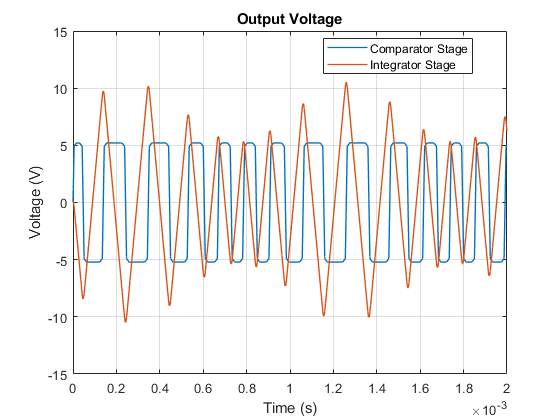
Model a triangle wave generator circuit by using two Band-Limited Op-Amp blocks. The first stage of the circuit represents a comparator constructed from an op-amp. Two Diode blocks model the Zener diodes that limit the output of the comparator to plus or minus 5 V. These limits result in a square wave.
Design Anti-Aliasing Filter for Analog-to-Digital Converters
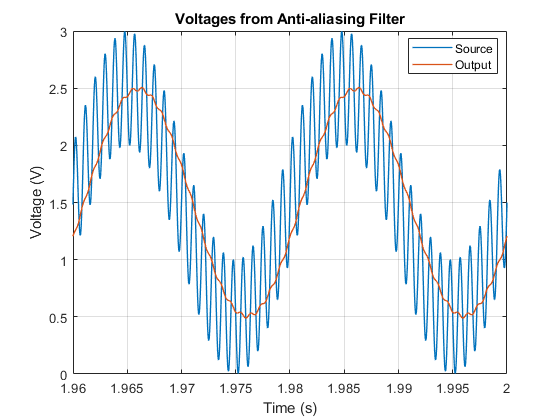
Design an analog anti-aliasing filter that you can use with an analog-to-digital (A-to-D) converter (ADC). The filter cut-off frequency is 500 Hz, corresponding to the Nyquist frequency which is half the ADC sampling frequency of 1 kHz. The test signal incorporates a desired 50 Hz sinusoid and a higher frequency component at 1100 Hz that you cannot capture with a 1 kHz A-to-D sampling frequency. The scope shows the captured signal with and without anti-aliasing. With the anti-aliasing filter, the ADC correctly measures the 50 Hz sine wave with an amplitude of 1 volt and a DC offset of 1.5 V.
PWM Circuit Using 555 Timer
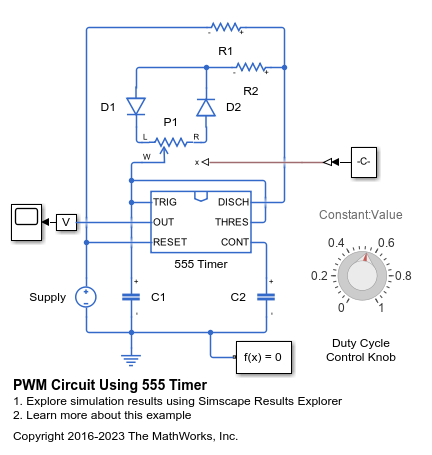
A pulse-width-modulated (PWM) output implemented using a 555 Timer in astable mode. The duty cycle is set by a potentiometer, P1. The potentiometer is controlled during run-time via Duty Cycle Control Knob. The scope shows the resultant output from the 555 Timer. To end the simulation, click on the Stop button.
Use of Peltier Device as Thermoelectric Cooler
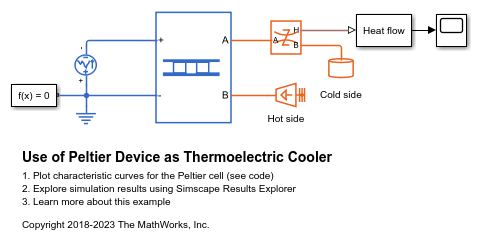
A Peltier device working in cooling mode with a hot side temperature of 50 degC. In cooling mode, the Coefficient of Performance (COP) of the Peltier cell is equal to the total heat transferred through the Thermoelectric cooler (TEC) divided by the electric input power, COP = Qc/Pin.
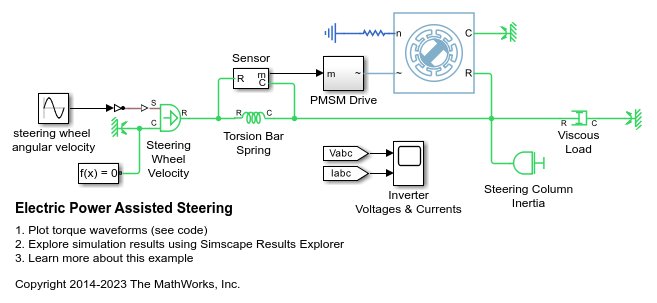
Electric Power Assisted Steering
Use a Permanent Magnet Synchronous Motor (PMSM) to amplify driver-applied force in a power-assisted automobile steering system.
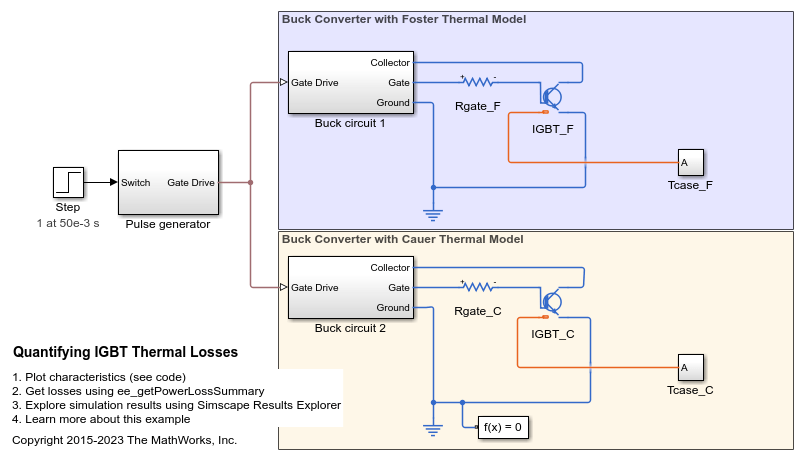
Quantifying IGBT Thermal Losses
The generation of a temperature profile based on switching and conduction losses in an insulated-gate bipolar transistor (IGBT). There are two buck converters. For one converter, the IGBT attaches to a Foster thermal model. For the other converter, the IGBT attaches to a Cauer thermal model. The parameters for the thermal models are tuned to give roughly equivalent results. At a simulation time of 50ms, the driving frequency changes from 40kHz to 20kHz, which increases the conduction losses and decreases the switching losses. The change in the losses results in a corresponding change in the temperature of the IGBT.
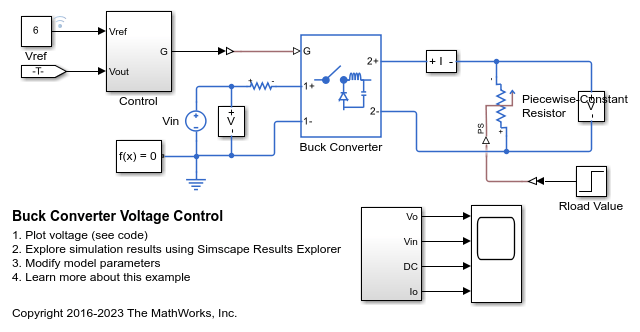
Buck Converter Voltage Control
Control the output voltage of a buck converter. To adjust the duty cycle, the Control subsystem uses a PI-based control algorithm. The input voltage is considered constant throughout the simulation. A variable resistor provides the load for the system. The total simulation time (t) is 0.25 seconds. At t = 0.15 seconds, the load changes.

Analyze Fuel Cell Performance
A Fuel Cell block with nominal parameters that operates at constant voltage and varying fuel flow rates at different hydrogen pressures. The power delivered varies as a function of the hydrogen pressure.
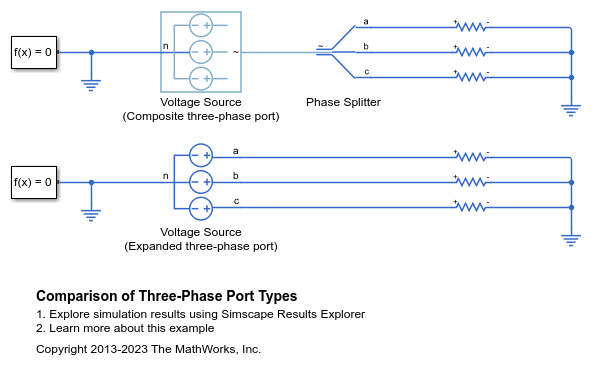
Comparison of Three-Phase Port Types
A comparison of Composite three-phase ports versus Expanded three-phase ports. The first circuit shows a Voltage Source configured with a Composite three-phase port. A Phase Splitter block provides the interface to the Simscape™ foundation library electrical elements. The second circuit shows a Voltage Source configured with an Expanded three-phase port which can connect directly to the Simscape foundation library electrical elements. The Voltage Source can be changed from Composite to Expanded three-phase ports by use of the Modeling option mask parameter.
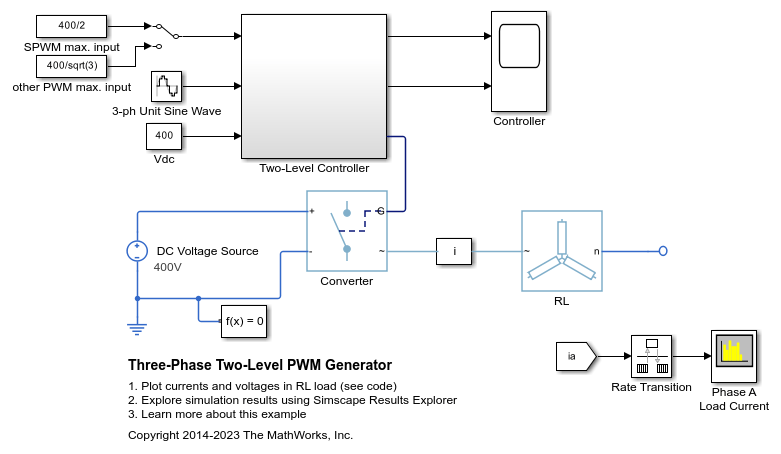
Three-Phase Two-Level PWM Generator
Use the PWM Generator (Three-phase, Two-level) to control a Converter. The inputs to the PWM Generator are reference AC waveforms and a DC-link voltage of 400 V. There is one time scope for the controller waveforms.
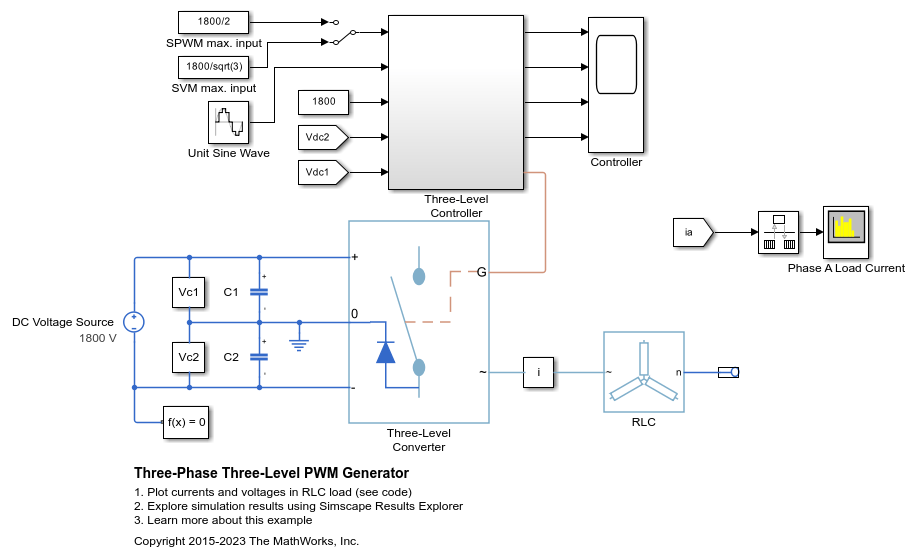
Three-Phase Three-Level PWM Generator
Use the PWM Generator (Three-phase, Three-level) to control a Three-Level Converter. The upper and lower supply voltages are input to a Neutral point controller, which balances the DC-link capacitor voltages. Reference AC waveforms are used as inputs to the PWM Generator. There is one time scope for the controller waveforms.

Custom Solenoid with Magnetic Hysteresis
A limited travel solenoid with return spring. Magnetic hysteresis is modeled using the Reluctance with Hysteresis library block.
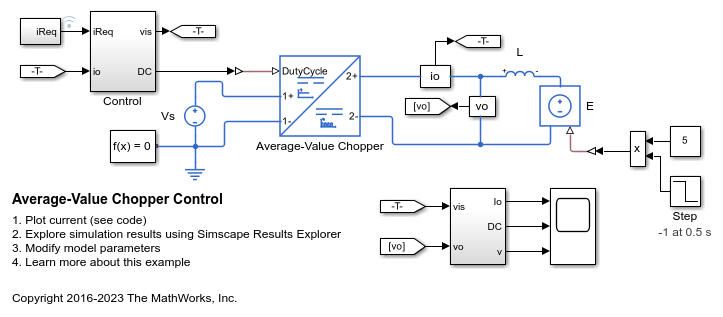
Average-Value Chopper Control
Control a four-quadrant chopper. The Control subsystem implements a simple PI-based control algorithm for controlling the output current. An average-value Chopper model is used to speed up the simulation. The simulation uses both positive and negative references. The total simulation time (t) is 1 s. At t = 0.5 s, the polarity of the load DC source E changes.

Energy Scavenger
How the performance of a rotational energy scavenger can be explored using a simple representative model. Electrical energy is produced from an off-center mass attached to the shaft of a DC motor. The mass, geometry, motor and electrical parameters must be matched to the expected mechanical excitation. The generated electrical power is less than the extracted mechanical power primarily due to motor winding losses and viscous damping for the rotor. This example is based on Nunna, K. "Constructive interconnection and damping assignment passivity-based control with applications", Imperial College London (2014). The model here is simplified in that the DC-DC converter is omitted.
Teaching Resources

DC Circuit Analysis
Learn the concepts of mesh and nodal analysis, Thevenin and Norton equivalent circuits, RL and RLC circuits, and op amps.

