daubfactors
R2026bSyntax
Description
Examples
Use the function daubfactors to obtain the quadrature mirror filters associated with a member of each Daubechies wavelet family.
Extremal Phase Wavelet
Obtain the scaling filter associated with the extremal phase wavelet with 6 vanishing moments. Confirm that the sum of the filter coefficients is 1.
n = 6;
wvf = "db";
h = daubfactors(n,wvf);
sum(h)
ans = 1
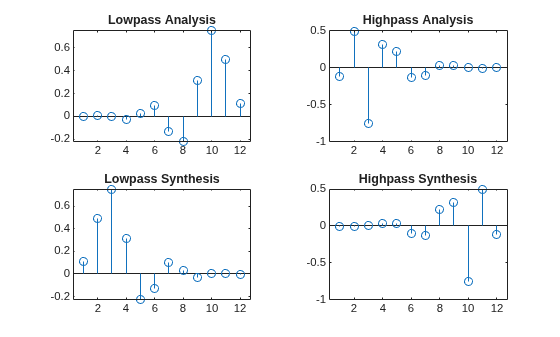
Use the function orthfilt to obtain the quadrature mirror filters associated with the wavelet. The first filter pair lod and hid are the lowpass and highpass decomposition (analysis) filters, respectively. The second filter pair lor and hir are the lowpass and highpass reconstruction (synthesis) filters, respectively. Plot the filters.
[lod,hid,lor,hir] = orthfilt(h); tiledlayout(2,2) nexttile stem(lod) title("Lowpass Analysis") nexttile stem(hid) title("Highpass Analysis") nexttile stem(lor) title("Lowpass Synthesis") nexttile stem(hir) title("Highpass Synthesis")
Choose a filter pair and use the function isorthwfb to confirm that the filter bank satisfies the necessary and sufficient conditions to be a two-channel orthonormal perfect reconstruction filter bank.
[tf,checks] = isorthwfb(lod,hid) %#ok<*ASGLU>tf = logical
1
checks = 7×3 table
Pass-Fail Maximum Error Test Tolerance
_________ _____________ ______________
Equal-length filters pass 0 0
Even-length filters pass 0 0
Unit-norm filters pass 1.1102e-15 1.4901e-08
Filter sums pass 2.2204e-16 1.4901e-08
Even and odd downsampled sums pass 2.2204e-16 1.4901e-08
Zero autocorrelation at even lags pass 1.0155e-15 1.4901e-08
Zero crosscorrelation at even lags pass 4.8572e-17 1.4901e-08
Least Asymmetric Wavelet
Obtain the scaling filter associated with the least asymmetric wavelet with 5 vanishing moments. Confirm that the sum of the filter coefficients is 1.
n = 9;
wvf = "sym";
h = daubfactors(n,wvf);
sum(h)ans = 1
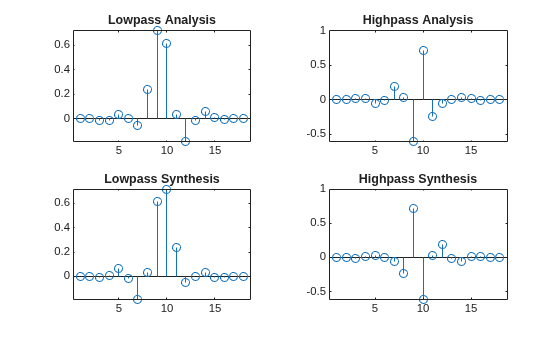
Obtain the associated quadrature mirror filters.
[lod,hid,lor,hir] = orthfilt(h); tiledlayout(2,2) nexttile stem(lod) title("Lowpass Analysis") nexttile stem(hid) title("Highpass Analysis") nexttile stem(lor) title("Lowpass Synthesis") nexttile stem(hir) title("Highpass Synthesis")
Use the scaling filter that daubfactors returns to confirm that the filter bank formed from the filter defines a two-channel orthonormal perfect reconstruction filter bank.
[tf,checks] = isorthwfb(h)
tf = logical
1
checks = 7×3 table
Pass-Fail Maximum Error Test Tolerance
_________ _____________ ______________
Equal-length filters pass 0 0
Even-length filters pass 0 0
Unit-norm filters pass 2.3315e-15 1.4901e-08
Filter sums pass 4.4409e-16 1.4901e-08
Even and odd downsampled sums pass 1.1102e-16 1.4901e-08
Zero autocorrelation at even lags pass 2.216e-15 1.4901e-08
Zero crosscorrelation at even lags pass 5.9307e-18 1.4901e-08
Complex Symlet
Obtain the scaling filter associated with the complex symlet with 11 vanishing moments. Confirm that the sum of the filter coefficients is 1.
n = 9;
wvf = "csym";
h = daubfactors(n,wvf);
sum(h)ans = 1.0000 + 0.0000i
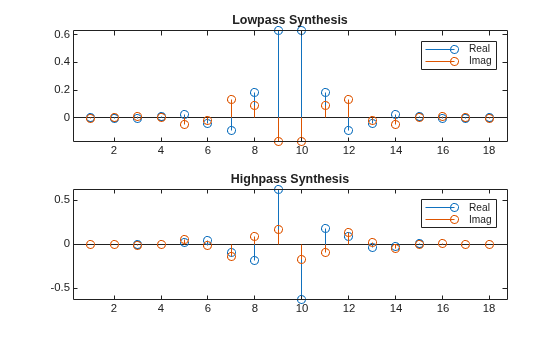
Obtain the associated quadrature mirror filters. Plot the real and imaginary parts of the synthesis filters. Because the complex symlet has an odd number of vanishing moments, the lowpass filter is symmetric about the midpoint.
[lod,hid,lor,hir] = orthfilt(h); tiledlayout(2,1) nexttile stem([real(lor).' imag(lor).']) title("Lowpass Synthesis") legend("Real","Imag") nexttile stem([real(hir).' imag(hir).']) title("Highpass Synthesis") legend("Real","Imag")
Confirm that the filter bank defines a two-channel orthonormal perfect reconstruction filter bank.
[tf,checks] = isorthwfb(lor,hir)
tf = logical
1
checks = 7×3 table
Pass-Fail Maximum Error Test Tolerance
_________ _____________ ______________
Equal-length filters pass 0 0
Even-length filters pass 0 0
Unit-norm filters pass 2.2204e-15 1.4901e-08
Filter sums pass 4.9685e-17 1.4901e-08
Even and odd downsampled sums pass 1.1411e-17 1.4901e-08
Zero autocorrelation at even lags pass 2.0348e-15 1.4901e-08
Zero crosscorrelation at even lags pass 2.2657e-17 1.4901e-08
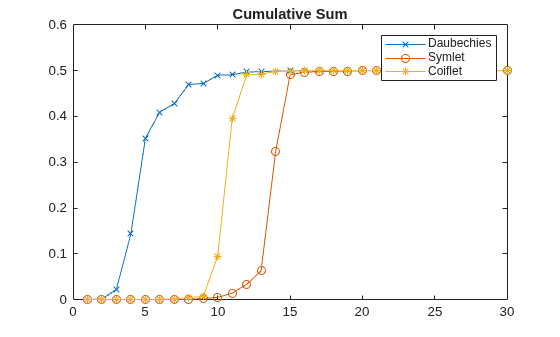
For a given support, the cumulative sum of the squared coefficients of a scaling filter increases more rapidly for an extremal phase wavelet than other wavelets.
Generate the scaling filter coefficients for the db15 and sym15 wavelets. Both wavelets have support of width .
n = 15;
lor_db = daubfactors(n);
lor_sym = daubfactors(n,"sym");Next, generate the scaling filter coefficients for the coif5 wavelet. This wavelet also has support of width .
lor_coif = coifwavf("coif5");Confirm that the sum of the coefficients for all three wavelets equals 1.
sum(lor_db)
ans =
1
sum(lor_sym)
ans = 1.0000
sum(lor_coif)
ans = 1.0000
Plot the cumulative sums of the squared coefficients. Note how rapidly the Daubechies sum increases. The sum increases rapidly because its energy is concentrated at small abscissas. Since the Daubechies wavelet has extremal phase, the cumulative sum of its squared coefficients increases more rapidly than the other two wavelets.
plot(cumsum(lor_db.^2),"x-")
hold on
plot(cumsum(lor_sym.^2),"o-")
plot(cumsum(lor_coif.^2),"*-")
hold off
legend("Daubechies","Symlet","Coiflet")
title("Cumulative Sum")
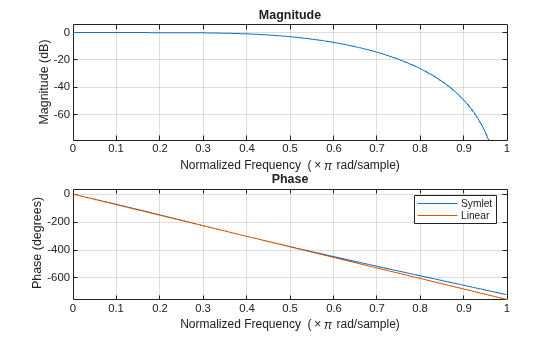
Obtain the scaling filter associated with the symlet of order 4.
n = 4;
scal_sym = daubfactors(n,"sym");
Use the function freqz (Signal Processing Toolbox) to plot the frequency response of the filter. Compare the phase angle with a linear phase filter.
freqz(scal_sym)
subPlots = get(gcf,"Children");
phasePlot = subPlots(2);
yLimits = get(phasePlot,"Ylim");
hold(phasePlot,"on");
plot(phasePlot,[0 1],[0 yLimits(1)])
legend(phasePlot,"Symlet","Linear")
hold(phasePlot,"off")
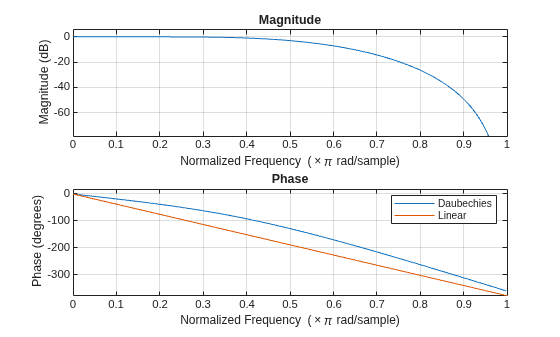
Obtain the scaling filter associated with the Daubechies wavelet of order 4. Plot the frequency response of the filter. Compare the phase angle with a linear phase filter.
db_sym = daubfactors(n);

freqz(db_sym)
subPlots = get(gcf,"Children");
phasePlot = subPlots(2);
yLimits = get(phasePlot,"Ylim");
hold(phasePlot,"on");
plot(phasePlot,[0 1],[0 yLimits(1)])
legend(phasePlot,"Daubechies","Linear")
hold(phasePlot,"off")
Input Arguments
Output Arguments
More About
References
[1] Shensa, M.J. “The Discrete Wavelet Transform: Wedding the a Trous and Mallat Algorithms.” IEEE Transactions on Signal Processing 40, no. 10 (1992): 2464–82. https://doi.org/10.1109/78.157290.
[2] Daubechies, I. Ten Lectures on Wavelets, CBMS-NSF Regional Conference Series in Applied Mathematics. Philadelphia, PA: SIAM Ed, 1992.
[3] Daubechies, Ingrid. “Orthonormal Bases of Compactly Supported Wavelets.” Communications on Pure and Applied Mathematics 41, no. 7 (1988): 909–96. https://doi.org/10.1002/cpa.3160410705.
[4] Lawton, W. “Applications of Complex Valued Wavelet Transforms to Subband Decomposition.” IEEE Transactions on Signal Processing 41, no. 12 (1993): 3566–68. https://doi.org/10.1109/78.258098.
[5] Lina, Jean-Marc, and Michel Mayrand. “Complex Daubechies Wavelets.” Applied and Computational Harmonic Analysis 2, no. 3 (1995): 219–29. https://doi.org/10.1006/acha.1995.1015.
[6] Xiao-Ping Zhang, M.D. Desai, and Ying-Ning Peng. “Orthogonal Complex Filter Banks and Wavelets: Some Properties and Design.” IEEE Transactions on Signal Processing 47, no. 4 (1999): 1039–48. https://doi.org/10.1109/78.752601.

