AI-Based CSI Feedback
R2026bCSI Feedback Process
In conventional 5G radio networks, the parameters for channel state information (CSI) are quantities that relate to the state of a channel and are derived from the channel estimate array computed by the user equipment (UE). The CSI feedback includes several parameters, such as the channel quality indication (CQI), the precoding matrix indices (PMI) with different codebook sets, and the rank indicator (RI).
The UE processes the CSI reference signal (CSI-RS) to measure and compute the CSI parameters, and to reduce the amount of CSI feedback data. The UE reports CSI parameters to the access network node (gNB) as feedback. The CSI-RS messaging and feedback between a gNB and UE, along with downlink data transmissions, are scheduled based on the CSI parameters.
As an alternative approach, the UE compresses and feeds back the channel estimate array. After receipt, the gNB decompresses and processes the channel estimate to determine downlink data link parameters. The compression and decompression can be achieved using an autoencoder neural network [[1], [2]]. This approach eliminates the use of existing quantized codebook and can improve overall system performance.
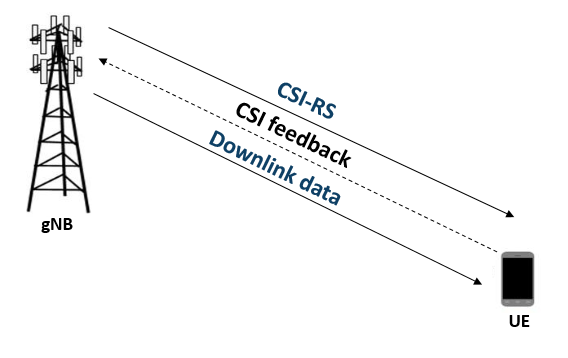
Upon receiving the CSI parameters, the gNB adjusts transmission parameters—such as modulation and coding schemes, precoding, and the number of transmission layers—to optimize downlink performance based on current channel conditions and then schedules downlink data transmissions.
Wireless channel prediction enhances the efficiency and reliability of data transmission in communication systems. Advancements in machine learning, particularly neural networks, offer a data-driven approach to wireless channel prediction. This approach does not rely on predefined models but instead learns directly from historical channel data. As a result, neural networks adapt to realistic data, which makes them less sensitive to disturbances and interference. Fundamentally, channel prediction using neural networks is a time series learning problem because it forecasts future channel states based on past estimations.
AI Workflow for CSI Feedback Compression and Prediction
Efficient CSI feedback is crucial for minimizing signal errors and maintaining robust data transmission across rapidly changing wireless channels. Bandwidth-intensive and slow-to-adapt traditional CSI feedback processing methods motivate the use of AI-driven, data-centric approaches. Neural networks, particularly autoencoders, can learn compact representations of highly dimensional CSI, enabling effective feedback compression. To gain effective feedback compression in your own autoencoding system, you can use 5G Toolbox™ to adopt an end-to-end, AI-driven, data-centric workflow.
Use these examples to explore the steps of the AI workflow for efficient and adaptive CSI feedback autoencoding in 5G networks.
Generate data.
Generate MIMO OFDM Channel Realizations for AI-Based Systems — Generate synthetic data for training and testing a CSI feedback compression network. In the example, you generate channel estimates to train AI-based systems, such as an autoencoder for channel state information (CSI) feedback compression and temporal channel prediction.
Generate Data for AI-Based 5G MIMO Channel Estimation — Generate training data for neural network channel estimators in a 5G NR MIMO-OFDM downlink.
Prepare a data set.
Preprocess Data for AI-Based CSI Feedback Compression — Preprocess channel realizations for CSI for neural network training.
Preprocess Data for AI-Based CSI Prediction — Preprocess channel realizations for training a gated recurrent unit (GRU) channel prediction network that enhances feedback on CSI.
Preprocess Data for AI Eigenvector-Based CSI Feedback Compression — Preprocess channel realizations for eigenvector-based CSI for neural network training.
Train a deep learning model.
Train Autoencoders for CSI Feedback Compression — Use neural networks to compress and reconstruct CSI data.
Train Transformer Autoencoder for Eigenvector-based CSI Feedback Compression — Use neural networks to compress and reconstruct eigenvector-based CSI data.
Train and Evaluate Neural Networks for 5G MIMO Channel Estimation — Train and compare three neural network architectures for channel estimation in a 5G NR MIMO-OFDM downlink
Test a deep learning model.
Test AI-based CSI Compression Techniques for Enhanced PDSCH Throughput — Evaluate the throughput of NR physical downlink shared channel links using deep learning models.
Deploy a deep learning model.
CSI Feedback with Autoencoders Implemented on an FPGA (Deep Learning HDL Toolbox) — Deploy autoencoder-based CSI feedback on hardware for real-time applications.
MATLAB and PyTorch Coexecution
After exploring the workflow steps above, see Call Python from MATLAB for Wireless to explore additional techniques in MATLAB® and PyTorch®, for training, testing, and code generation and hardware deployment, that show the potential of AI-based neural networks for efficient and adaptive CSI feedback in 5G networks.
References
[1] Wen, Chao-Kai, Wan-Ting Shih, and Shi Jin. “Deep Learning for Massive MIMO CSI Feedback.” IEEE Wireless Communications Letters 7, no. 5 (October 2018): 748–51. https://doi.org/10.1109/LWC.2018.2818160.
[2] Zimaglia, Elisa, Daniel G. Riviello, Roberto Garello, and Roberto Fantini. “A Novel Deep Learning Approach to CSI Feedback Reporting for NR 5G Cellular Systems.” In 2020 IEEE Microwave Theory and Techniques in Wireless Communications (MTTW), 47–52. Riga, Latvia: IEEE, 2020. https://doi.org/10.1109/MTTW51045.2020.9245055.

