主要内容

bellhopModel

R2026b

MATLAB interface to Bellhop beam tracing model

Since R2026b

    Description

    Add-On Required: This feature requires the Underwater Acoustic Channels add-on.

    The bellhopModel object provides an interface between MATLAB® and the Bellhop beam tracing model for underwater sound propagation. Configure Bellhop with parameters calculated in MATLAB. Use the object functions to calculate propagation paths and transmission losses between underwater sources and receivers with Bellhop. Summarize and visualize the results in MATLAB.

    Creation

    Description

    bhModel = bellhopModel creates a bellhopModel object with default property values.

    example

    bhModel = bellhopModel(PropertyName=Value) specifies one or more property values using name-value arguments.

    Properties

    expand all

    Sound Speed

    Underwater sound speeds in meters per second, specified as an M-by-1 positive column vector with at least two rows or an M-by-N positive matrix with at least two rows. M is the number of depth values in the profile. When specified as a matrix, N is the number of range values in the profile.

    For more information about the Munk profile, see [1].

    Data Types: double

    Depths in meters of the underwater sound speed profile, specified as an M-by-1 real column vector with at least two rows. M must equal the number of rows in SoundSpeed. A depth of 0 corresponds to a flat sea surface. Depth is positive toward the sea bottom, with negative values indicating points above a flat sea surface, such as the crest of a wave.

    The limits of SoundSpeedDepth must extend to at least the minimum depth of SurfaceAltimetryProfile and the maximum depth of BottomBathymetryProfile if you specify either property. If you specify sound speeds at depths downward starting from 0 meters in an environment with a non-flat sea surface, bellhopModel extrapolates from the sound speed at 0 meters upward to the maximum wave crest of SurfaceAltimetryProfile.

    For more information about the Munk profile, see [1].

    Data Types: double

    Ranges in meters of the underwater sound speed profile, specified as a 1-by-N positive row vector. The object uses SoundSpeedRange only when SoundSpeed is specified as a matrix. N must equal the number of columns in SoundSpeed.

    Data Types: double

    Sound speed interpolation method, specified as one of the values in the table:

    ValueBehavior
    "linear"

    One-dimensional linear interpolation.

    "n2-linear"One-dimensional distance-weighted linear interpolation.
    "pchip"

    Shape-preserving piecewise cubic interpolation.

    "cubic-spline"

    Cubic spline interpolation.

    "quadrilateral"

    Quadrilateral bilinear interpolation. This option is valid only when SoundSpeed is specified as a matrix.

    Data Types: char | string

    Sea Bottom

    Depths in meters of the sea floor between source and receiver, specified as "flat" or a two-column positive matrix. When specified as "flat", the depth for all ranges is the maximum depth specified by SoundSpeedDepth. When specified as a matrix, specify the first column as range in meters and the second as sea floor depths in meters.

    Data Types: double | char | string

    Sea floor reflection coefficients based on sediment type, specified as a scalar or a two-column complex-valued matrix. When specified as a scalar other than 1 or -1, the scalar value is expanded across grazing angles 0 degrees through 90 degrees. When specified as a matrix, specify the first column as the grazing angle in degrees and the second as complex-valued reflection coefficients.

    The object computes the default bottom coefficients using Zoeppritz equations assuming standard fluid-solid interface acoustics between sea water and clayey silt ocean floor.

    Data Types: double
    Complex Number Support: Yes

    Interpolation method for bottom bathymetry, specified as either "linear" or "curvilinear". Specify "linear" to use piecewise linear interpolation and "curvilinear" to use Bellhop's curvilinear interpolation.

    Data Types: char | string

    Sea Surface

    Heights in meters of sea surface between source and receiver, specified as the value "flat" or a two-column real matrix. When you specify this property as "flat", the height for all ranges is 0 meters. When you specify this property as a matrix, specify the first column as range in meters and the second as sea surface heights in meters.

    Data Types: double | char | string

    Sea surface reflection coefficients, specified as a scalar or a two-column complex-valued matrix. When specified as a scalar other than 1 or -1, the scalar is expanded across grazing angles 0 degrees through 90 degrees. When specified as a matrix, specify the first column as the grazing angle in degrees and the second as complex-valued reflection coefficients.

    Data Types: double
    Complex Number Support: Yes

    Interpolation method for surface altimetry, specified as either "linear" or "curvilinear". Specify "linear" to use piecewise linear interpolation and "curvilinear" to use Bellhop's curvilinear interpolation.

    Data Types: char | string

    Volume Attenuation

    Seawater attenuation model, specified as either "thorp" or "francois-garrison". By default, the object uses the Thorp model [2]. To use the Francois and Garrison [3] model, specify SeawaterAttenuation as "francois-garrison". The Francois and Garrison model computes attenuation using values set by the EffectiveSalinity, EffectiveTemperature, EffectiveAcidity, and EffectiveDepth properties.

    Data Types: char | string

    Practical salinity in parts per thousand, specified as a positive scalar. Practical salinity is defined by the Practical Salinity Scale (PSS-78) [4]. The object uses EffectiveSalinity only when you specify SeawaterAttenuation as "francois-garrison".

    Data Types: double

    Sea water temperature in degrees Celsius, specified as a scalar. EffectiveTemperature must be greater than –2. The object uses EffectiveTemperature only when you specify SeawaterAttenuation as "francois-garrison".

    Data Types: single | double

    Acidity of sea water on the pH scale, specified as a positive scalar. The object uses EffectiveAcidity only when you specify SeawaterAttenuation as "francois-garrison".

    Data Types: double

    Effective depth of sea water in meters, specified as a positive scalar. The object uses EffectiveDepth only when you specify SeawaterAttenuation as "francois-garrison".

    Data Types: double

    Ray Tracing

    Number of rays to shoot from the source, specified as either "auto" or a positive integer. Specify NumRays as "auto" for Bellhop to choose the number of rays automatically.

    Data Types: char | string | double

    Angles in degrees of rays shot from the source, specified as a 1-by-2 vector or an Nr-element vector. Positive values correspond to downward angles and negative values correspond to upward angles.

    When you specify RayElevationAngles as a 1-by-2 vector, angles are evenly spaced between the values specified. In this case, the first value is the lower limit and the second value is the upper limit. When you specify RayElevationAngles as an Nr-element vector, each value is the angle of departure for one ray. Nr must equal NumRays.

    Data Types: double

    Step size in meters of the numerical integrator in Bellhop, specified as either "auto" or a positive scalar. Specify StepSize as "auto" for Bellhop to choose the step size automatically.

    Data Types: double | char | string

    Beam shape accompanying each ray, specified as either "geometric-hat" or "geometric-gaussian". bellhopModel currently supports geometric beams in Cartesian coordinates only.

    Data Types: char | string

    Depth in meters at which Bellhop stops ray tracing, specified as either empty ([]) or a positive scalar. Specify RayTraceDepthLimit as empty to use the maximum depth defined by SoundSpeedDepth.

    Data Types: double

    Range in meters at which rays escape, specified as either empty ([]) or a positive scalar. Specify RayTraceRangeLimit as empty to use the range between the source and the receiver.

    Data Types: double

    Object Functions

    propagationPathsCalculate underwater propagation paths using Bellhop
    transmissionLossCalculate transmission loss in underwater environment

    Examples

    collapse all

    Create a bellhopModel object with the default parameters.

    bhModel = bellhopModel
    bhModel = 
      bellhopModel handle with properties:
    
                           SoundSpeed: [27×1 double]
                      SoundSpeedDepth: [27×1 double]
               SSPInterpolationMethod: "linear"
              BottomBathymetryProfile: "flat"
         BottomReflectionCoefficients: [181×2 double]
              SurfaceAltimetryProfile: "flat"
        SurfaceReflectionCoefficients: -1
    
      Show all properties


    Set the sea water attenuation method to be the Francois and Garrison model.

    bhModel.SeawaterAttenuation = "francois-garrison";
    get(bhModel)
                           SoundSpeed: [27×1 double]
                      SoundSpeedDepth: [27×1 double]
                      SoundSpeedRange: []
               SSPInterpolationMethod: "linear"
              BottomBathymetryProfile: "flat"
         BottomReflectionCoefficients: [181×2 double]
        BathymetryInterpolationMethod: "linear"
              SurfaceAltimetryProfile: "flat"
        SurfaceReflectionCoefficients: -1
         AltimetryInterpolationMethod: "linear"
                  SeawaterAttenuation: "francois-garrison"
                    EffectiveSalinity: 19.3000
                 EffectiveTemperature: 33.5000
                     EffectiveAcidity: 7.5000
                       EffectiveDepth: 4000
                              NumRays: "auto"
                   RayElevationAngles: [-30 30]
                             StepSize: "auto"
                             BeamType: "geometric-hat"
                   RayTraceDepthLimit: []
                   RayTraceRangeLimit: []
                    ShowAllProperties: 0
    

    You can also set properties of a bellhopModel object upon creation using name-value arguments. Create a bellhopModel object that uses piecewise cubic interpolation for its underwater sound speed profile.

    bhModelModified = bellhopModel(SSPInterpolationMethod="pchip")
    bhModelModified = 
      bellhopModel handle with properties:
    
                           SoundSpeed: [27×1 double]
                      SoundSpeedDepth: [27×1 double]
               SSPInterpolationMethod: "pchip"
              BottomBathymetryProfile: "flat"
         BottomReflectionCoefficients: [181×2 double]
              SurfaceAltimetryProfile: "flat"
        SurfaceReflectionCoefficients: -1
    
      Show all properties


    To run this example, you must have Bellhop installed, and you must also configure MATLAB with the Bellhop executable path by using the bellhopConfiguration function.

    Create a bellhopModel object with the default configuration.

    bhModel = bellhopModel
    bhModel = 
      bellhopModel handle with properties:
    
                           SoundSpeed: [27×1 double]
                      SoundSpeedDepth: [27×1 double]
               SSPInterpolationMethod: "linear"
              BottomBathymetryProfile: "flat"
         BottomReflectionCoefficients: [181×2 double]
              SurfaceAltimetryProfile: "flat"
        SurfaceReflectionCoefficients: -1
    
      Show all properties


    Calculate the propagation paths from a source at (0, 40, 1000) m with an operating frequency of 1000 Hz to a receiver at (20000, 35000, 1500) m.

    fc = 1000;
    srcLocation = [0;40;1e3];
    rxLocation = [20e3;35e3;1.5e3];
    propPaths = propagationPaths(bhModel,fc,srcLocation,rxLocation)
    propPaths = 9×7 table
        PathLoss    PathDelay    PhaseShift    AngleOfDeparture    AngleOfArrival    NumSurfaceReflections    NumBottomReflections
        ________    _________    __________    ________________    ______________    _____________________    ____________________
    
         87.628       26.84            90        0    -2.8651       0    -3.4277               0                       0          
         89.403      26.791             0        0     9.7373       0    -9.9433               0                       0          
         96.489      27.378        108.71        0     17.501       0     17.612               1                       1          
         96.834       27.18        94.175        0    -16.733       0     -16.82               1                       1          
         97.168      27.752       -38.287        0    -19.547       0     19.641               2                       1          
         98.455      26.874       -125.13        0     15.284       0    -15.376               0                       1          
         111.64      28.868        162.11        0     25.236       0    -25.301               1                       2          
         113.84      29.425       -14.018        0    -27.367       0    -27.427               2                       2          
         114.57      29.738       -12.728        0     28.364       0     28.421               2                       2          


    Plot the eigenrays at the receiver location.

    propagationPaths(bhModel,fc,srcLocation,rxLocation)
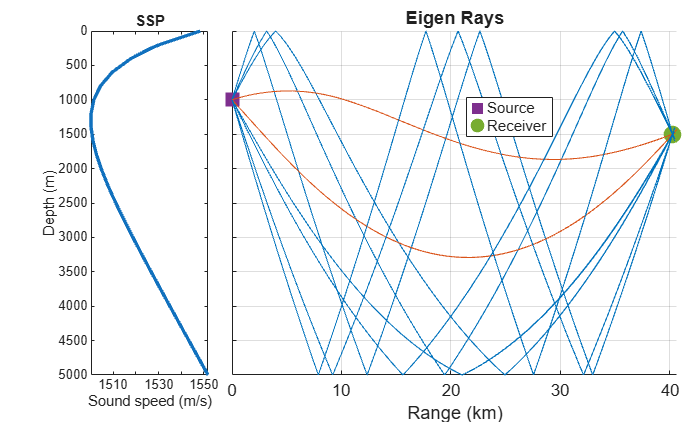
    Figure Bellhop Eigen Rays contains 2 axes objects. Axes object 1 with title SSP, xlabel Sound speed (m/s), ylabel Depth (m) contains an object of type line. Axes object 2 with title Eigen Rays, xlabel Range (km) contains 20 objects of type line. One or more of the lines displays its values using only markers These objects represent Source, Receiver.

    To run this example, you must have Bellhop installed, and you must also configure MATLAB with the Bellhop executable path by using the bellhopConfiguration function.

    Create a bellhopModel object with a maximum ray tracing range limit of 20 km.

    bhModel = bellhopModel(RayTraceRangeLimit=20e3);

    Plot the transmission loss from a source at (500, 300, 700) m with an operating frequency of 1000 Hz.

    fc = 1000;
    srcLocation = [500;300;700];
    transmissionLoss(bhModel,fc,srcLocation)
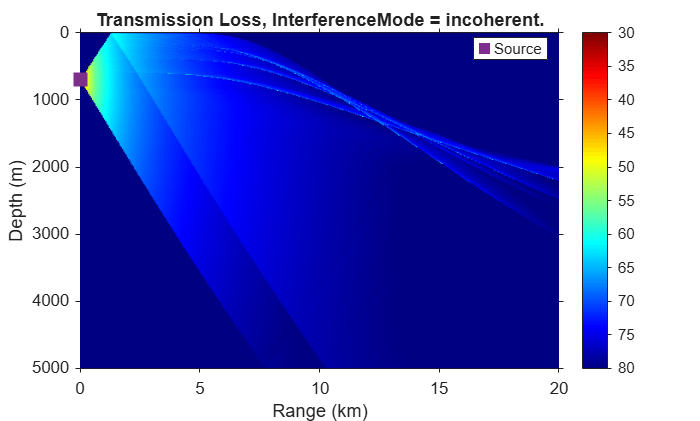
    Figure Bellhop Transmission Loss contains an axes object. The axes object with title Transmission Loss, InterferenceMode = incoherent., xlabel Range (km), ylabel Depth (m) contains 2 objects of type surface, line. One or more of the lines displays its values using only markers This object represents Source.

    Calculate the transmission loss for a receiver at (400, 3720, 2330) m.

    rxLocation = [400;3720;2330];
    tl = transmissionLoss(bhModel,fc,srcLocation,rxLocation)
    tl = 
    71.6842
    

    More About

    expand all

    References

    [1] Munk, Walter H. “Sound Channel in an Exponentially Stratified Ocean, with Application to SOFAR.” The Journal of the Acoustical Society of America 55, no. 2 (1974): 220–26. https://doi.org/10.1121/1.1914492.

    [2] Thorp, William H. “Analytic Description of the Low-Frequency Attenuation Coefficient.” The Journal of the Acoustical Society of America 42, no. 1 (1967): 270–270. https://doi.org/10.1121/1.1910566.

    [3] Francois, R. E., and G. R. Garrison. “Sound Absorption Based on Ocean Measurements. Part II: Boric Acid Contribution and Equation for Total Absorption.” The Journal of the Acoustical Society of America 72, no. 6 (1982): 1879–90. https://doi.org/10.1121/1.388673.

    [4] UNESCO, IWG. "The Practical Salinity Scale 1978 and the International Equation of State of Seawater 1980." Tenth Report of the Joint Panel on Oceanographic Tables and Standards (JPOTS) 25 (1981).

    Version History

    Introduced in R2026b