fit
R2026bDescription
The fit function fits a configured incremental neural network
model for classification (incrementalClassificationNeuralNetwork model object) or regression (incrementalRegressionNeuralNetwork model object) to streaming data. To
additionally track performance metrics using the data as it arrives, use updateMetricsAndFit
instead.
To fit or cross-validate a neural network classification or regression model to an entire
batch of data at once, see fitcnet or
fitrnet,
respectively.
Mdl = fit(Mdl,X,Y,Name=Value)
[
also returns solver convergence information in the structure
Mdl,ConvergenceInfo] = fit(___)ConvergenceInfo, using any of the input arguments from the previous
syntaxes.
Examples
Fit an incremental neural network classifier when you know only the expected maximum number of classes in the data.
Create an incremental neural network model. Specify that the maximum number of expected classes is 5.
clear
Mdl = incrementalClassificationNeuralNetwork(MaxNumClasses=5)
Mdl =
  incrementalClassificationNeuralNetwork

                   IsWarm: 0
                  Metrics: [1×2 table]
               ClassNames: [1×0 double]
           ScoreTransform: 'none'
               LayerSizes: 10
              Activations: "relu"
    OutputLayerActivation: "softmax"
                   Solver: "minibatch-lbfgs"


  Properties, Methods
Mdl is an incrementalClassificationNeuralNetwork model. All its properties are read-only. Mdl can process at most 5 unique classes. By default, the prior class distribution Mdl.Prior is empirical, which means the software updates the prior distribution as it encounters labels.
Mdl must be fit to data before you can use it to perform any other operations.
Load the human activity data set. Randomly shuffle the data.
load humanactivity
n = numel(actid);
rng(0,"twister") % For reproducibility
idx = randsample(n,n);
X = feat(idx,:);
Y = actid(idx);
For details on the data set, enter Description at the command line.
Fit the incremental model to the training data, in chunks of 50 observations at a time, by using the fit function. At each iteration:
Simulate a data stream by processing 50 observations.
Overwrite the previous incremental model with a new one fitted to the incoming observations.
Store the mean bias of the second layer and the prior probability that the subject is moving (
Y> 2) to see how these parameters evolve during incremental learning.
% Preallocation
numObsPerChunk = 50;
nchunk = floor(n/numObsPerChunk);
lb2 = zeros(nchunk,1);
priormoved = zeros(nchunk,1);
prev = zeros(10,60);
% Incremental fitting
for j = 1:nchunk
    ibegin = min(n,numObsPerChunk*(j-1) + 1);
    iend   = min(n,numObsPerChunk*j);
    idx = ibegin:iend;
    Mdl = fit(Mdl,X(idx,:),Y(idx));
    lb2(j) = mean(Mdl.LayerBiases{2});
    priormoved(j) = sum(Mdl.Prior(Mdl.ClassNames > 2));
    c = Mdl.LayerWeights{1};
    c-prev;
    prev = c;
end
Mdl is an incrementalClassificationNeuralNetwork model object trained on all the data in the stream.
To see how the parameters evolve during incremental learning, plot them on separate tiles.
t = tiledlayout(2,1);
nexttile
plot(lb2)
xlim([0 nchunk])
xline(Mdl.TrainingOptions.TuningPeriod/numObsPerChunk,"b--");
ylabel("Mean Layer 2 Bias")
nexttile
plot(priormoved)
xlim([0 nchunk])
ylabel("\pi(Subject Is Moving)")
xlabel(t,"Iteration")
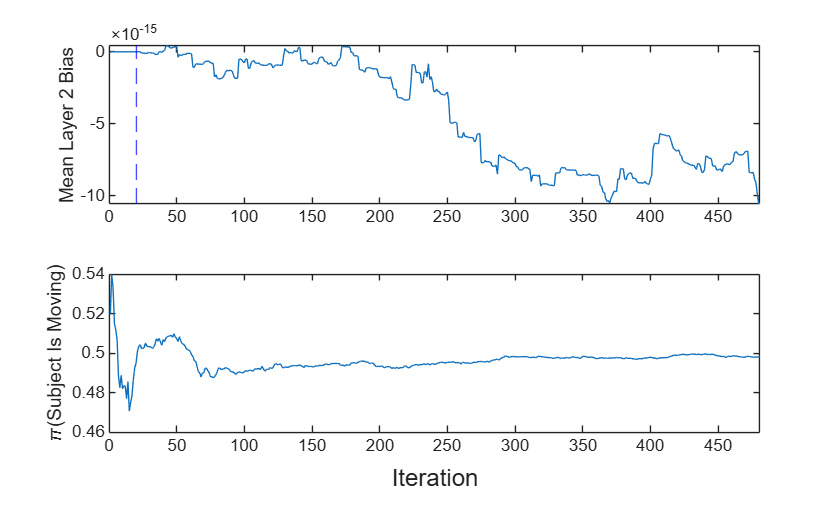
The plots indicate that Fit performs the following actions:
Fit the layer biases after the solver tuning period (blue vertical line) only.
Compute the prior probabilities during each iteration.
Because the prior class distribution is empirical, (subject is moving) changes as fit processes each chunk.
Incrementally train a neural network classification model only when its performance degrades.
Load the human activity data set. Randomly shuffle the data.
load humanactivity
n = numel(actid);
rng(0,"twister") % For reproducibility
idx = randsample(n,n);
X = feat(idx,:);
Y = actid(idx);
For details on the data set, enter Description at the command line.
Configure a neural network classification model for incremental learning so that the maximum number of expected classes is 5, and the metrics window size is 1000. Prepare the model for updateMetrics by fitting the model to the first 2000 observations, and store the classification error metric.
Mdl = incrementalClassificationNeuralNetwork(MaxNumClasses=5, ...
    MetricsWindowSize=1000,Metrics="classiferror");
initobs = 2000;
Mdl = fit(Mdl,X(1:initobs,:),Y(1:initobs));
Mdl is an incrementalClassificationNeuralNetwork model object.
Determine whether the model is warm by querying the model property.
isWarm = Mdl.IsWarm
isWarm = logical
   1
Mdl.IsWarm is 1; therefore, Mdl is warm.
Perform incremental learning, with conditional fitting, by following this procedure for each iteration:
Simulate a data stream by processing a chunk of 100 observations at a time.
Update the model performance on the incoming chunk of data.
Fit the model to the chunk of data only when the window misclassification error rate is greater than 0.05.
When tracking performance and fitting, overwrite the previous incremental model.
Store the misclassification error rate and the mean bias of the second layer to see how they evolve during training.
Track when
fittrains the model.
% Preallocation
numObsPerChunk = 100;
nchunk = floor((n - initobs)/numObsPerChunk);
lb2 = zeros(nchunk,1);
ce = array2table(nan(nchunk,2),VariableNames=["Cumulative","Window"]);
trained = false(nchunk,1);

% Incremental fitting
for j = 1:nchunk
    ibegin = min(n,numObsPerChunk*(j-1) + 1 + initobs);
    iend = min(n,numObsPerChunk*j + initobs);
    idx = ibegin:iend;
    Mdl = updateMetrics(Mdl,X(idx,:),Y(idx));
    ce{j,:} = Mdl.Metrics{"ClassificationError",:};
    if ce{j,2} > 0.05
        Mdl = fit(Mdl,X(idx,:),Y(idx));
        trained(j) = true;
    end
    lb2(j) = mean(Mdl.LayerBiases{2});
end
Mdl is an incrementalClassificationNeuralNetwork model object trained on all the data in the stream.
To see how the performance metrics and the mean bias of the second layer evolve during training, plot them on separate tiles.
t = tiledlayout(2,1);
nexttile
plot(lb2)
hold on
plot(find(trained),lb2(trained),"r.")
ylabel("Mean Layer 2 Bias")
xlim([0 nchunk]);
legend("Mean Layer 2 Bias","Training occurs",Location="best")
hold off
nexttile
plot(ce.Variables)
yline(0.05,"--")
xlim([0 nchunk])
ylabel("Misclassification Error Rate")
legend(ce.Properties.VariableNames,Location="best")
xlabel(t,"Iteration")
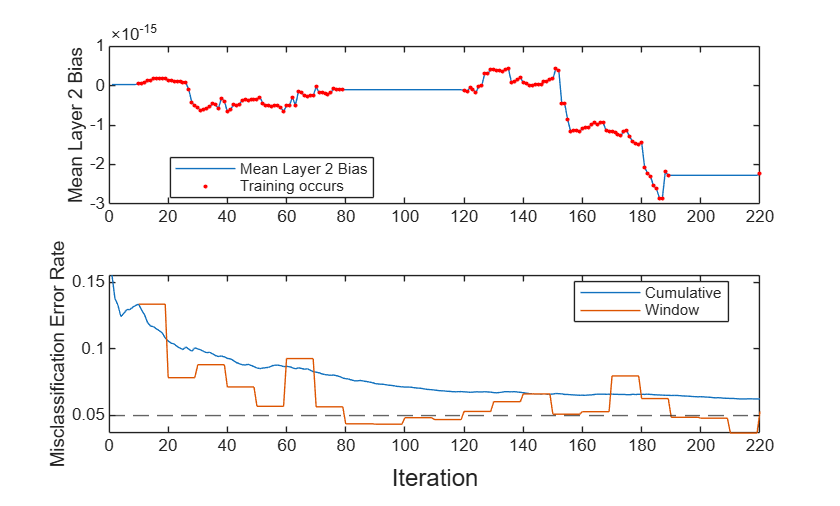
The trace plot of the mean layer 2 bias shows periods of constant values, during which the loss within the previous observation window is at most 0.05.
Input Arguments
Name-Value Arguments
Output Arguments
Tips
Unlike traditional training, incremental learning might not have a separate test (holdout) set. Therefore, to treat each incoming chunk of data as a test set, pass the incremental model and each incoming chunk to
updateMetricsbefore training the model on the same data.
Algorithms
Version History
Introduced in R2026b
See Also
Objects
Functions
fitcnet|fitrnet|predict|incrementalTrainingOptions|updateMetrics|updateMetricsAndFit|dlnetwork(Deep Learning Toolbox)

