updateMetrics
R2026bUpdate performance metrics in neural network incremental learning model given new data
Since R2026b
Description
Given streaming data, updateMetrics measures the performance of
a configured incremental neural network model for classification (incrementalClassificationNeuralNetwork model object) or regression (incrementalRegressionNeuralNetwork model object). updateMetrics
stores the performance metrics in the output model.
updateMetrics allows for flexible incremental learning. After you call
the function to update model performance metrics on an incoming chunk of data, you can perform
other actions before you train the model to the data. For example, you can decide whether you
need to train the model based on its performance on a chunk of data. Alternatively, you can
both update model performance metrics and train the model on the data as it arrives, in one
call, by using the updateMetricsAndFit
function.
To measure the model performance on a specified batch of data, call loss
instead.
Mdl = updateMetrics(Mdl,X,Y)Mdl, which is the input incremental learning model Mdl modified to contain the model performance metrics on the incoming
predictor and response data, X and Y
respectively.
When the input model is warm (Mdl.IsWarm is
true), updateMetrics overwrites previously computed
metrics, stored in the Metrics property, with the new values. Otherwise,
updateMetrics stores NaN values in
Metrics instead.
Examples
Train a neural network classification model by using fitcnet, convert it to an incremental learner, and then track its performance to streaming data.
Load and Preprocess Data
Load the human activity data set. Randomly shuffle the data.
load humanactivity
rng(0,"twister") % For reproducibility
n = numel(actid);
idx = randsample(n,n);
X = feat(idx,:);
Y = actid(idx);
For details on the data set, enter Description at the command line.
Train Neural Network Classification Model
Fit a neural network classification model to a random sample of half the data.
idxtt = randsample([true false],n,true);
TTMdl = fitcnet(X(idxtt,:),Y(idxtt))
TTMdl =
  ClassificationNeuralNetwork
             ResponseName: 'Y'
    CategoricalPredictors: []
               ClassNames: [1 2 3 4 5]
           ScoreTransform: 'none'
          NumObservations: 12039
               LayerSizes: 10
              Activations: 'relu'
    OutputLayerActivation: 'softmax'
                   Solver: 'LBFGS'
          ConvergenceInfo: [1×1 struct]
          TrainingHistory: [1000×7 table]


  Properties, Methods
TTMdl is a ClassificationNeuralNetwork model object representing a traditionally trained model.
Convert Trained Model
Convert the traditionally trained classification model to a model for incremental learning. Specify to track the classification error metric and use the FreeRex solver, which does not require a solver tuning period.
IncrementalMdl = incrementalLearner(TTMdl,Metrics="classiferror", ...
TrainingOptions=incrementalTrainingOptions("freerex"))
IncrementalMdl =
  incrementalClassificationNeuralNetwork

                   IsWarm: 1
                  Metrics: [2×2 table]
               ClassNames: [1 2 3 4 5]
           ScoreTransform: 'none'
               LayerSizes: 10
              Activations: "relu"
    OutputLayerActivation: "softmax"
                   Solver: "freerex"


  Properties, Methods
IncrementalMdl is an incrementalClassificationNeuralNetwork model. The model display shows that the model is warm (IsWarm is 1). Therefore, updateMetrics can track model performance metrics given data.
Track Performance Metrics
Track the model performance on the rest of the data by using the updateMetrics function. Simulate a data stream by processing 50 observations at a time. At each iteration:
Call
updateMetricsto update the cumulative and window classification error of the model given the incoming chunk of observations. Overwrite the previous incremental model to update theMetricsproperty. Note that the function does not fit the model to the chunk of data—the chunk is "new" data for the model.Store the classification error and mean bias of the second layer.
% Preallocation
idxil = ~idxtt;
nil = sum(idxil);
numObsPerChunk = 50;
nchunk = floor(nil/numObsPerChunk);
mc = array2table(zeros(nchunk,2),VariableNames=["Cumulative","Window"]);
lb2 = zeros(nchunk,1);
Xil = X(idxil,:);
Yil = Y(idxil);

% Incremental fitting
for j = 1:nchunk
    ibegin = min(nil,numObsPerChunk*(j-1) + 1);
    iend   = min(nil,numObsPerChunk*j);
    idx = ibegin:iend;
    IncrementalMdl = updateMetrics(IncrementalMdl,Xil(idx,:),Yil(idx));
    mc{j,:} = IncrementalMdl.Metrics{"ClassificationError",:};
    lb2(j) = mean(IncrementalMdl.LayerBiases{2});
end
IncrementalMdl is an incrementalClassificationNeuralNetwork model object that has tracked the model performance to observations in the data stream.
To see how the parameters evolve during incremental learning, plot them on separate tiles.
t = tiledlayout(2,1);
nexttile
plot(mc.Variables)
xlim([0 nchunk])
ylabel("Classification Error")
legend(mc.Properties.VariableNames)
nexttile
plot(lb2)
ylabel("Mean Layer 2 Bias")
xlim([0 nchunk]);
xlabel(t,"Iteration")
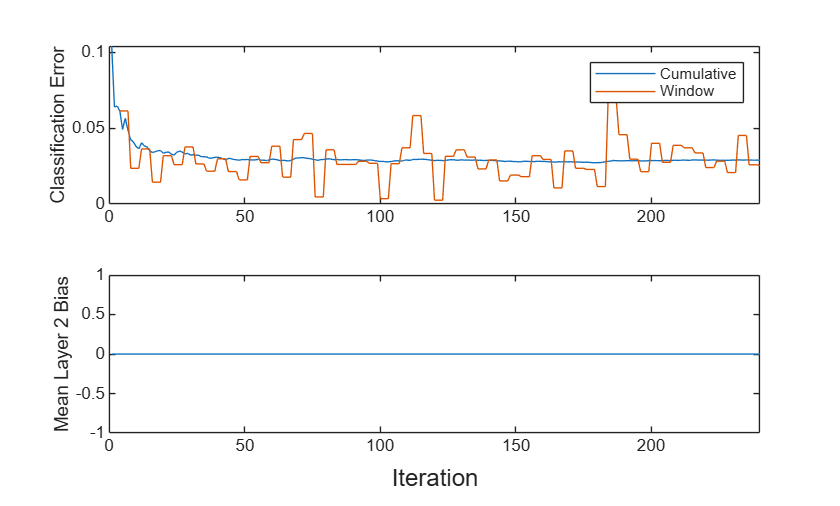
The cumulative loss is stable after approximately the tenth iteration, whereas the window loss jumps throughout the training. The mean layer 2 bias does not change because updateMetrics does not fit the model to the data.
Train a neural network classification model by using fitcnet, convert it to an incremental learner, track its performance on streaming data, and then fit the model to the data. For incremental learning functions, orient the observations in columns, and specify observation weights.
Load and Preprocess Data
Load the human activity data set. Randomly shuffle the data.
load humanactivity
rng(0,"twister"); % For reproducibility
n = numel(actid);
idx = randsample(n,n);
X = feat(idx,:);
Y = actid(idx);
For details on the data set, enter Description at the command line.
Suppose that the data from a stationary subject (Y <= 2) has double the quality of the data from a moving subject. Create a weight variable that assigns a weight of 2 to observations from a stationary subject and 1 to a moving subject.
W = ones(n,1) + (Y <=2);
Train Neural Network Classification Model
Fit a neural network classification model to a random sample of half the data. Specify observation weights.
idxtt = randsample([true false],n,true);
TTMdl = fitcnet(X(idxtt,:),Y(idxtt),Weights=W(idxtt))
TTMdl =
  ClassificationNeuralNetwork
             ResponseName: 'Y'
    CategoricalPredictors: []
               ClassNames: [1 2 3 4 5]
           ScoreTransform: 'none'
          NumObservations: 12039
               LayerSizes: 10
              Activations: 'relu'
    OutputLayerActivation: 'softmax'
                   Solver: 'LBFGS'
          ConvergenceInfo: [1×1 struct]
          TrainingHistory: [1000×7 table]


  Properties, Methods
TTMdl is a ClassificationNeuralNetwork model object representing a traditionally trained neural network classification model.
Convert Trained Model
Convert the traditionally trained model to a model for incremental learning. Specify to use the FreeRex solver, a metrics warm-up period of 1000 observations, and to track the classification error metric.
IncrementalMdl = incrementalLearner(TTMdl, ...
TrainingOptions=incrementalTrainingOptions("freerex"), ...
MetricsWarmupPeriod=1000,Metrics="classiferror")
IncrementalMdl =
  incrementalClassificationNeuralNetwork

                   IsWarm: 0
                  Metrics: [2×2 table]
               ClassNames: [1 2 3 4 5]
           ScoreTransform: 'none'
               LayerSizes: 10
              Activations: "relu"
    OutputLayerActivation: "softmax"
                   Solver: "freerex"


  Properties, Methods
IncrementalMdl is an incrementalClassificationNeuralNetwork model. Because class names are specified in IncrementalMdl.ClassNames, labels encountered during incremental learning must be in IncrementalMdl.ClassNames.
Separately Track Performance Metrics and Fit Model
Perform incremental learning on the rest of the data by using the updateMetrics and fit functions. For incremental learning, orient the observations of the predictor data in columns. At each iteration:
Simulate a data stream by processing 50 observations at a time.
Call
updateMetricsto update the cumulative and window classification error of the model given the incoming chunk of observations. Overwrite the previous incremental model to update the losses in theMetricsproperty. Note that the function does not fit the model to the chunk of data—the chunk is "new" data for the model. Specify that the observations are oriented in columns, and specify the observation weights.Store the classification error.
Call
fitto fit the model to the incoming chunk of observations. Overwrite the previous incremental model to update the model parameters. Specify that the observations are oriented in columns, and specify the observation weights.
% Preallocation
idxil = ~idxtt;
nil = sum(idxil);
numObsPerChunk = 50;
nchunk = floor(nil/numObsPerChunk);
mc = array2table(zeros(nchunk,2),VariableNames=["Cumulative","Window"]);
Xil = X(idxil,:)';
Yil = Y(idxil);
Wil = W(idxil);

% Incremental fitting
for j = 1:nchunk
    ibegin = min(nil,numObsPerChunk*(j-1) + 1);
    iend   = min(nil,numObsPerChunk*j);
    idx = ibegin:iend;
    IncrementalMdl = updateMetrics(IncrementalMdl,Xil(:,idx),Yil(idx), ...
        Weights=Wil(idx),ObservationsIn="columns");
    mc{j,:} = IncrementalMdl.Metrics{"ClassificationError",:};
    IncrementalMdl = fit(IncrementalMdl,Xil(:,idx),Yil(idx), ...
        Weights=Wil(idx),ObservationsIn="columns");
end
IncrementalMdl is an incrementalClassificationNeuralNetwork model object trained on all the data in the stream.
Alternatively, you can use updateMetricsAndFit to update performance metrics of the model given a new chunk of data, and then fit the model to the data.
Plot a trace plot of the performance metrics.
plot(mc.Variables)
xlim([0 nchunk])
xline(IncrementalMdl.MetricsWarmupPeriod/numObsPerChunk,"r-.");
legend(mc.Properties.VariableNames)
ylabel("Classification Error")
xlabel("Iteration")
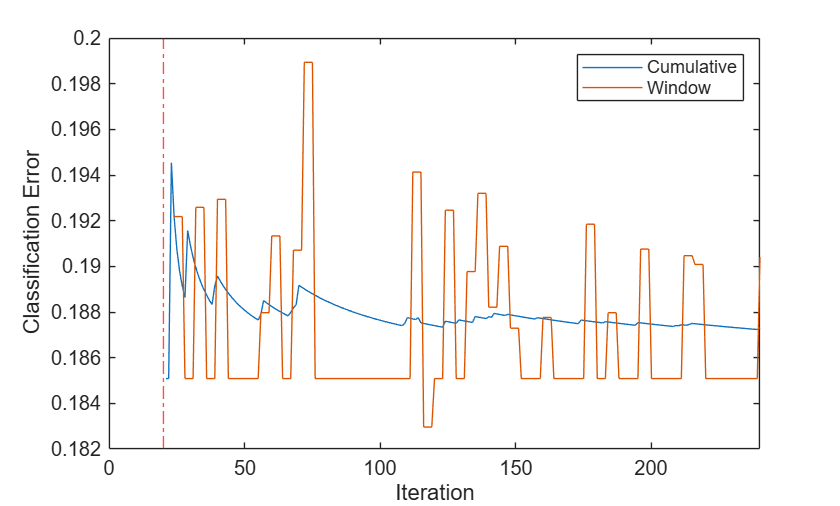
After the metrics warm-up period (vertical red line), the cumulative loss gradually stabilizes, whereas the window loss jumps throughout the training.
Input Arguments
Name-Value Arguments
Output Arguments
Tips
Unlike traditional training, incremental learning might not have a separate test (holdout) set. Therefore, to treat each incoming chunk of data as a test set, pass the incremental model and each incoming chunk to
updateMetricsbefore training the model on the same data usingfit.
Algorithms
Version History
Introduced in R2026b
See Also
Objects
Functions
fitcnet|fitrnet|fit|updateMetricsAndFit|dlnetwork(Deep Learning Toolbox)

