segmentObjects
R2026bDescription
The segmentObjects function segments all objects that
have been added to the sam2VideoObjectSegmenter object on a specified video frame, returning
binary masks and confidence scores for each object.
Call segmentObjects after adding at least one object for
segmentation using addObjectsToSegment. You can call
segmentObjects on any frame in any order and SAM 2 propagates
object identity from prompted frames to the requested frame using temporal processing.
However, processing frames sequentially enables SAM 2 to build temporal context more
effectively.
You can visualize results using the insertObjectMask
function.
Note
This functionality requires the Image Processing Toolbox™ Model for Segment Anything Model 2 add-on.
[
segments all added objects on the video frame specified by
masks,objectIDs,maskScores] = segmentObjects(vidSegmenter,frameId)frameId and returns the binary segmentation masks
masks, the corresponding object identifiers
objectIDs, and per-pixel confidence scores
maskScores.
Examples
Segment and track multiple vehicles across video frames using a sam2VideoObjectSegmenter object. Use Grounding DINO to detect vehicles, then use addObjectsToSegment to specify which objects to track. This example demonstrates how identity drift occurs when frames are processed sparsely, how sequential processing prevents drift by building temporal context, and how to use removeObjectsToSegment to manage object lifecycles in long videos.
Create a Grounding DINO object detector configured to detect vehicles.
gdino = groundingDinoObjectDetector("swin-tiny",ClassNames="vehicle");
Create a SAM 2 video object segmenter by specifying an input video which shows vehicle traffic on a highway.
vidSegmenter = sam2VideoObjectSegmenter("visiontraffic.avi");Configuring Segment Anything Model 2 (SAM 2)
Loading video
Write images extracted to folder:
C:\Users\user\AppData\Local\Temp\tp9c2373e5_6819_42ca_82e0_0100767b85c4
Writing images extracted from visiontraffic.avi: 0/531
Completed.
Preprocessing complete
Initializing SAM 2 temporal processing. This operation can take several minutes.
Add Multiple Objects on a Single Frame
Detect vehicles on frame 140 and visualize the detections.
img140 = imread(vidSegmenter.FramePaths(140));
bboxes140 = detect(gdino,img140);
annotatedImg = insertObjectAnnotation(img140,"rectangle",bboxes140, ...
    "vehicle " + (1:size(bboxes140,1)));
figure
imshow(annotatedImg)
title("Detected Vehicles — Frame 140")
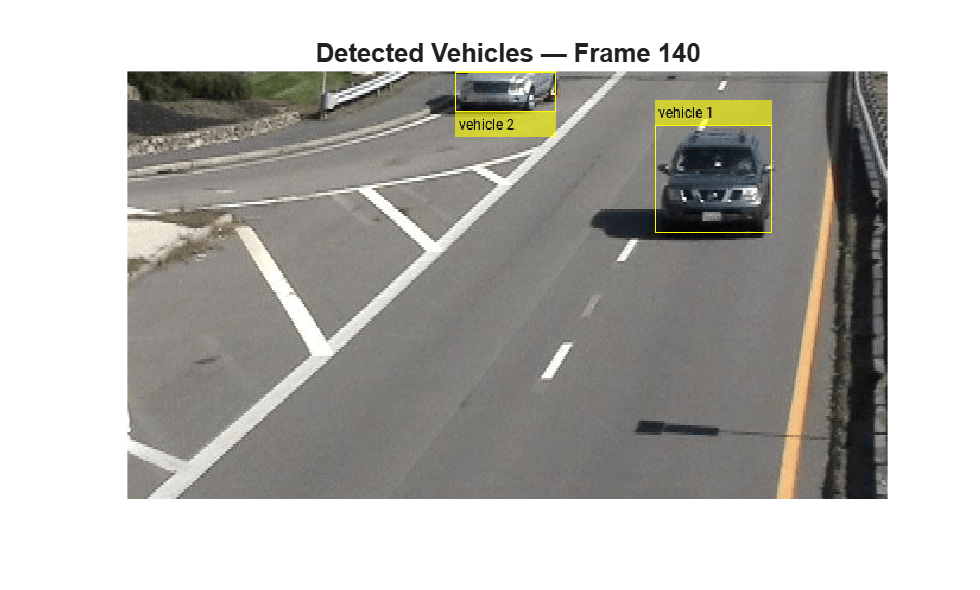
Add all detected vehicles for segmentation on frame 140. Use a vector of object IDs with a scalar frame number. Provide the bounding box prompts as a cell array.
numVehicles140 = size(bboxes140,1);
objectIDs = ["vehicle_1" "vehicle_2"];
bboxCell = cell(numVehicles140,1);
for i = 1:numVehicles140
    bboxCell{i} = bboxes140(i,:);
end
addObjectsToSegment(vidSegmenter,objectIDs,140, ...
    ObjectBoundingBox=bboxCell);
Observe Identity Drift During Sparse Processing
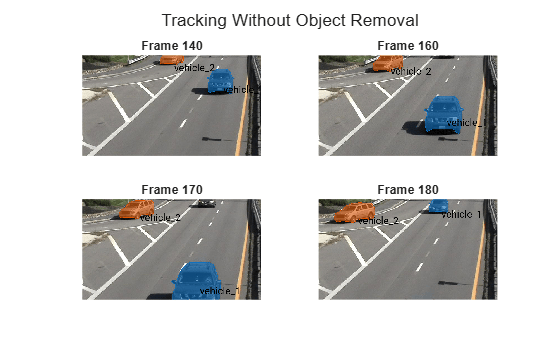
Segment and visualize frames 140, 160, 170 and 180. By frame 170, one of the original vehicles begins leaving the frame while a new vehicle enters from the opposite side.
By frame 180, the segmenter associates the newly entering vehicle with the identity of the vehicle that left the scene. This identity drift occurs because the segmenter was called on sparse frames (140, 160, 170, 180) rather than sequentially. Without the intermediate frames showing the object gradually leaving, the model lacks temporal context to distinguish departure from continued presence and latches onto a visually similar object.
framesToVisualize = [140 160 170 180];
colors = lines(numVehicles140);
figure
tiledlayout(2,2,TileSpacing="compact")
for i = 1:numel(framesToVisualize)
    fIdx = framesToVisualize(i);
    [masks,idsOut] = segmentObjects(vidSegmenter,fIdx);
    img = imread(vidSegmenter.FramePaths(fIdx));
    maskedImg = insertObjectMask(img,masks,MaskColor=colors);

    % Label each mask with its object ID at the mask centroid.
    for k = 1:numel(idsOut)
        [r,c] = find(masks(:,:,k));
        pos = [mean(c) mean(r)];
        maskedImg = insertText(maskedImg,pos,idsOut(k), ...
            FontSize=35,BoxOpacity=0,TextColor="black");
    end

    nexttile
    imshow(maskedImg)
    title("Frame " + fIdx)
end
sgtitle("Tracking Without Object Removal")
Prevent Identity Drift with Sequential Processing
Processing frames sequentially enables the segmenter to build temporal context and naturally handle object departures without identity drift. In addition, explicitly removing departed objects using removeObjectsToSegment frees resources and ensures the segmenter does not search for them in subsequent frames.
Reset the segmenter and add the same vehicles on frame 140.
removeObjectsToSegment(vidSegmenter,objectIDs);
addObjectsToSegment(vidSegmenter,objectIDs,140, ...
     ObjectBoundingBox=bboxCell);
Segment frames sequentially from 170 to 180. Sequential processing builds temporal context that prevents drift. To detect departures, compare the object IDs returned by the segmentObjects function against the previously tracked set. When you detect a departure, call removeObjectsToSegment to free resources. You can also monitor mask area trends as an alternative method to detect departure before the object fully exits.
startFrame = 170;
endFrame = 180;

prevIDs = objectIDs;
removedObjects = strings(0);

figure
tiledlayout(2,2,TileSpacing="compact")

for idx = startFrame:2:endFrame
    [masks,idsOut] = segmentObjects(vidSegmenter,idx);
    fprintf("Frame %d: Detected Objects %s\n",idx,strjoin(idsOut,", "));
    % Detect which objects are no longer returned.
    departed = setdiff(prevIDs,idsOut);
    % Remove objects that have departed
    if ~isempty(departed)
        fprintf("Frame %d: Removing %s\n",idx,strjoin(departed,", "));
        removeObjectsToSegment(vidSegmenter,departed);
        removedObjects = [removedObjects,departed]; %#ok<AGROW>
    end
    prevIDs = idsOut;

    % Visualize masks
    if ismember(idx,[170 174 178 180])
        img = imread(vidSegmenter.FramePaths(idx));
        maskedImg = insertObjectMask(img,masks,MaskColor=colors(1:size(idsOut,2),:));
        for k = 1:numel(idsOut)
            [r,c] = find(masks(:,:,k));
            pos = [mean(c) mean(r)];
            maskedImg = insertText(maskedImg,pos,idsOut(k), ...
                FontSize=35,BoxOpacity=0,TextColor="black");
        end
        nexttile
        imshow(maskedImg)
        title("Frame " + idx)
    end

end
Frame 170: Detected Objects vehicle_1, vehicle_2
Frame 172: Detected Objects vehicle_1, vehicle_2
Frame 174: Detected Objects vehicle_1, vehicle_2
Frame 176: Detected Objects vehicle_1, vehicle_2
Frame 178: Detected Objects vehicle_1, vehicle_2
Frame 180: Detected Objects vehicle_2
Frame 180: Removing vehicle_1
sgtitle("Sequential Processing Prevents Identity Drift")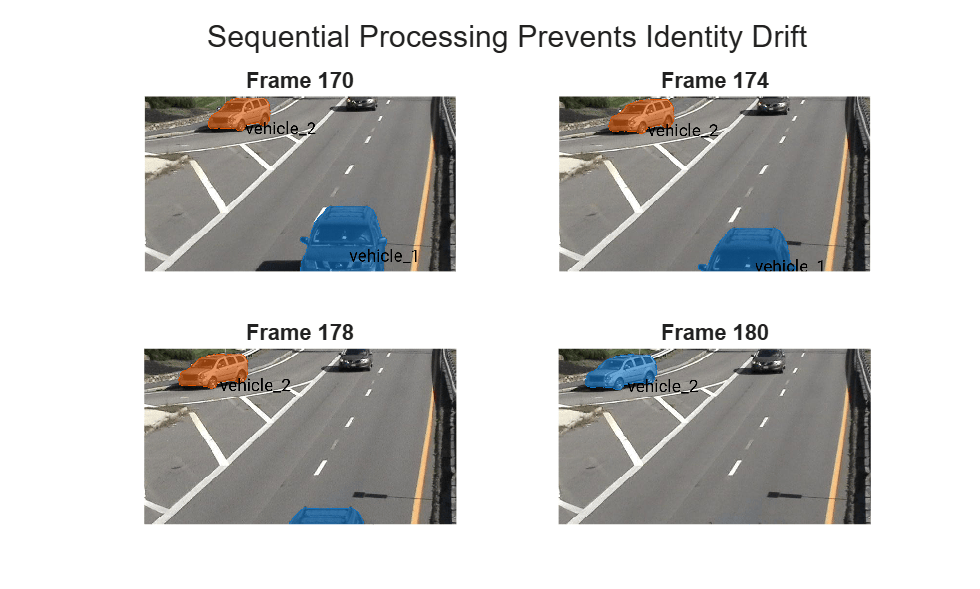
Display which objects were removed after they left the scene.
removedObjects
removedObjects =
"vehicle_1"
Detect and Add New Objects To Segment as They Enter
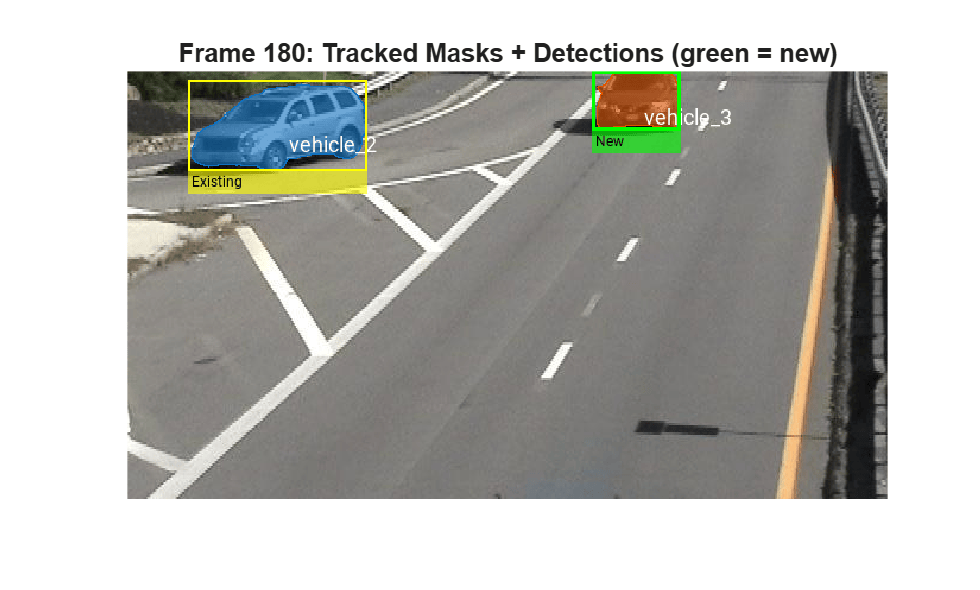
To detect new objects entering the scene, run the object detector periodically and compare the detected bounding boxes against the existing tracked masks. Any detection that does not overlap with a current mask is a new object that needs to be added with a fresh identity. Run the detector on frame 180 where a new vehicle has entered.
img180 = imread(vidSegmenter.FramePaths(180));
bboxes180 = detect(gdino,img180);
[masks180,currentIDs] = segmentObjects(vidSegmenter,180);
fprintf("Currently Tracked Masks on Frame 180: %d", numel(currentIDs))
Currently Tracked Masks on Frame 180: 1
fprintf("Detected Vehicles on Frame 180: %d",size(bboxes180,1))Detected Vehicles on Frame 180: 2
Compare each detection against bounding boxes of the current masks. Extract bounding boxes from the currently tracked masks using regionprops.
maskBboxes = zeros(size(masks180,3),4);
for k = 1:size(masks180,3)
    props = regionprops(masks180(:,:,k),"BoundingBox");
    maskBboxes(k,:) = props(1).BoundingBox;
end
Then, identify detections that do not overlap with any existing track using using bboxOverlapRatio.
isNewDet = false(size(bboxes180,1),1);
for i = 1:size(bboxes180,1)
    overlapRatios = bboxOverlapRatio(bboxes180(i,:),maskBboxes);
    isNewDet(i) = all(overlapRatios < 0.3);
end
Add newly detected objects to the video segmenter using addObjectsToSegment.
newObjCount = 0;
for i = find(isNewDet)
    newObjCount = newObjCount + 1;
    newID = "vehicle_" + (numel(currentIDs) + newObjCount + 1);
    fprintf("Frame 180: Adding new object %s from detection %d\n",newID,i);
    addObjectsToSegment(vidSegmenter,newID,180,ObjectBoundingBox=bboxes180(i,:));
end
Frame 180: Adding new object vehicle_3 from detection 2
Call segmentObjects again to get updated masks that include the newly added objects. Visualize the tracked masks with object IDs and overlay detected bounding boxes. Highlight newly added detections in green and existing detections in yellow.
[masks180updated,idsUpdated] = segmentObjects(vidSegmenter,180);
maskedImg180 = insertObjectMask(img180,masks180updated,MaskColor=lines(size(masks180updated,3)));
for k = 1:numel(idsUpdated)
    [r,c] = find(masks180updated(:,:,k));
    pos = [mean(c) mean(r)];
    maskedImg180 = insertText(maskedImg180,pos,idsUpdated(k), ...
        FontSize=18,BoxOpacity=0,TextColor="white");
end

if any(~isNewDet)
    maskedImg180 = insertObjectAnnotation(maskedImg180,"rectangle", ...
        bboxes180(~isNewDet,:),"Existing","Color","yellow","LineWidth",2);
end

if any(isNewDet)
    maskedImg180 = insertObjectAnnotation(maskedImg180,"rectangle", ...
        bboxes180(isNewDet,:),"New","Color","green","LineWidth",3);
end
figure
imshow(maskedImg180)
title("Frame 180: Tracked Masks + Detections (green = new)")
Continue Sequential Processing with Detection and Removal
Continue processing frames 182 to 190 sequentially, combining object removal and periodic detection into a single loop.
prevIDs = idsUpdated;
vizFrames = [185 191 203 209];

figure
tiledlayout(2,2,TileSpacing="compact")

for fIdx = 182:3:210
    [masks,ids] = segmentObjects(vidSegmenter,fIdx);
    fprintf("Frame %d: Detected Objects %s\n",fIdx,strjoin(ids,", "));
    % Remove departed objects
    departed = setdiff(prevIDs,ids);
    if ~isempty(departed)
        fprintf("Frame %d: Removed %s\n",fIdx,strjoin(departed,", "));
        removeObjectsToSegment(vidSegmenter,departed);
    end

    % Visualize select frames
    if ismember(fIdx,vizFrames)
        img = imread(vidSegmenter.FramePaths(fIdx));
        maskedImg = insertObjectMask(img,masks,MaskColor=lines(size(masks,3)));
        for k = 1:numel(ids)
            [r,c] = find(masks(:,:,k));
            pos = [mean(c) mean(r)];
            maskedImg = insertText(maskedImg,pos,ids(k), ...
                FontSize=18,BoxOpacity=0,TextColor="white");
        end
        nexttile
        imshow(maskedImg)
        title("Frame " + fIdx + " (" + numel(ids) + " tracked)")
    end

    prevIDs = ids;
end
Frame 182: Detected Objects vehicle_2, vehicle_3
Frame 185: Detected Objects vehicle_2, vehicle_3
Frame 188: Detected Objects vehicle_2, vehicle_3
Frame 191: Detected Objects vehicle_2, vehicle_3
Frame 194: Detected Objects vehicle_2, vehicle_3
Frame 197: Detected Objects vehicle_2, vehicle_3
Frame 200: Detected Objects vehicle_2, vehicle_3
Frame 203: Detected Objects vehicle_2, vehicle_3
Frame 206: Detected Objects vehicle_3
Frame 206: Removed vehicle_2
Frame 209: Detected Objects vehicle_3
sgtitle("Combined Workflow: Sequential Processing with Removal")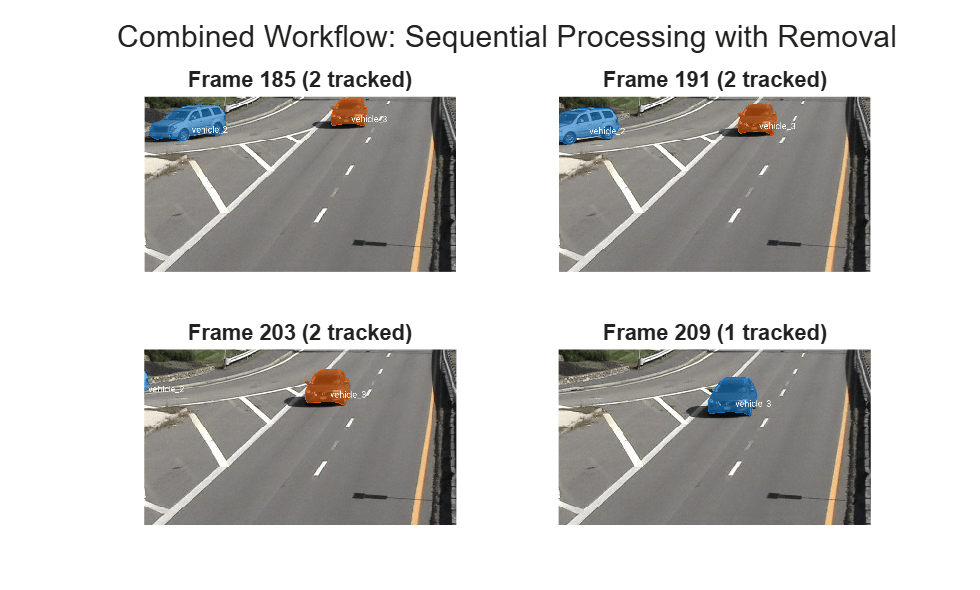
By processing frames sequentially, removing departed objects, and running the detector periodically to discover new objects, the segmenter maintains correct identity associations throughout the video.
Input Arguments
Output Arguments
Tips
If an object is not segmented on a particular frame (for example, it is fully occluded), that object may not appear in the output. Check
objectIDsto determine which objects were successfully segmented.If segmentation quality degrades on frames far from the prompted frames, add additional prompts on those frames using
addObjectsToSegmentand re-runsegmentObjects.Use
maskScoresto identify unreliable predictions. Low average confidence within the mask region suggests the model is uncertain about the object location or boundary.When an object leaves the scene,
segmentObjectsstops returning its ID. Use ID presence or mask area to detect departures rather thanmaskScores, which remain high even during departure.Process frames sequentially to prevent identity drift. Sparse frame processing loses temporal context and increases the risk of confusing visually similar objects.
Version History
Introduced in R2026b

