Dual Passive Radiator Subwoofer Modeling with Simscape Acoustics
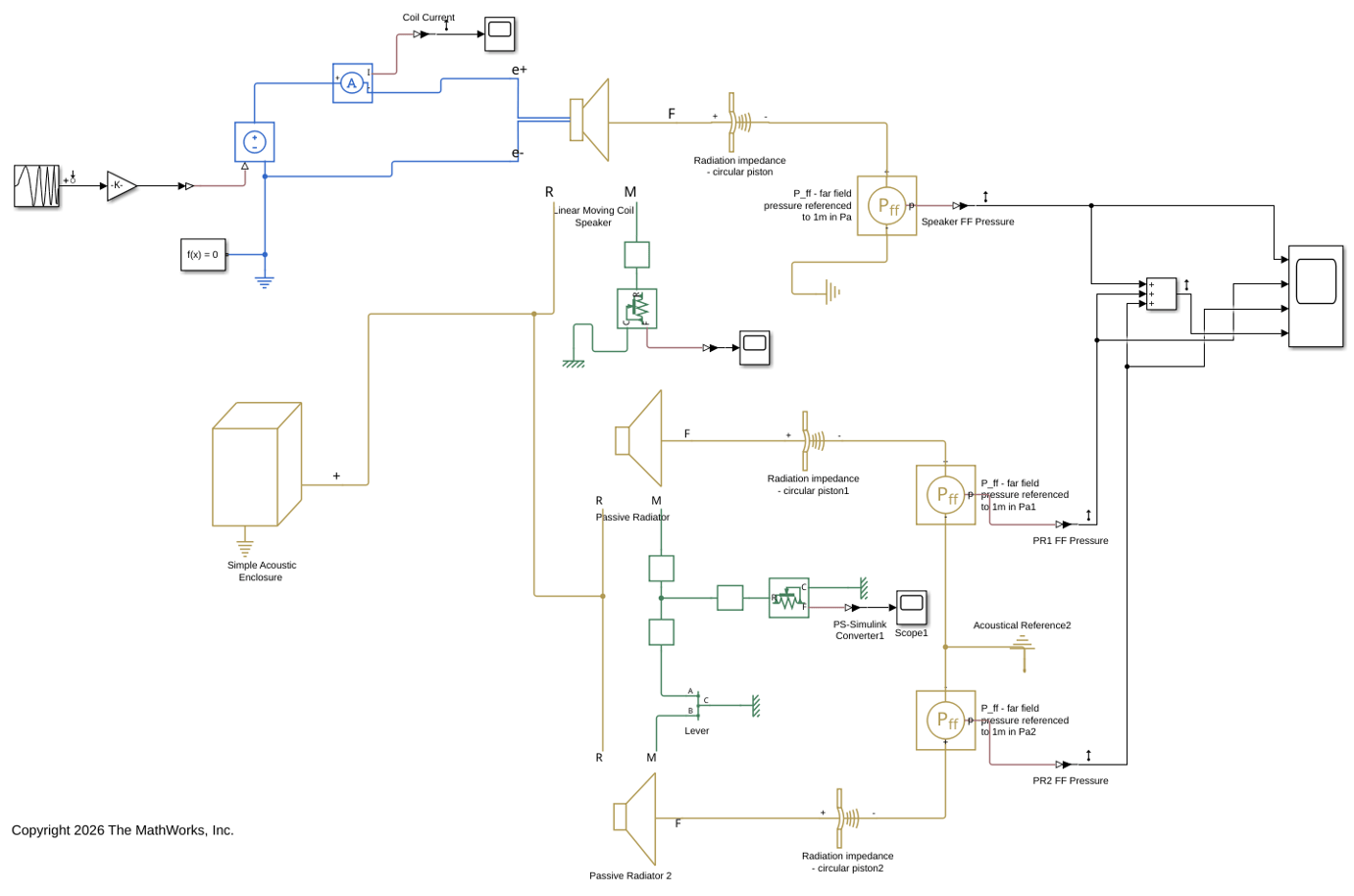
R2026bThis example shows how to model a dual passive radiator subwoofer using the Simscape™ Acoustics library. The model captures the acoustic, mechanical, and electrical behavior of a subwoofer system where two passive radiators are mounted on opposite sides of the enclosure to extend low-frequency response while minimizing cabinet vibration.
Introduction
Subwoofers require large moving masses and large displacement to achieve high output at low frequencies. Passive radiators extend the bass response without requiring a physical port, using a mass-spring system driven by the back pressure inside the enclosure.
A dual passive radiator design mounts two passive radiators on opposite sides of the enclosure. This arrangement causes their vibration forces to act in opposition, significantly reducing the net cabinet vibration compared to a single passive radiator configuration. This is an important design consideration because subwoofer vibration forces can be large enough to move the cabinet across a surface.
System Architecture
The dual passive radiator subwoofer model consists of three main domains:
Electrical domain - A voltage source drives the speaker coil through its resistance and inductance.
Acoustic domain - The speaker and both passive radiators radiate into the far field. The sealed enclosure couples the back of the speaker to the front of both passive radiators.
Mechanical domain - The speaker and passive radiator masses create vibration forces on the enclosure. The two passive radiators are oriented so their forces oppose each other, reducing net vibration.
Open the model.
model = "dualPassiveRadiatorSubwoofer";
open_system(model);
Model Components
The model uses the following Simscape Acoustics blocks:
Linear Moving Coil Speaker - Models the electro-mechano-acoustic transducer including the voice coil electrical impedance, mechanical suspension, and acoustic coupling through the diaphragm area.
Passive Radiator - Models the mechanical and acoustic behavior of a passive cone (no electrical drive). Each passive radiator is characterized by its moving mass, suspension stiffness, mechanical damping, and diaphragm area.
Simple Acoustic Enclosure - Models the sealed air volume behind the speaker that couples to the passive radiators.
Circular Piston Radiation Impedance - Models the acoustic radiation loading on each radiating surface.
Far-Field Pressure Sensor - Computes the radiated pressure at a reference distance from each source.
The mechanical domain uses a Lever block configured with a force ratio of negative unity to reverse the direction of one passive radiator's vibration force, representing the opposing orientation of the two radiators.
Simulation
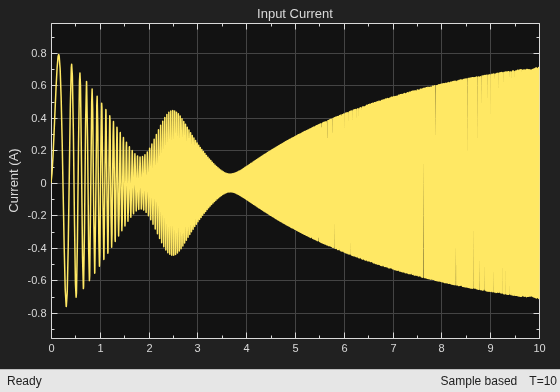
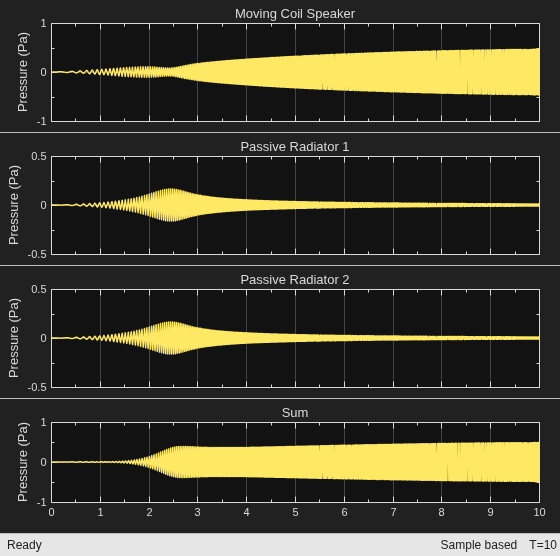
Simulate the model. The input is a chirp signal that sweeps across the low-frequency range. The scopes display the time-domain far-field pressure from the speaker and each passive radiator, the combined pressure, and the vibration force transmitted to the enclosure.
sim(model);
Results
The scopes show the individual far-field pressure from the speaker and each passive radiator, the combined output, and the vibration force on the enclosure.
Because the two passive radiators are mounted on opposite sides of the enclosure, their vibration forces largely cancel each other. This results in significantly lower net vibration force transmitted to the mounting surface compared to a single passive radiator design where the forces would add constructively.
close_system(model,0)
Acknowledgments
The original version of this model was authored by Dr. Stephen C. Thompson of Penn State University.
Copyright 2026 The MathWorks, Inc.
See Also
Moving Coil Speaker | Passive Radiator | Simple Acoustic Enclosure | Circular Piston Radiation Impedance

