Passive Radiator
R2026bPassive Radiator block

To add a block to a model, double-click the canvas and start typing the block name. Then, select the block from the list.
Libraries:
Simscape Acoustics /
Applications /
Moving Coil Speakers
Description
Add-On Required: This feature requires the Simscape Acoustics add-on.
This block models the mechanical and acoustic elements of a passive radiator. The block has acoustic conserving ports for the front and back of the radiator and an optional mechanical translational conserving port for the mass of the nonmoving speaker components.
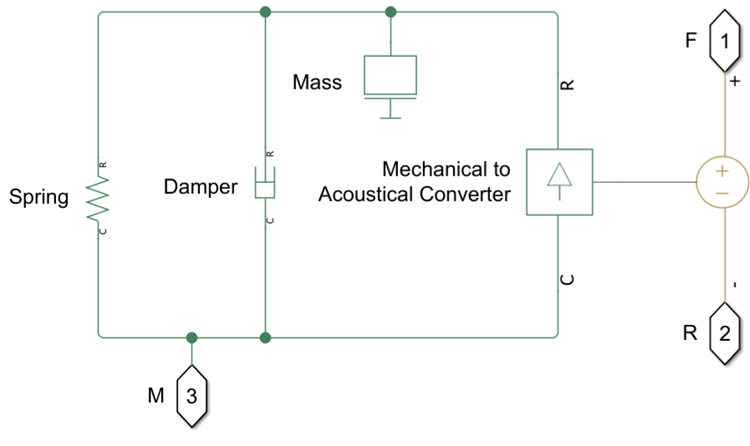
A passive radiator is an unpowered loudspeaker driven by the pressure inside an acoustic enclosure. Radiators are typically included in an acoustic enclosure with at least one powered loudspeaker to boost low frequencies. The Passive Radiator block models the physical properties of a passive radiator by implementing an equivalent circuit using Simscape™ blocks from the mechanical translational and acoustic domains. The figure shows the equivalent circuit using the following Simscape blocks:
The block models the total mass of the moving speaker using a Mass (Simscape) block.
The block models speaker stiffness using a Translational Spring (Simscape) block.
The block models mechanical friction in the speaker using a Translational Damper (Simscape) block.
The block models how cone movement causes compression and rarefaction in air molecules using a Mechanical to Acoustic Converter block.
Examples
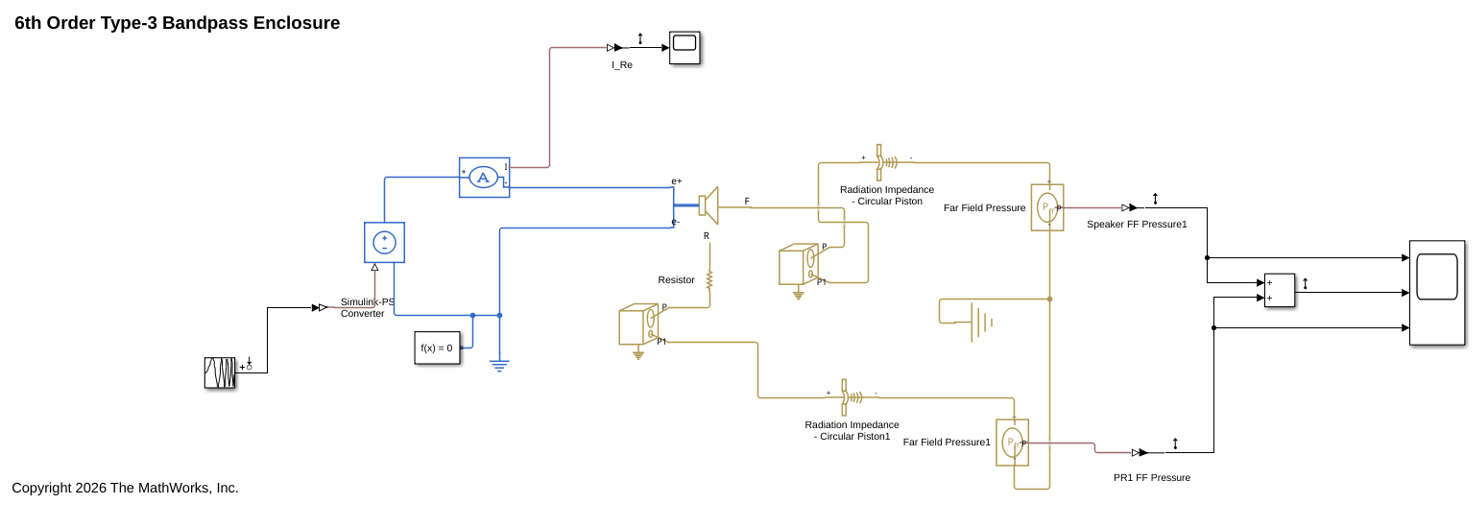
Loudspeaker Enclosure Modeling with Simscape Acoustics
Simulate different types of loudspeakers using Simscape Acoustics.
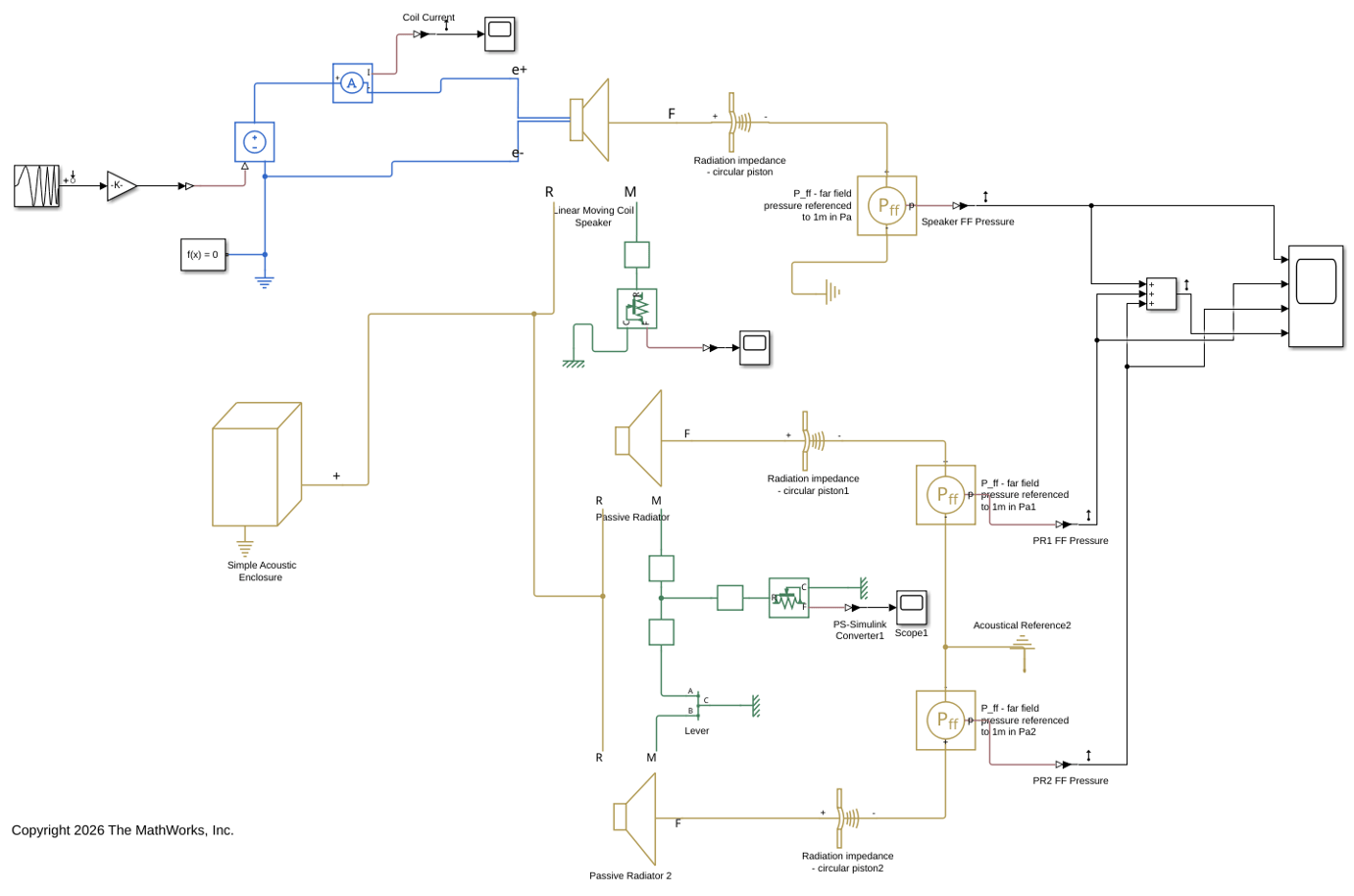
Dual Passive Radiator Subwoofer Modeling with Simscape Acoustics
Simulate a dual passive radiator subwoofer in Simscape Acoustics.
Ports
Conserving
Parameters
Version History
Introduced in R2026b

