Microspeaker
R2026bMicrospeaker block

To add a block to a model, double-click the canvas and start typing the block name. Then, select the block from the list.
Libraries:
Simscape Acoustics /
Applications /
Moving Coil Speakers
Description
Add-On Required: This feature requires the Simscape Acoustics add-on.
This block models the electrical, mechanical, and acoustic elements of a microspeaker. A microspeaker is a small moving coil speaker often used for headphones. The block has electrical conserving ports for the electrical signal that drives the voice coil and acoustic conserving ports for the front and rear of the microspeaker.
The Microspeaker block models the physical properties of a microspeaker by implementing an equivalent circuit using Simscape™ blocks from the electrical, mechanical translational, and acoustic domains. This block uses a similar circuit to the linear Moving Coil Speaker block, with parameters chosen to reflect the smaller size of the microspeaker. The block also models a rear enclosure and an optional front cover. The figure shows the equivalent circuit using the following Simscape blocks in each domain:
Electrical: The Microspeaker block models heating losses in the voice coil using a Resistor (Simscape) block. The block models magnetic energy stored from the coil turns using an Inductor (Simscape) block. The resistance and inductance values depend on wire material, diameter, length, turn radius, number of turns, and other physical properties of the modeled speaker.
Mechanical Translational: The Microspeaker block models the total mass of the moving speaker using a Mass (Simscape) block. The block models speaker stiffness using a Translational Spring (Simscape). Mechanical friction in the speaker is modeled using a Translational Damper (Simscape) block.
Acoustic: The Microspeaker block models the compliance of the air in the enclosure using an Acoustic Compliance block. The block uses a pair of Acoustic Inertance and Acoustic Resistance blocks to model the acoustic mass and resistance of the vent, and another pair to model the mass and resistance of the mesh. If you include the front cover, the block also models the compliance of air, acoustic mass, and resistance of the cover.
Transducers: Current through the voice coil creates a magnetic force that moves the speaker diaphragm. The Microspeaker block models this interaction using a Translational Electromechanical Converter (Simscape). Cone movement causes compression and rarefaction in air molecules. The block models this interaction using a Mechanical to Acoustic Converter.
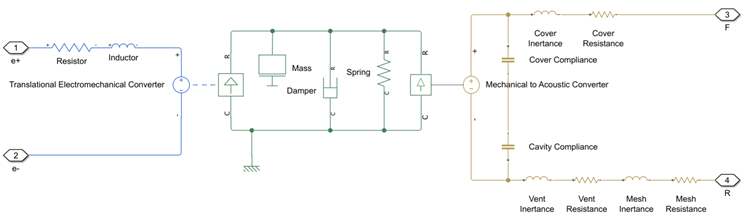
The block computes acoustic parameters for the front cover and the rear enclosure using equations from a previous microspeaker lumped-element model [1]. The equivalent circuit follows figure 14 of the reference but removes components modeling radiation impedances to accommodate different models of headphones or earbud enclosures.
Examples
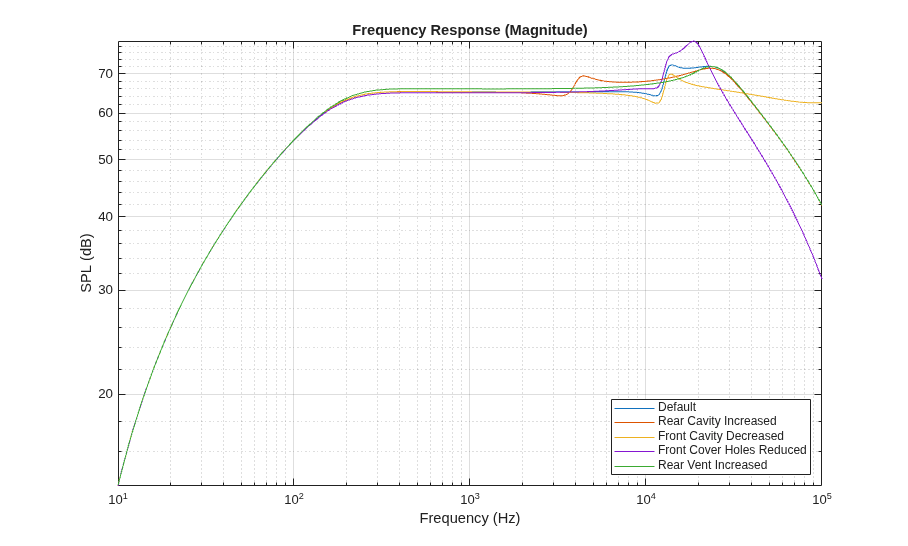
Model and Analyze a Microspeaker
Model and analyze the acoustic response of a microspeaker using Simscape Acoustics.
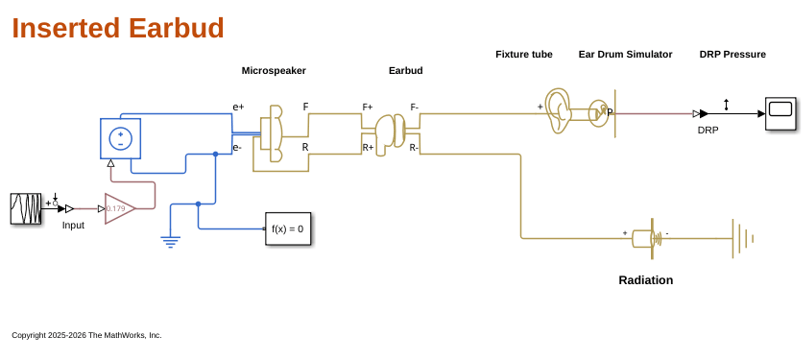
Model an Inserted Earbud
Model the acoustic response of an earbud inserted into an ear using Simscape Acoustics.
Ports
Conserving
Parameters
References
[1] Huang, Jin H., Hong-Ching Her, Y. C. Shiah, and Shaw-Jyh Shin. “Electroacoustic Simulation and Experiment on a Miniature Loudspeaker for Cellular Phones.” Journal of Applied Physics 103, no. 3 (2008): 033502. https://doi.org/10.1063/1.2837112.
Version History
Introduced in R2026b

