play
R2026bDescription
Add-On Required: This feature requires the Automated Driving Toolbox Test Suite for Euro NCAP Protocols add-on.
play( plays the
scenario simulation from the scenario descriptor plot object
scenarioDescriptorPlotObj)scenarioDescriptorPlotObj.
play(
specifies additional options for playing the scenario simulation using one or more
name-value arguments. For example, scenarioDescriptorPlotObj,Name=Value)PlaybackSpeed=2 simulates the scenario
with a speed double the default playback speed of the input scenario by skipping two
consecutive scenario frames.
Examples
Load a driving scenario into the workspace.
load("scenarioWithSingleActor.mat")Create a scenario descriptor from the loaded driving scenario.
scenarioDescriptor = getScenarioDescriptor(sc);
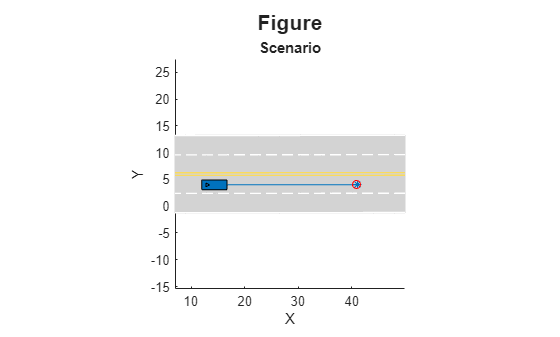
Plot the first frame of the scenario simulation from the scenario descriptor object.
plot(scenarioDescriptor)
Create a scenario descriptor plot object from the scenario descriptor object.
scenarioDescriptorPlotObj = plot(scenarioDescriptor)
scenarioDescriptorPlotObj =
  ScenarioDescriptorPlot with properties:

       SimulationTime: 0
    MaxSimulationTime: 0.9300

       NumDescriptors: 1
        FigureHandles: [1×1 Figure]

            Waypoints: "StartEnd"
             CropType: "None"
               XLimit: []
               YLimit: []
               ZLimit: []
                Title: "Figure"
        SubPlotTitles: "Scenario"
             GridSize: []
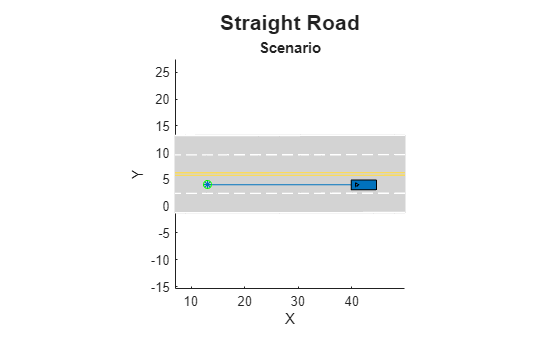
Configure the scenario descriptor plot object to change the title.
configure(scenarioDescriptorPlotObj,Title="Straight Road")Play the entire scenario simulation, instead of displaying only the first frame of the scenario.
play(scenarioDescriptorPlotObj)
Close the scenario descriptor plot.
close(scenarioDescriptorPlotObj)
Load a driving scenario containing multiple actor collisions into the workspace.
load("scenarioWithMultipleCollisions.mat")Create a scenario descriptor from the loaded driving scenario.
scenarioDescriptor = getScenarioDescriptor(sc);
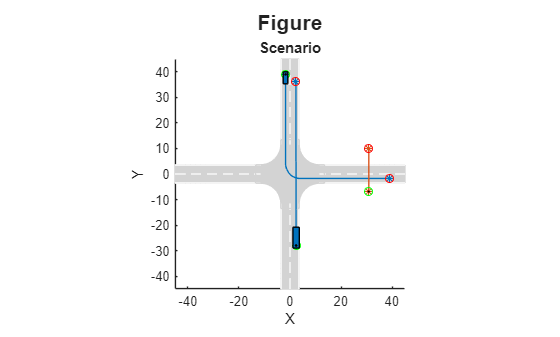
Plot the first frame of the scenario simulation, and create a scenario descriptor plot object from the scenario descriptor object.
scenarioDescriptorPlotObj = plot(scenarioDescriptor)
scenarioDescriptorPlotObj =
  ScenarioDescriptorPlot with properties:

       SimulationTime: 0
    MaxSimulationTime: 8.0500

       NumDescriptors: 1
        FigureHandles: [1×1 Figure]

            Waypoints: "StartEnd"
             CropType: "None"
               XLimit: []
               YLimit: []
               ZLimit: []
                Title: "Figure"
        SubPlotTitles: "Scenario"
             GridSize: []
Configure the scenario descriptor plot object to change the title.
configure(scenarioDescriptorPlotObj,Title="Collision Scenario")If you know your scenario contains a collision, you can directly plot the first frame in which a collision occurs. Seek and plot the first collision instance from the loaded scenario.
seek(scenarioDescriptorPlotObj,"Collision")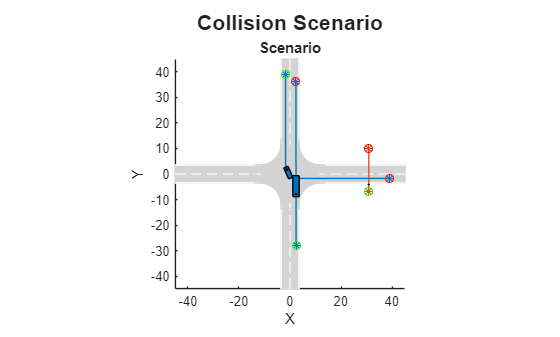
Rather than specifically plotting the collision instance, you can simulate the scenario, and stop when a collision occurs.
Note: The input scenario contains two collision instances, and the play function stops the simulation at the first collision instance.
play(scenarioDescriptorPlotObj,StopAtEvent="Collision")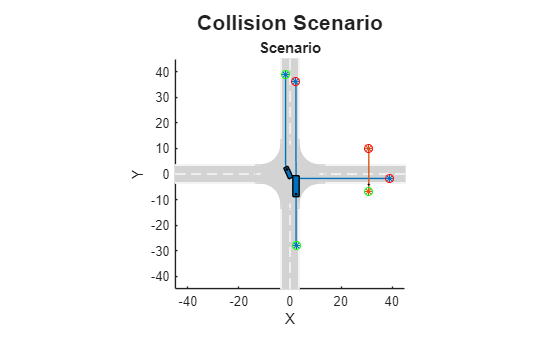
Load a MAT file containing two scenario descriptors.
load("scenarioDescriptors")Plot the first frames of the scenario simulations for both loaded scenario descriptors in a single figure.
scenarioDescriptorPlotObj = plot(scenarioDescriptors)
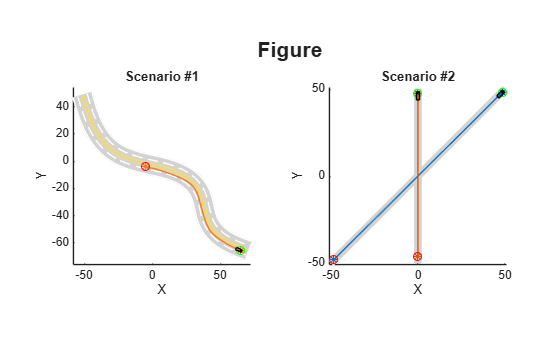
scenarioDescriptorPlotObj =
  ScenarioDescriptorPlot with properties:

       SimulationTime: [2×1 double]
    MaxSimulationTime: [2×1 double]

       NumDescriptors: 2
        FigureHandles: [1×1 Figure]

            Waypoints: "StartEnd"
             CropType: "None"
               XLimit: []
               YLimit: []
               ZLimit: []
                Title: "Figure"
        SubPlotTitles: ["Scenario #1"    "Scenario #2"]
             GridSize: []
Configure the scenario descriptor plot object to change the title and subplot titles.
configure(scenarioDescriptorPlotObj,Title="Scenarios",SubPlotTitles=["Curved Road" "Straight Road"])
Play the entirety of both scenario simulations, instead of displaying only the first frame of each.
play(scenarioDescriptorPlotObj)
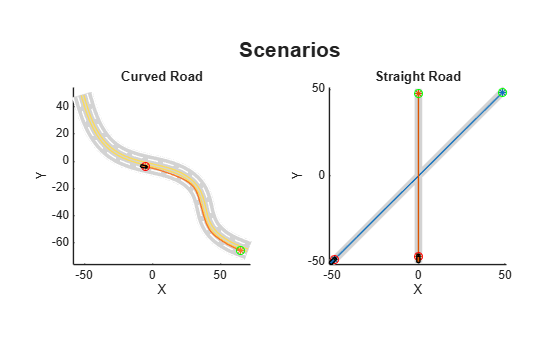
Close the scenario descriptor plot.
close(scenarioDescriptorPlotObj)
Input Arguments
Name-Value Arguments
Limitations
Version History
Introduced in R2026a
See Also
ScenarioDescriptorPlot | plot | configure | seek | close | getScenarioDescriptor | getScenario | drivingScenario

