轮胎和车辆
R2026b使用 Simscape™ Driveline™ Tires and Vehicles 库中的模块,可在各种可变环境条件下测试传动系统模型的响应。您还可以通过指定轮胎的柔性、惯量和滚动阻力以及车身的重心和正面面积等属性来提高模型的保真度。
函数
sdlUtility.tirread | 将 TIR 文件导入 Tire (Magic Formula) 模块 (自 R2022b 起) |
App
| 纵向车辆性能设计 | 为 Longitudinal Vehicle 模块设计性能规格 (自 R2025a 起) |
Simscape 模块
 | Longitudinal Vehicle | Longitudinal motion abstract vehicle with ideal brakes and tires |
 | Road Profile | Road profile with varying elevation and friction properties |
 | Tire (Friction Parameterized) | Tire with friction parameterized in terms of static and kinetic coefficients |
 | Tire (Magic Formula) | Tire defined by Magic Formula coefficients |
 | Tire (Simple) | No-slip tire model with minimal parameters |
 | Vehicle Body | Vehicle body with two axles in longitudinal motion |
 | Three-Axle Vehicle Body | Vehicle body with three axles (自 R2026a 起) |
 | Rolling Resistance | Model rolling resistance |
 | Tire-Road Interaction (Magic Formula) | Tire-road dynamics given by Magic Formula coefficients |
主题
- Rotational-Translational Couplings
Couple rotational and translational dynamics.
- Complete Vehicle Model
Explore a model that includes an engine, a transmission, and drivetrain-wheel-road coupling.
- Control Vehicle Throttle Input Using a Powertrain Blockset Driver
Control a Simscape Driveline vehicle using a Powertrain Blockset™ driver.
- Model a Road Profile with Varying Elevation and Friction
Adjust surface grade and frictional properties using a Simscape Driveline Road Profile block.
精选示例
Engine Braking
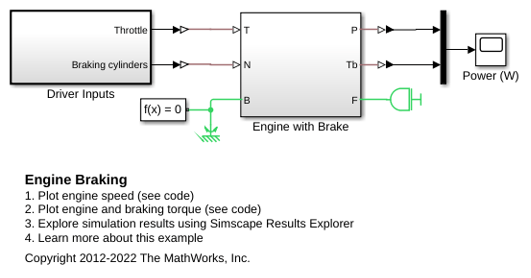
A diesel engine equipped with a Jake Brake (R) or compression release engine brake. This type of brake is activated by the driver to slow the vehicle without relying on friction braking mechanisms. Air is released from a number of cylinders at the end of their compression strokes. In this example, the driver can dynamically select to activate braking on zero to eight cylinders. The braking torque for each cylinder is set using a lookup table with engine speed as the input.
Four-Wheel Drive Testbed
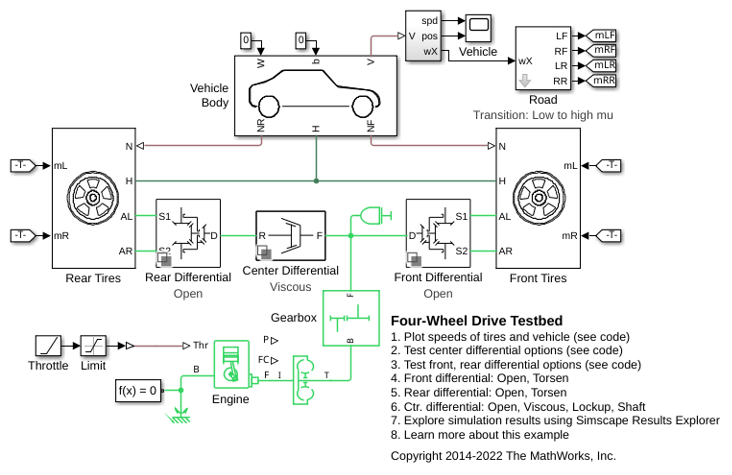
A four-wheel drive vehicle with open and limited slip differentials. The front and rear differentials can be standard or Type I Torsen. The center differential can be a solid shaft, viscous coupling, viscous coupling with a locking clutch, or open with no torque transfer. The differential options are in variant subsystems. The variants can be selected using the hyperlinks embedded in the model.
Limited Slip Differential with Clutches
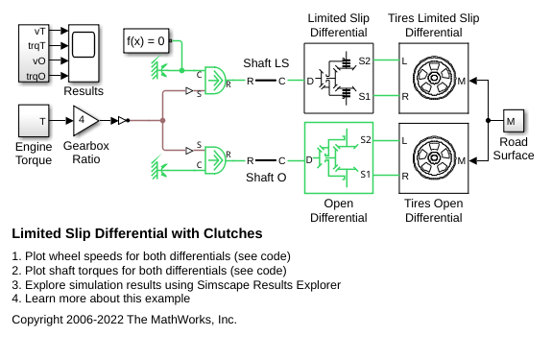
A comparison between the behavior of an open differential and a limited slip differential with clutch packs. The limited slip differential is modeled using components from the Gears library and Clutches library in Simscape™ Driveline™. Wheel slip is limited by clutches that engage when the torque applied to the input of the differential exceeds a threshold. The clutches lock the differential so that the output shafts of the differential spin at the same speed.
Piston Engine Testbed
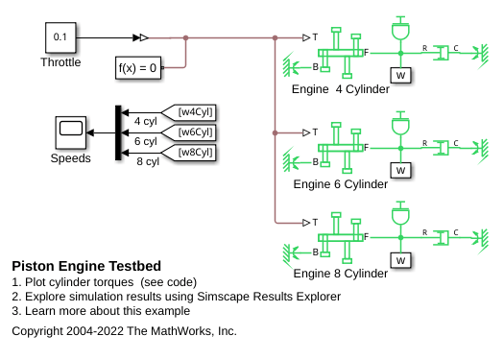
The effect of varying the number of cylinders in a piston engine. Four, six, and eight cylinder engines are included with firing offsets evenly distributed about their four-stroke cycles. Piston pressures are normalized by the number of cylinders to emphasize the effect on output vibration.
Tire Parameterization and Performance
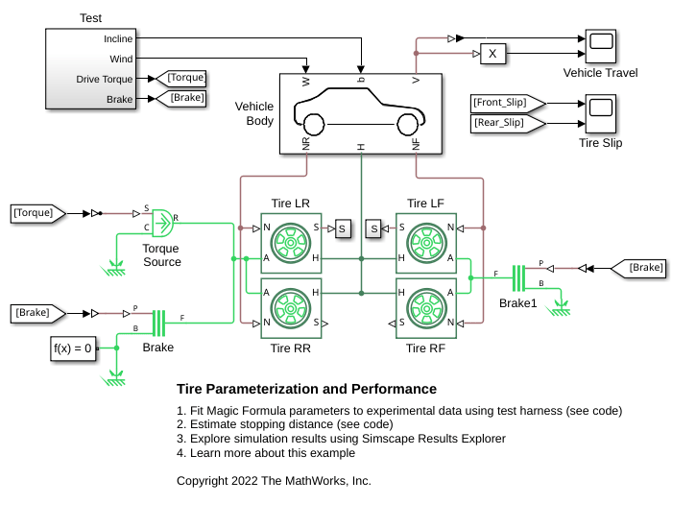
Use Simscape™ Driveline™ to fit tire Magic Formula coefficients to experimental data and to measure the simulated stopping distance of a vehicle supported by the tires. The example uses the sdlUtility.tirread function to load initial tire parameters from a .TIR file. Then, the example uses the MATLAB® optimization function fminsearch with a test harness model to fit the tire coefficients to the experimental data. Other products available for performing this type of parameter fitting with Simscape Driveline models are the Optimization Toolbox™ and Simulink® Design Optimization™. These products provide predefined functions to manipulate and analyze blocks using GUIs or a command line approach. This example uses Fast Restart to quickly simulate tire response for different parameters during the optimization.
Torsen Differential
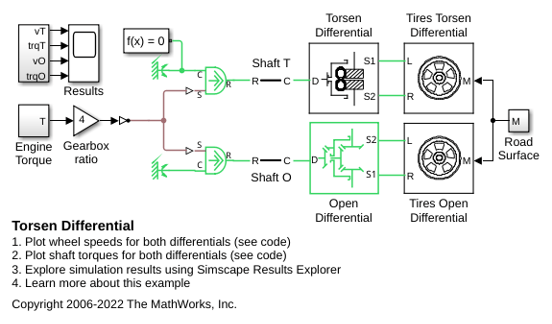
A comparison between the behavior of an open differential and a Torsen limited slip differential. The Torsen differential is modeled using components from the Gears library in Simscape™ Driveline™. Slip is limited in the Torsen differential because it uses non-backdrivable worm gears, which are modeled by Sun-Planet Worm Gear components. The result is higher torque applied to the wheel with greater traction, and identical speeds for the left and right axles.
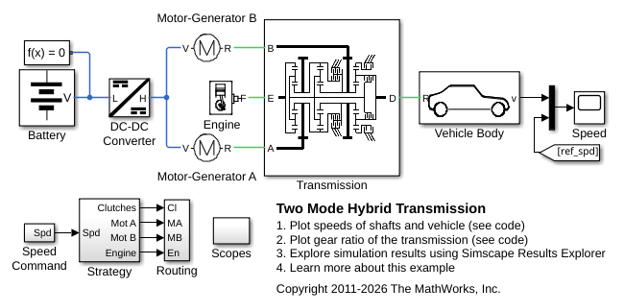
Two Mode Hybrid Transmission
The basic architecture of a two mode hybrid transmission. It consists of three planetary gear sets and four clutches. This combination permits four fixed gear ratios plus two power-split modes. The power split modes are used to transition between fixed gear ratios and for heavy acceleration/deceleration. The fixed ratios help with efficiency when cruising. For the first power split (input-split regime), only Clutch 1 is engaged. For the second power split (compound-split regime), only Clutch 2 is engaged. Engaging two clutches simultaneously removes one degree of freedom and hence results in a fixed ratio.
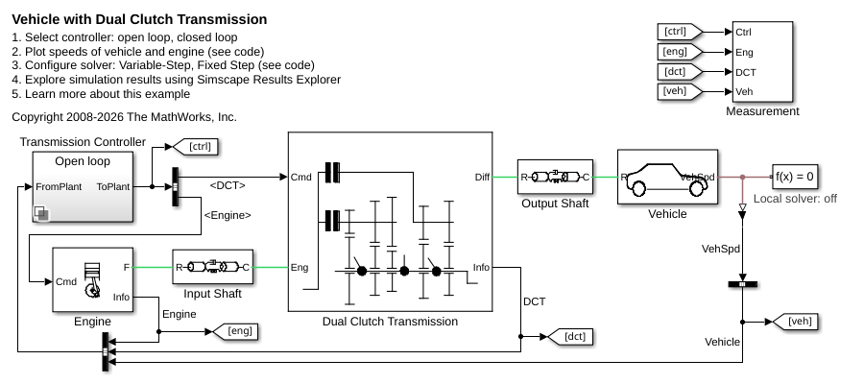
配备双离合变速器的车辆
此示例展示了一辆配备五速双离合变速器的车辆。换挡通过两个离合器实现,一个离合器的压力逐渐增大,同时另一个离合器的压力则逐渐降低。通过爪形离合器进行挡位预选,可确保在接合当前离合器之前,已完全挂入正确的挡位。
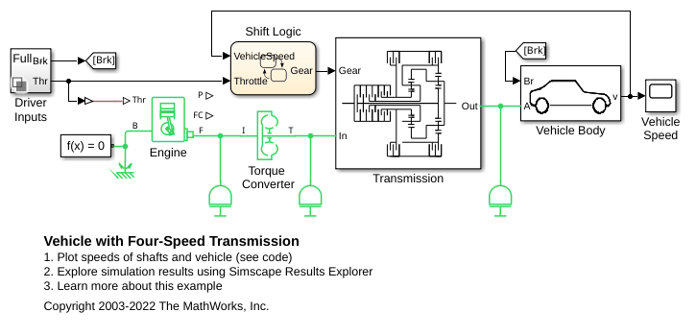
配备四速变速器的车辆
此示例展示了一辆由 Simscape™ Driveline™ 组件表示的完整车辆,包括发动机、动力传动系统、四速变速器、轮胎以及纵向车辆动态特性。变速器控制器在 Stateflow® 中作为状态机实现,根据节气门和车速选择挡位。
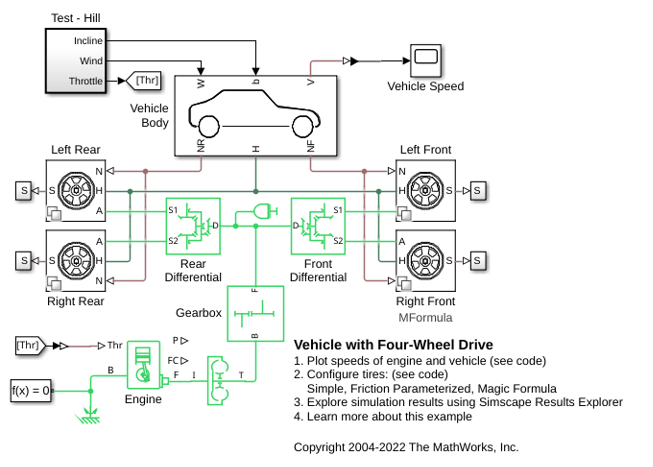
配备四轮驱动的车辆
此模型展示了一辆四轮驱动车辆从静止状态起步,爬升一个 15 度坡道的过程。车辆最初会向后溜车,直到发动机产生足够的扭矩来克服坡道阻力。随着车辆开始加速,可以观察到轮胎的柔性动态特性。通过模型中的超链接,可以将为所有轮胎选择的模型变体设置为“简单”、“摩擦参数化”或“魔术公式”轮胎模型。
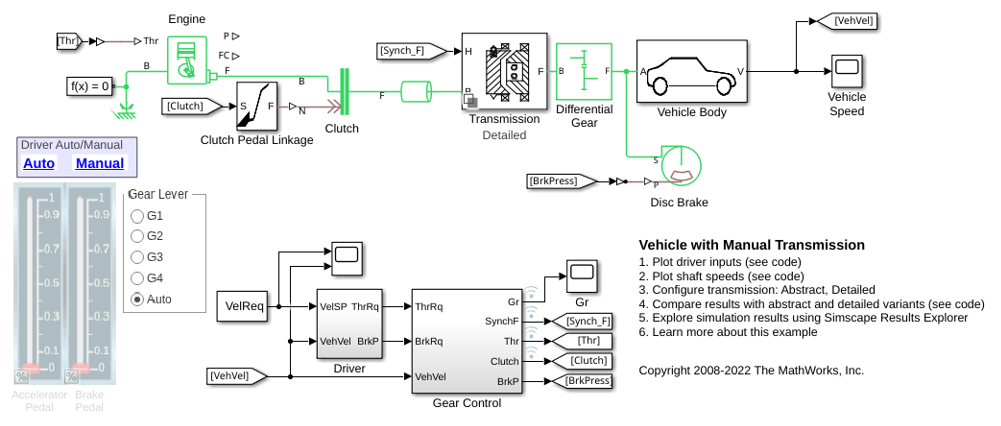
Vehicle with Manual Transmission
A vehicle that has a four-speed manual transmission. The key elements of the transmission are four synchronizers. By engaging or disengaging these synchronizers and associated dog clutches, the transmission provides four ratios 3.581, 2.022, 1.384, and 1, respectively. The synchronizers are modeled using the Cone Clutch and Dog Clutch blocks.
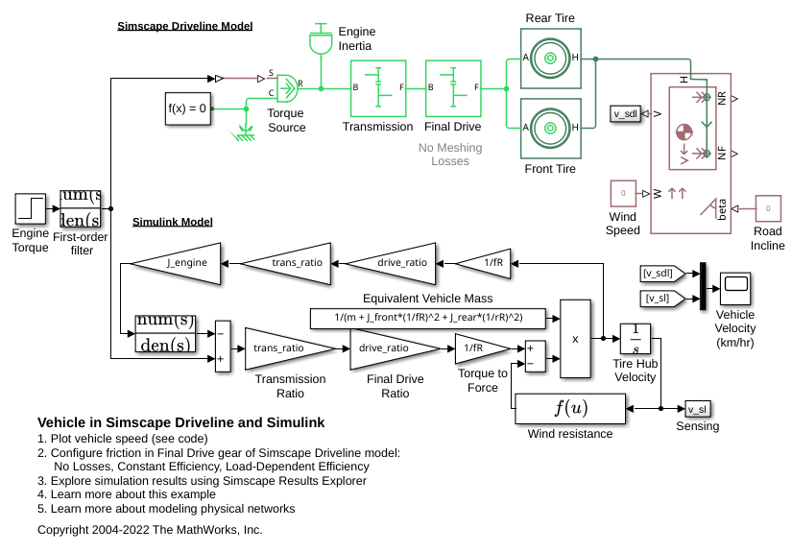
Simscape Driveline 和 Simulink 中的车辆模型
此模型展示了在 Simscape™ Driveline™ 和 Simulink® 中建模的两辆等效的简化车辆。仿真结果完全相同,并且 Simscape Driveline 模型易于扩展,可以包含不同的效应和更高水平的建模保真度。可以在不引入代数环的情况下添加齿轮啮合损耗和更详细的轮胎建模。

