waveletPooling1dLayer
R2026bDescription
A 1-D discrete wavelet pooling layer applies the forward and inverse discrete wavelet transforms to reconstruct approximations of the layer input. Use this layer to downsample the layer input along the time dimension. The layer supports learnable (adaptive) and nonadaptive pooling. For more information, see Discrete Wavelet Pooling. Use of this layer requires Deep Learning Toolbox™.
Creation
Description
layer = waveletPooling1dLayer
The input to waveletPooling1dLayer must be a real-valued dlarray (Deep Learning Toolbox) object
with format "CBT". The output is a dlarray object with
format "CBT". For information, see Layer Output Format.
Note
When you initialize the learnable parameters of waveletPooling1dLayer, the
layer weights are set to unity. It is not recommended to initialize the weights
directly.
layer = waveletPooling1dLayer(PropertyName=Value)
Example: layer =
waveletPooling1dLayer(Wavelet="db4",Boundary="zeropad") creates a wavelet
pooling layer that uses the extremal phase Daubechies wavelet with four vanishing moments
and zero padding at the boundaries.
Properties
Examples
Load the ECG signal. The data is arranged as a 2048-by-1 vector. Save the signal in single precision as a dlarray object with format "TCB".
load wecg
len = length(wecg);
dlsig = dlarray(single(wecg),"TCB");
Create the default 1-D discrete wavelet pooling layer. By default, the learnable parameters DetailWeights and LowpassWeights are both empty.
dwtPool = waveletPooling1dLayer
dwtPool =
  waveletPooling1dLayer with properties:

                            Name: ''
     DetailWeightLearnRateFactor: 0
    LowpassWeightLearnRateFactor: 0
                         Wavelet: 'db1'
             ReconstructionLevel: 1
                   AnalysisLevel: 2
                        Boundary: 'reflection'
      SelectedDetailCoefficients: 1
              ExpectedOutputSize: 'none'

   Learnable Parameters
                   DetailWeights: []
                  LowpassWeights: []

   State Parameters
    No properties.

  Show all properties
Include the default 1-D wavelet pooling layer in a Layer array.
layers = [ ...
    sequenceInputLayer(1,MinLength=len)
    waveletPooling1dLayer]
layers =
2×1 Layer array with layers:
1 '' Sequence Input Sequence input with 1 channels
2 '' waveletPooling1dLayer waveletPooling1dLayer
Convert the layer array to a dlnetwork object. Because the layer array has an input layer and no other inputs, the software initializes the network.
dlnet = dlnetwork(layers)
dlnet =
  dlnetwork with properties:

         Layers: [2×1 nnet.cnn.layer.Layer]
    Connections: [1×2 table]
     Learnables: [2×3 table]
          State: [0×3 table]
     InputNames: {'sequenceinput'}
    OutputNames: {'layer'}
    Initialized: 1

  View summary with summary.
Confirm the network learnable parameters are DetailWeights and LowpassWeights.
dlnet.Learnables
ans = 2×3 table
     Layer        Parameter            Value
    _______    ________________    _____________

    "layer"    "DetailWeights"     {1×1 dlarray}
    "layer"    "LowpassWeights"    {1×1 dlarray}
Inspect the wavelet pooling layer in the network. Confirm the software initialized the weights.
dlnet.Layers(2)
ans =
  waveletPooling1dLayer with properties:

                            Name: 'layer'
     DetailWeightLearnRateFactor: 0
    LowpassWeightLearnRateFactor: 0
                         Wavelet: 'db1'
             ReconstructionLevel: 1
                   AnalysisLevel: 2
                        Boundary: 'reflection'
      SelectedDetailCoefficients: 1
              ExpectedOutputSize: 'none'

   Learnable Parameters
                   DetailWeights: [1×1 dlarray]
                  LowpassWeights: [1×1 dlarray]

   State Parameters
    No properties.

  Show all properties
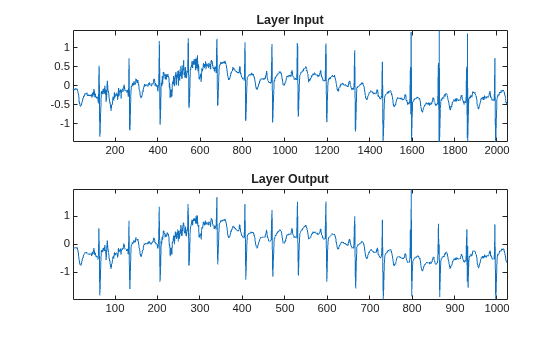
By default, the layer uses the Haar (db1) wavelet and outputs the level-one lowpass approximation of the input. Run the signal through the network. Confirm the output has 1024 samples.
dlnetout = forward(dlnet,dlsig);
size(dlnetout)
ans = 1×3

           1           1        1024
Plot the layer input and output.
dlnetout2 = squeeze(dlnetout);
tiledlayout(2,1)
nexttile
plot(wecg)
title("Layer Input")
axis tight
nexttile
plot(dlnetout2)
title("Layer Output")
axis tight
Load the Espiga3 electroencephalogram (EEG) data set. The data consists of 23 channels of EEG sampled at 200 Hz. There are 995 samples in each channel. The channels are arranged column-wise. Save the multisignal in single precision as a dlarray, specifying the dimensions in order. dlarray permutes the array dimensions to the "CBT" shape expected by a deep learning network.
load Espiga3
[N,ch] = size(Espiga3);
dlsig = dlarray(single(Espiga3),"TCB");
Create a Layer array containing a sequence input layer and a 1-D discrete wavelet pooling layer. For the pooling layer:
Set the analysis level to 5 and reconstruction level to 2.
Set the DWT boundary extension mode to
"zeropad".Specify a 1-by-3 mask so that the layer excludes the detail coefficients at levels 3 and 4 from the pooling. For multichannel input,
waveletPooling1dLayerautomatically expands the mask to all channels.
alevel = 5;
rlevel = 2;
bdy = "zeropad";
msk = [0 0 1];

layers = [ ...
    sequenceInputLayer(ch,MinLength=N)
    waveletPooling1dLayer(AnalysisLevel=alevel, ...
    ReconstructionLevel=rlevel, ...
    Boundary=bdy, ...
    SelectedDetailCoefficients=msk)];
Convert the layer array to a dlnetwork object.
dlnet = dlnetwork(layers);
dlnet.Layers(2)
ans =
  waveletPooling1dLayer with properties:

                            Name: 'layer'
     DetailWeightLearnRateFactor: 0
    LowpassWeightLearnRateFactor: 0
                         Wavelet: 'db1'
             ReconstructionLevel: 2
                   AnalysisLevel: 5
                        Boundary: 'zeropad'
      SelectedDetailCoefficients: [0 0 1]
              ExpectedOutputSize: 'none'

   Learnable Parameters
                   DetailWeights: [23×3 dlarray]
                  LowpassWeights: [23×1 dlarray]

   State Parameters
    No properties.

  Show all properties
Run the signal through the network.
netout = forward(dlnet,dlsig);
Now use the same layer property values in the functions dldwt and dlidwt.
Use the dldwt function to obtain the differentiable DWT of the signal down to level 5. To specify the extension mode, use the PaddingMode name-value argument. To obtain the full wavelet decomposition, set the full wavelet decomposition option to true.
[A,D] = dldwt(dlsig, ...
    Level=alevel, ...
    FullTree=true, ...
    PaddingMode=bdy);
The dlidwt function expects the wavelet subband gains (masks) to be an NC-by-L matrix, where NC is the number of channels in the signal and L is the difference between the decomposition level (used to obtain the coefficients) and the reconstruction level. Repeat copies of the mask used in the pooling layer into a 23-by-1 matrix. Then use the dlidwt function to reconstruct the DWT up to level 2. Set the extension mode to zero padding. To exclude from all channels the detail coefficients at levels 3 and 4, set the DetailGain name-value argument to the new mask.
newmsk=repmat(msk,23,1);
dlout = dlidwt(A,D, ...
    Level=rlevel, ...
    DetailGain=newmsk, ...
    PaddingMode=bdy);
Confirm the sizes of the layer output and dlidwt output are identical.
size(netout)
ans = 1×3

    23     1   249
size(dlout)
ans = 1×3

    23     1   249
Confirm the outputs are equal.
netoutEx = extractdata(netout);
dloutEx = extractdata(dlout);
norm(netoutEx(:)-dloutEx(:),"Inf")
ans = single
0
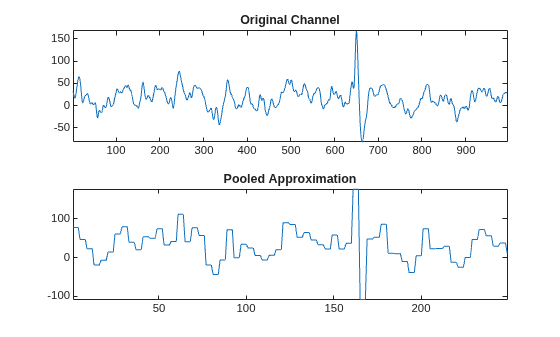
Choose a channel. Plot that channel and its pooled approximation.
chan = 7;
orig = Espiga3(:,chan);
pool = squeeze(netoutEx(chan,1,:));
tiledlayout(2,1)
nexttile
plot(orig)
axis tight
title("Original Channel")
nexttile
plot(pool)
axis tight
title("Pooled Approximation")
Create a signal with 2047 samples. Save the signal in single precision as a dlarray object. dlarray permutes the array dimensions to the "CBT" shape expected by a deep learning network.
load wecg
sig = wecg(1:end-1);
dlsig = dlarray(sig,"TCB");
[ch,N] = size(dlsig)
ch =
1
N =
2047
The reconstruction level and the difference between the analysis and reconstruction levels can affect the output size.
Reconstruction Level Greater Than 0, Difference Between Analysis and Reconstruction Levels Greater Than 1
Use the dldwt function to obtain the differentiable DWT of the signal down to level 4. Specify the sym4 wavelet and zero padding as the extension mode. Obtain the full wavelet decomposition by setting FullTree to true.
wv = "sym4";
alevel = 4;
bdy = "zeropad";

[A,D] = dldwt(dlsig, ...
    Wavelet=wv, ...
    Level=alevel, ...
    FullTree=true, ...
    PaddingMode=bdy); %#ok<*ASGLU>
Create a waveletPooling1dLayer using the same parameters as the dldwt function. Specify a reconstruction level of 2.
rlevel = 2;

wpl = waveletPooling1dLayer(Wavelet=wv, ...
    AnalysisLevel=alevel, ...
    ReconstructionLevel=rlevel, ...
    Boundary=bdy);
Create a Layer array containing a sequence input layer appropriate for the signal and the wavelet pooling layer. Convert the layer array to a dlnetwork object. Run the signal through the network.
layers = [
    sequenceInputLayer(ch,MinLength=N)
    wpl];
dlnet = dlnetwork(layers);
dlnetout = forward(dlnet,dlsig);
Compare the size of the layer output along the time dimension with the size of the coefficients at the corresponding decomposition level. Because the reconstruction level is greater than 0 and the difference between the analysis and reconstruction levels is greater than 1, the sizes are equal. The layer effectively sets FullTree to true, which removes any ambiguity regarding the size of the reconstruction.
[size(dlnetout,3) size(D{rlevel},3)]ans = 1×2
517 517
Reconstruction Level is 0
Use the dldwt function to obtain the differentiable DWT of the signal down to level 2. Specify the sym4 wavelet and zero padding as the extension mode. Set FullTree to true to obtain the full wavelet decomposition.
wv = "sym4";
alevel = 2;
bdy = "zeropad";

[A,D] = dldwt(dlsig, ...
    Wavelet=wv, ...
    Level=alevel, ...
    FullTree=true, ...
    PaddingMode=bdy);
Use the dlidwt function to obtain the reconstruction at level 0. Compare the size of the reconstruction with the size of the original signal. Even though FullTree is true, the sizes are different. Because the reconstruction level is 0, ambiguity exists.
rlevel = 0;

xrec = dlidwt(A,D, ...
    Wavelet=wv, ...
    Level=rlevel, ...
    PaddingMode=bdy);

[size(dlsig) ; size(xrec)]
ans = 2×3

           1           1        2047
           1           1        2048
Because the reconstruction level is 0, the size of the reconstruction must equal the size of the original signal. You can set ExpectedOutputSize to remove the ambiguity.
xrec2 = dlidwt(A,D, ...
    Wavelet=wv, ...
    Level=rlevel, ...
    PaddingMode=bdy, ...
    ExpectedOutputSize=size(dlsig,3));

[size(dlsig) ; size(xrec2)]
ans = 2×3

           1           1        2047
           1           1        2047
Similarly, to remove the ambiguity in the wavelet pooling layer, you can specify ExpectedOutputSize. Create a Layer array containing a sequence input layer and the wavelet pooling layer. Convert the layer array to a dlnetwork object. Run the signal through the network.
wpl = waveletPooling1dLayer(Wavelet=wv, ...
    AnalysisLevel=alevel, ...
    ReconstructionLevel=rlevel, ...
    Boundary=bdy, ...
    ExpectedOutputSize=size(dlsig,3));

layers = [
    sequenceInputLayer(ch,MinLength=N)
    wpl];
dlnet = dlnetwork(layers);
dlnetout = forward(dlnet,dlsig);

[size(dlsig) ; size(dlnetout)]
ans = 2×3

           1           1        2047
           1           1        2047
Difference Between Analysis and Reconstruction Levels is 1
When the difference between the analysis and reconstruction levels is 1, the pooling layer behaves as if FullTree is false. Use the dldwt function to obtain the differentiable DWT of the signal down to level 3. Specify the sym4 wavelet and zero padding as the extension mode. Set FullTree to false.
wv = "sym4";
alevel = 3;
bdy = "zeropad";

[A,D] = dldwt(dlsig, ...
    Wavelet=wv, ...
    Level=alevel, ...
    FullTree=false, ...
    PaddingMode=bdy);
If the input coefficients are a tensor, the dlidwt function performs a single-level IDWT. Obtain the size of the reconstruction.
xrec2 = dlidwt(A,D, ...
    Wavelet=wv, ...
    PaddingMode=bdy);
size(xrec2,3)
ans =
518
Use the wavedec function to obtain the bookkeeping vector of a signal whose length equals the size of the dlarray signal. Use the same input parameters. Because dldwt uses zero padding boundary extension, set extmode to "zpd". Extract from the bookkeeping vector the size of the coefficients at level 2. Because FullTree is false, the size extracted from the bookkeeping vector does not equal the size of the reconstruction..
[~,l] = wavedec(sig,alevel,wv,extmode="zpd");
extractedSize = l(end-3+1)
extractedSize = 517
Use the dlidwt function to obtain the reconstruction at level 2, but this time specify ExpectedOutputSize to equal the extracted value.
xrec2 = dlidwt(A,D, ...
    Wavelet=wv, ...
    PaddingMode=bdy, ...
    ExpectedOutputSize=extractedSize);
size(xrec2,3)
ans =
517
Create a wavelet pooling layer. Set the layer properties to agree with the dldwt and dlidwt input arguments, including the expected output size. Create a Layer array containing a sequence input layer and the wavelet pooling layer. Convert the layer array to a dlnetwork object. Run the signal through the network. Confirm the size of the network output equals ExpectedOutputSize.
rlevel = 2;

wpl = waveletPooling1dLayer(Wavelet=wv, ...
    AnalysisLevel=alevel, ...
    ReconstructionLevel=rlevel, ...
    Boundary=bdy, ...
    ExpectedOutputSize=extractedSize);

layers = [
    sequenceInputLayer(ch,MinLength=N)
    wpl];
dlnet = dlnetwork(layers);
dlnetout = forward(dlnet,dlsig);

size(dlnetout,3)
ans =
517
More About
References
[1] Williams, Travis and Robert Y. Li. “Wavelet Pooling for Convolutional Neural Networks.” International Conference on Learning Representations (2018), https://openreview.net/pdf?id=rkhlb8lCZ.
[2] Wolter, Moritz, and Jochen Garcke. “Adaptive Wavelet Pooling for Convolutional Neural Networks.” In Proceedings of The 24th International Conference on Artificial Intelligence and Statistics, edited by Arindam Banerjee and Kenji Fukumizu, vol. 130. PMLR, 2021. https://proceedings.mlr.press/v130/wolter21a.html.
Extended Capabilities
Version History
Introduced in R2026aSee Also
Apps
- Deep Network Designer (Deep Learning Toolbox)
Functions
Objects
waveletPooling2dLayer|modwtLayer|dlarray(Deep Learning Toolbox) |dlnetwork(Deep Learning Toolbox)
Topics
- Practical Introduction to Multiresolution Analysis
- List of Deep Learning Layers (Deep Learning Toolbox)
- Networks and Layers Supported for Code Generation (MATLAB Coder)
- Supported Networks, Layers, and Classes (GPU Coder)

