asset3d.write
R2026bDescription
Add-On Required: This feature requires the 3D Asset Processing Library for MATLAB add-on.
asset3d.write(
specifies one or more export options using name-value arguments. For example,
obj,filename,Name=Value)FileType="glb" exports to GLB file instead of the format indicated by
the file extension.
Examples
Create a mesh, modify its size and position, and write the result to an FBX file. Then, read the file back to confirm the exported geometry.
Create a temporary folder for your asset files.
tmpDir = fullfile(tempdir,"asset3dWriteExamples");
if ~isfolder(tmpDir)
    mkdir(tmpDir)
end
Define a simple pyramid mesh.
vertices = [0 0 0; 1 0 0; 1 1 0; 0 1 0; 0.5 0.5 1];
faces = [1 2 5; 2 3 5; 3 4 5; 4 1 5; 1 3 4; 1 2 3];
meshObj = asset3d.Mesh(vertices,faces);
Scale and translate the mesh before exporting it.
scale(meshObj,[2 1.5 1])
translate(meshObj,[1 0 0])
Write the transformed mesh to an FBX file using a Z-up convention.
fbxFile = fullfile(tmpDir,"transformedPyramid.fbx");
asset3d.write(meshObj,fbxFile,UpAxis="Z")
Read the asset from the exported file back into the workspace, and inspect the result.
exportedMesh = asset3d.read(fbxFile)
exportedMesh =
  Mesh with properties:

         Vertices: [5×3 double]
            Faces: [6×3 double]
      FaceNormals: [6×3 double]
    VertexNormals: [5×3 double]
           UpAxis: "Z"

           Bounds: [2×3 double]
         Centroid: [2 0.7500 0.2021]
          Extents: [2 1.5000 1]
             Area: 7.6213
           Volume: 1
     IsWatertight: 1

       FaceColors: []
     VertexColors: []
               UV: [0×2 double]
         Material: [1×1 asset3d.Material]
Inspect the axis-aligned bounding box limits of the exported mesh.
exportedMesh.Bounds
ans = 2×3

    1.0000         0         0
    3.0000    1.5000    1.0000
Display the original mesh and the exported mesh side by side.
figure

subplot(1,2,1)
patch(meshObj,FaceColor=[0.2 0.55 0.85],EdgeColor="k")
axis equal
view(3)
grid on
title("Original Mesh")

subplot(1,2,2)
patch(exportedMesh,FaceColor=[0.2 0.55 0.85],EdgeColor="k")
axis equal
view(3)
grid on
title("Exported Mesh")
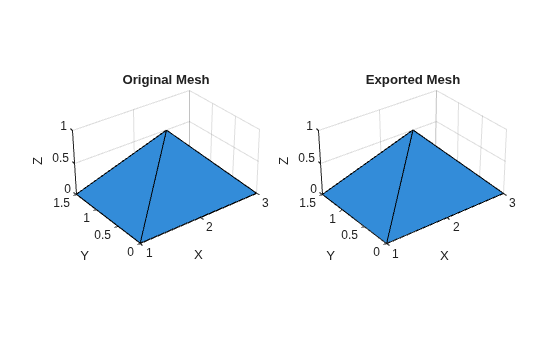
Create a two-part scene and export it to a GLB file. Use the FileType argument to specify the output format and the UpAxis argument to control the axis convention used in the exported file.
Create a temporary folder for the asset files.
tmpDir = fullfile(tempdir,"asset3dWriteExamples");
if ~isfolder(tmpDir)
    mkdir(tmpDir)
end
Define the vertices and faces for a box mesh.
boxVertices = [-0.5 -0.5 -0.5; 0.5 -0.5 -0.5; 0.5 0.5 -0.5; -0.5 0.5 -0.5; -0.5 -0.5 0.5; 0.5 -0.5 0.5; 0.5 0.5 0.5; -0.5 0.5 0.5];
boxFaces = [1 2 3; 1 3 4; 5 8 7; 5 7 6; 1 5 6; 1 6 2; 2 6 7; 2 7 3; 3 7 8; 3 8 4; 4 8 5; 4 5 1];
Create a body mesh and a sensor mesh with different sizes and colors.
blueFaces = repmat(uint8([70 140 230]),size(boxFaces,1),1);
orangeFaces = repmat(uint8([230 150 60]),size(boxFaces,1),1);
bodyMesh = asset3d.Mesh(boxVertices,boxFaces,FaceColors=blueFaces);
sensorMesh = asset3d.Mesh(boxVertices,boxFaces,FaceColors=orangeFaces);
bodyMesh = scale(bodyMesh,[3 1.5 1]);
sensorMesh = scale(sensorMesh,[0.6 0.6 0.6]);
Assemble the meshes into a scene.
sceneOut = asset3d.Scene;
addMesh(sceneOut,bodyMesh,Name="Body",NodeName="body")
T = eye(4);
T(1:3,4) = [0; 0; 0.8];
addMesh(sceneOut,sensorMesh,Name="Sensor",NodeName="sensor",ParentNodeName="body",Transform=T)
Write the scene to a GLB file.
glbFile = fullfile(tmpDir,"vehicleScene.glb");
asset3d.write(sceneOut,glbFile,FileType="glb",UpAxis="Z")
Read the scene from the exported file back into the workspace and inspect it.
exportedScene = asset3d.read(glbFile)
exportedScene =
  Scene with properties:

    Geometry: dictionary (string ⟼ asset3d.Mesh) with 2 entries
       Graph: [1×1 struct]
      UpAxis: "Y"

      Bounds: [2×3 double]
    Centroid: [0 0 0.3000]
     Extents: [3 1.5000 1.6000]
        Area: 20.1600
      Volume: 4.7160
Display the scene graph structure of the scene.
dispGraph(exportedScene)
world
    ├── body [Mesh: 12 faces]
    └── sensor [Mesh: 12 faces]
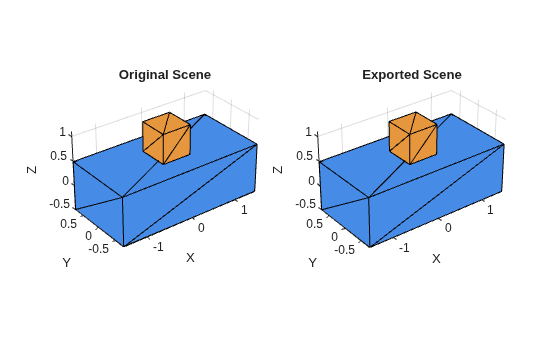
Display the original scene and the exported scene side by side.
figure

subplot(1,2,1)
patch(sceneOut,EdgeColor="k")
axis equal
view(3)
grid on
title("Original Scene")

subplot(1,2,2)
patch(exportedScene,EdgeColor="k")
axis equal
view(3)
grid on
title("Exported Scene")
Input Arguments
Name-Value Arguments
Version History
Introduced in R2026b
See Also
asset3d.read | asset3d.segmentMeshSDF | asset3d.showSegments | Mesh | Scene | trellis

