主要内容

min

Minimum signal data value

Since R2026a

    Description

    sigMin = min(sigObj) returns the minimum data value in the Simulink.sdi.Signal object sigObj.

    example

    sigMin = min(sigObj,startTime) returns the minimum in the time interval between startTime and the end of simulation.

    sigMin = min(sigObj,startTime,endTime) returns the minimum in the time interval specified by startTime and endTime, inclusive.

    Examples

    collapse all

    Suppose you log a signal generated from a Random Number block to the Simulation Data Inspector. You can get descriptive statics about the logged signal using the Simulink.sdi.Signal object.
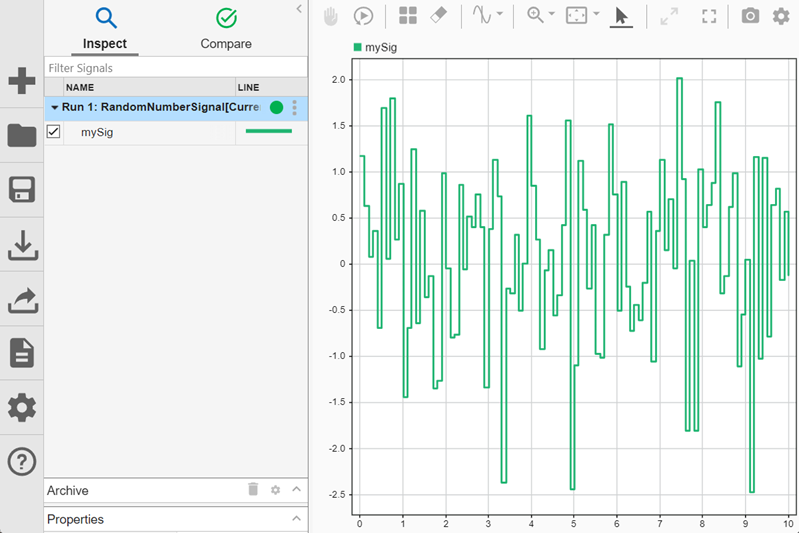
    A signal generated from a Random Number block plotted on a time plot in the Simulation Data Inspector.

    Access the Simulink.sdi.Signal object for the signal named mySig.

    runObj = Simulink.sdi.Run.getLatest;
    sigObj = getSignalsByName(runObj,"mySig");

    Find the minimum sample value using the min function.

    minVal = min(sigObj)
    minVal =
    
       -2.4828

    To find the minimum sample value near the end of the simulation, specify the starting time. For example, to find the minimum value in the last two seconds of the simulation, specify startTime as 8.

    minValEnd = min(sigObj,8)
    minValEnd =
    
       -2.4828

    To find the minimum sample value in a specific interval, specify the start and end time to search in. For example, find the minimum sample value between 2 seconds and 4 seconds.

    minValInterval = min(sigObj,2,4)
    minValInterval =
    
       -2.3775

    Input Arguments

    collapse all

    Input signal, specified as a numerical scalar Simulink.sdi.Signal object.

    To find the minimum value of a composite signal element, such as a bus element, or the minimum value of the real or imaginary part of a complex signal, use the Children property. The Children property contains Simulink.sdi.Signal objects that make up the composite signal or real and imaginary parts of the complex signal.

    • For composite signals, access elements in the Children property by index.

    • For complex signals, the first element in the Children property is the real part of the complex signal and the second element is the imaginary part.

    Example: minVal = min(complexSig.Children(1))

    Start time, specified as a nonnegative scalar less than endTime. This time specifies the beginning of the time interval in which to find a minimum value.

    End time, specified as a nonnegative scalar greater than startTime and less than the simulation time. This time specifies the end of the time interval in which to find a minimum value.

    Output Arguments

    collapse all

    Minimum value, returned as a scalar.

    Version History

    Introduced in R2026a