rms
R2026bDescription
Examples
Suppose you log a signal generated from a Random
Number block to the Simulation Data Inspector. You can get descriptive statics
about the logged signal using the Simulink.sdi.Signal object.
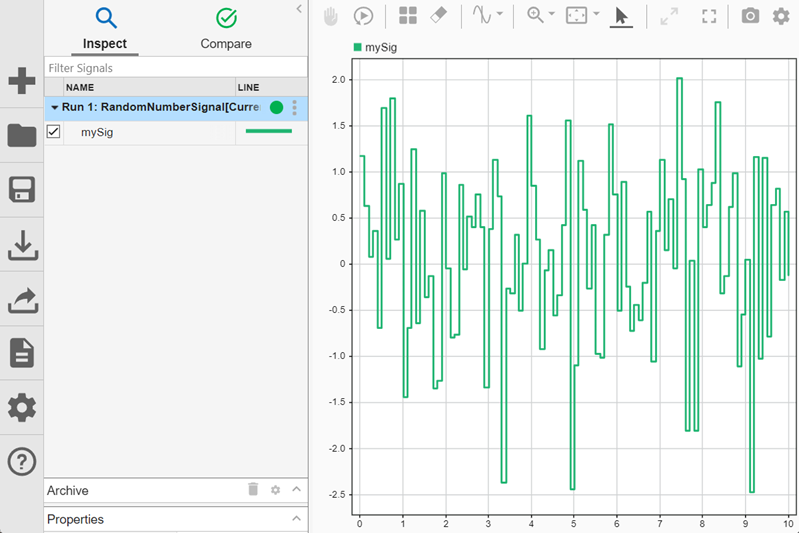
Access the Simulink.sdi.Signal object for the signal named
mySig.
runObj = Simulink.sdi.Run.getLatest;
sigObj = getSignalsByName(runObj,"mySig");
Find the root mean square value for the signal using the rms
function.
rmsVal = rms(sigObj)
rmsVal =

    0.9470
To find the root mean square value of the signal near the end of the simulation,
specify the starting time. For example, to find the root mean square value in the last
two seconds of the simulation, specify startTime as
8.
rmsValEnd = rms(sigObj,8)
rmsValEnd =

    0.9600
To find the root mean square value of the signal in a specific interval, specify the start and end time to search in. For example, find the root mean square value between 2 seconds and 4 seconds.
rmsValInterval = rms(sigObj,2,4)
rmsValInterval =

    0.8825
Input Arguments
Output Arguments
Version History
Introduced in R2026a

