主要内容

fieldCurvature

Compute tangential and sagittal field curvature

Since R2026a

Description

Add-On Required: This feature requires the Optical Design and Simulation Library for Image Processing Toolbox add-on.

fc = fieldCurvature(opsys) computes the tangential and sagittal field curvature for the optical system opsys.

example

fc = fieldCurvature(opsys,Name=Value) specifies options for computing field curvature using one or more name-value arguments. For example, NumSamples=200 specifies to compute the field curvature at 200 evenly spaced coordinate points.

Examples

collapse all

Create an optical system that contains a double Gauss lens using the helper function createDoubleGauss. The function is attached to this example as a supporting file.

opsys = createDoubleGauss;

Compute the field curvature using the fieldCurvature object function. Specify the maximum field angle at which to compute tangential and sagittal field curvature as 15 degrees.

fc = fieldCurvature(opsys,Wavelengths=[486 586 656],MaxFieldAngle=15);
fc_plot = show(fc)
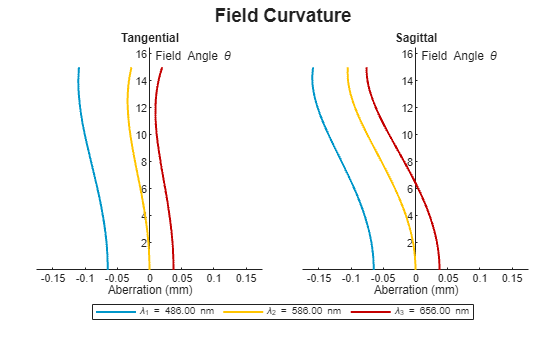
Figure contains an object of type optics.chart.fieldcurvaturechart. The chart of type optics.chart.fieldcurvaturechart has title Field Curvature.

fc_plot = 
  FieldCurvatureChart with properties:

    FieldCurvature: [1×1 optics.result.FieldCurvature]
             Color: [3×3 double]
             Title: "Field Curvature"
            Legend: on
              Grid: "off"
            Parent: [1×1 Figure]

  Show all properties

Input Arguments

collapse all

Optical system for which to compute the field curvature, specified as an opticalSystem object.

Name-Value Arguments

collapse all

Specify optional pairs of arguments as Name1=Value1,...,NameN=ValueN, where Name is the argument name and Value is the corresponding value. Name-value arguments must appear after other arguments, but the order of the pairs does not matter.

Example: fieldCurvature(NumSamples=200) specifies to compute the field curvature at 200 evenly spaced coordinate points.

Wavelengths for which to compute field curvature, specified as an M-element numeric vector. M is the number of wavelengths, and each element of the vector represents a wavelength, in nanometers. By default, the field curvature is computed at the wavelengths specified by the Wavelengths property of the opticalSystem object opsys.

Index of the reference wavelength at which to compute the field curvature, specified as a positive integer.

If you specify the Wavelengths name-value argument, the default index of the reference wavelength is M/2, rounded up to the nearest integer. M is the number of wavelengths in Wavelengths. If you do not specify the Wavelengths name-value argument, the default reference wavelength is the primary wavelength specified by the PrimaryWavelengthIndex property of the opticalSystem object opsys.

Maximum field angle, or angle from the optical axis, at which to compute the lens distortion, specified as a numeric scalar in the range [0, 180]. By default, the MaxFieldAngle value is set to 0.9 times the value of the half-angle. To compute the half field of view, or half-angle, use the halfFieldOfView object function.

Decrease the field angle to minimize discontinuities at the possible expense of missing important performance information at larger field angles, such as vignetting.

Number of evenly sampled points at which to compute field curvature, specified as a positive integer. To produce a smoother curve, increase the number of sampled points at the expense of increased computation time.

Output Arguments

collapse all

Tangential and sagittal field curvature values, returned as a FieldCurvature object. The difference in curvature between the sagittal and tangential planes contributes to astigmatism of the optical system.

Limitations

  • A blocking surface, such as a lens or diaphragm, can prevent certain rays from reaching the image plane. This can cause the marginal rays to have discontinuous paths. Since the chief ray is defined based on its position relative to the marginal rays, it can also exhibit discontinuous behavior. This can lead to incorrect assessments of where the image surface actually lies, affecting the calculation of field curvature. By sampling a smaller field angle using the MaxFieldAngle name-value argument, you can reduce or eliminate the impact of the discontinuity from the analysis plot.

More About

collapse all

Version History

Introduced in R2026a