AI 验证
R2026b利用 AI 验证技术,通过检查 AI 模型及 AI 驱动的系统是否符合行业标准与法规要求,识别并降低相关风险。AI Verification Library for Deep Learning Toolbox 提供了用于评估和验证深度神经网络属性的工具。例如,您可以验证网络的稳健性属性、计算网络输出边界、查找对抗样本以及检测分布外数据,并检查与行业标准的合规性。此外,Deep Learning Toolbox Interface for alpha-beta-CROWN Verifier 支持包能够对 PyTorch® 和 ONNX™ 网络进行形式化验证,例如证明稳健性属性。
如果您有 Statistics and Machine Learning Toolbox™,还可以验证基于树的分类器的稳健性。
函数
主题
算法
- Verification of Neural Networks
Learn about verification of neural networks using AI Verification Library for Deep Learning Toolbox™. - Verify Robustness of Deep Learning Neural Network
This example shows how to verify the adversarial robustness of a deep learning neural network. - Verify Robustness of Imported ONNX Network
This example shows how to verify the adversarial robustness of an imported ONNX™ deep neural network. (自 R2024a 起) - Out-of-Distribution Detection for Deep Neural Networks
This example shows how to detect out-of-distribution (OOD) data in deep neural networks. - Train Robust Deep Learning Network with Jacobian Regularization
Train a neural network that is robust to adversarial examples using a Jacobian regularization scheme. - 在 GPU 上重现网络训练
此示例说明如何在 GPU 上多次训练网络并获得相同结果。 (自 R2024b 起) - Uncertainty Estimation for Regression (Statistics and Machine Learning Toolbox)
Learn about estimating the uncertainty of the true response for a regression problem. - Train Custom Quantile Neural Network
This example shows how to customize and train a neural network that makes quantile predictions. (自 R2026a 起) - Quantify Uncertainty in Object Detection Using Split Conformal Prediction
This example shows how to apply split conformal prediction (SCP) to an object detection model to quantify uncertainty in the predicted labels and bounding boxes. (自 R2026a 起) - Deep Learning Layers Supported for Formal Verification
Discover all the deep learning layers supported for AI verification. - AI Verification Tips and Tricks
Learn tips for formally verifying neural networks.
时间序列
- 使用深度学习进行电池荷电状态估计
定义需求、准备数据、训练深度学习网络、验证稳健性、将网络集成到 Simulink 中以及部署模型。 (自 R2024b 起)
- 步骤 1: Define Requirements for Battery State of Charge Estimation
- 步骤 2: Prepare Data for Battery State of Charge Estimation Using Deep Learning
- 步骤 3: Train Deep Learning Network for Battery State of Charge Estimation
- 步骤 4: Compress Deep Learning Network for Battery State of Charge Estimation
- 步骤 5: Test and Verify Deep Learning Network for Battery State of Charge Estimation
- 步骤 6: Integrate AI Model into Simulink for Battery State of Charge Estimation
- 步骤 7: Generate Code for Battery State of Charge Estimation Using Deep Learning
- 步骤 8: Deploy Code for Battery State of Charge Estimation Using Deep Learning
- ECG Signal Classification Using Deep Learning
This example shows how to develop and verify a deep learning model that classifies electrocardiogram (ECG) signals to detect atrial fibrillation (AFib). (自 R2026a 起)
- 步骤 1: Define Requirements for ECG Signal Classification Using Deep Learning
- 步骤 2: Prepare Data for ECG Signal Classification
- 步骤 3: Train Deep Learning Network for ECG Signal Classification
- 步骤 4: Improve Adversarial Robustness of Deep Learning Network for ECG Signal Classification
- 步骤 5: Test Deep Learning Network for ECG Signal Classification
- 步骤 6: Out-of-Distribution Detection for ECG Signal Classification
- 步骤 7: Uncertainty Quantification for ECG Signal Classification
- 步骤 8: Investigate ECG Signal Classifications Using Grad-CAM
- 步骤 9: Build Deep Learning ECG Signal Classification App Using App Designer
表格数据
- Verify and Deploy Airborne Collision Avoidance System (ACAS) Xu Neural Networks
Verify a set of neural networks trained for airborne collision avoidance integrated into a Simulink model using formal methods and scenario-based closed-loop testing. (自 R2026a 起)
- 步骤 1: Explore ACAS Xu Neural Networks
- 步骤 2: Verify Local Robustness of ACAS Xu Neural Networks
- 步骤 3: Verify Global Stability of ACAS Xu Neural Networks
- 步骤 4: Verify Global Stability of ACAS Xu Neural Network Using Adaptive Mesh
- 步骤 5: Verify VNN-COMP Benchmark for ACAS Xu Neural Networks
- 步骤 6: Verify VNN-COMP Benchmark for ACAS Xu Neural Networks Using α,β-CROWN
- 步骤 7: Define and Verify AI Constituent Requirements for ACAS Xu Neural Networks
- 步骤 8: Integrate ACAS Xu Neural Networks into Simulink
- 步骤 9: Define and Verify AI System Requirements for ACAS Xu Neural Networks Integrated Into Simulink
- Transmission System Fault Detection Using Tree-Based Machine Learning Models
Define requirements, prepare data, train tree-based classifiers, verify predictive behavior, integrate classifiers into Simulink, and deploy models. (自 R2026b 起)
- 步骤 1: Define Requirements for Transmission System Fault Detection
- 步骤 2: Generate Data and Segment Signals for Transmission System Fault Detection
- 步骤 3: Extract Features and Partition Data for Transmission System Fault Detection
- 步骤 4: Perform Feature Selection and Model Training for Transmission System Fault Detection
- 步骤 5: Assess Stability of Models for Transmission System Fault Detection
- 步骤 6: Import and Verify Models in Simulink for Transmission System Fault Detection
- 步骤 7: Generate C Code for Inference Models Used in Transmission System Fault Detection
视觉
- Generate Untargeted and Targeted Adversarial Examples for Image Classification
This example shows how to use the fast gradient sign method (FGSM) and the basic iterative method (BIM) to generate adversarial examples for a pretrained neural network. - Train Image Classification Network Robust to Adversarial Examples
This example shows how to train a neural network that is robust to adversarial examples using fast gradient sign method (FGSM) adversarial training. - Generate Adversarial Examples for Semantic Segmentation
This example shows how to generate adversarial examples for a semantic segmentation network using the basic iterative method (BIM). - Out-of-Distribution Data Discriminator for YOLO v4 Object Detector
This example shows how to detect out-of-distribution (OOD) data in a YOLO v4 object detector. - Verify an Airborne Deep Learning System
This example shows how to verify a deep learning system for airborne applications and is based on the work in [5,6,7], which includes the development and verification activities required by DO-178C [1], ARP4754A [2], and prospective EASA and FAA guidelines [3,4]. (自 R2023b 起)
文本
- Out-of-Distribution Detection for BERT Document Classifier
This example shows how to detect out-of-distribution data for a BERT document classifier. (自 R2024b 起) - Out-of-Distribution Detection for LSTM Document Classifier
This example shows how to detect out-of-distribution (OOD) data in an LSTM document classifier. (自 R2024a 起)
认证工作流
- Runway Sign Classifier: Certify an Airborne Deep Learning System (DO Qualification Kit)
Demonstrates the certification of airborne deep learning system.
精选示例
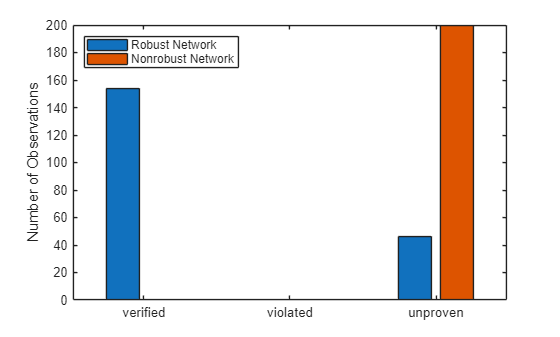
Verify Robustness of Deep Learning Neural Network
Verify the adversarial robustness of a deep learning neural network.
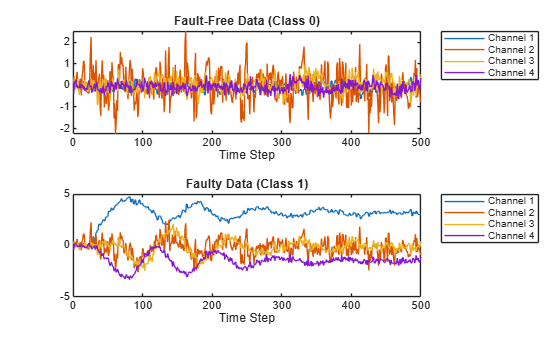
Out-of-Distribution Detection for Deep Neural Networks
Detect out-of-distribution (OOD) data in deep neural networks.
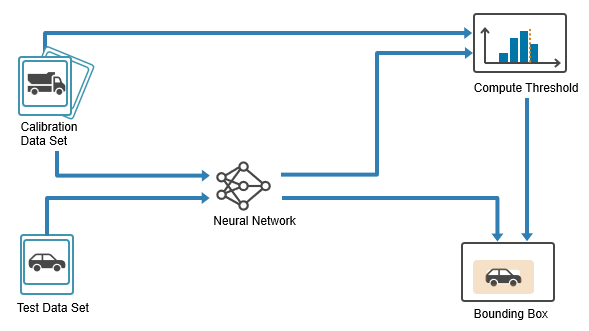
Quantify Uncertainty in Object Detection Using Split Conformal Prediction
Apply split conformal prediction (SCP) to an object detection model to quantify uncertainty in the predicted labels and bounding boxes.
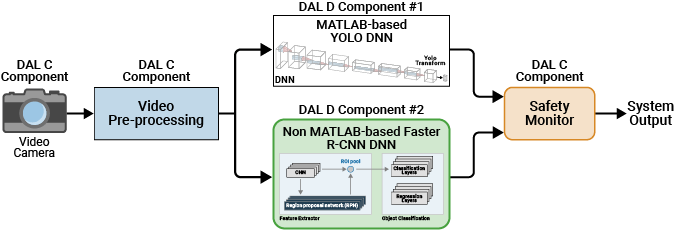
Verify an Airborne Deep Learning System
Verify a deep learning system for airborne applications and is based on the work in [5,6,7], which includes the development and verification activities required by DO-178C [1], ARP4754A [2], and prospective EASA and FAA guidelines [3,4]. To verify that the system complies with aviation industry standards and prospective guidelines, including activities such as requirements tracing, testing and reporting, see Runway Sign Classifier: Certify an Airborne Deep Learning System (DO Qualification Kit).
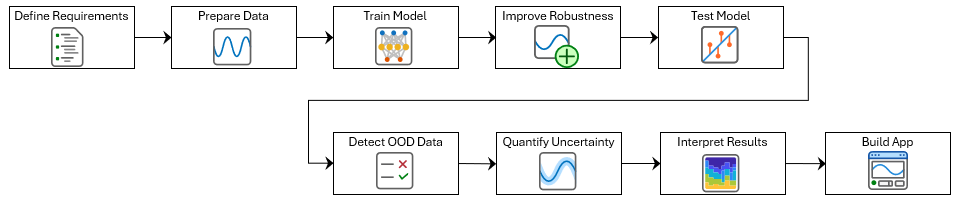
ECG Signal Classification Using Deep Learning
Develop and verify a deep learning model that classifies electrocardiogram (ECG) signals to detect atrial fibrillation (AFib). The example guides you through a complete workflow for building an AI system, with a focus on robustness, explainability, and verification against defined requirements.
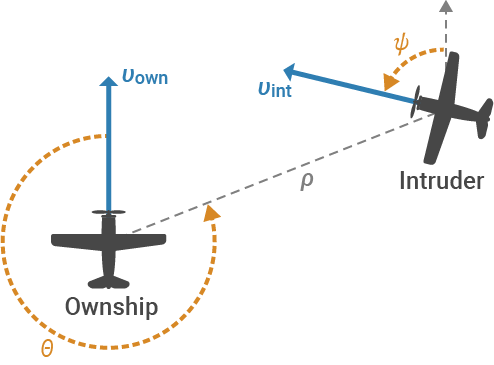
Verify and Deploy Airborne Collision Avoidance System (ACAS) Xu Neural Networks
Verify a set of neural networks trained for airborne collision avoidance integrated into a Simulink model using formal methods and scenario-based closed-loop testing.
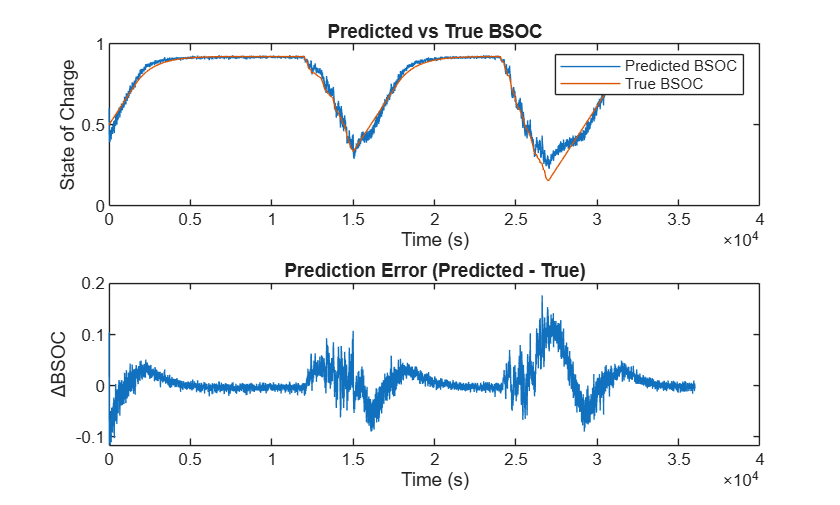
Generate AUTOSAR C Code for Deep Learning Model
Integrate a trained deep neural network in a Simulink® model mapped to an AUTOSAR Classic software component.

